When homeowners start thinking about landscape lighting, one of the first questions is often:
“Where should we put the lights?”
But that’s actually not the best place to start.
Before deciding where a fixture should go, there’s a more important question:
What do you want the light to do?
Do you want to showcase the architecture of your home?
Make a walkway easier to navigate?
Turn a beautiful tree into a nighttime focal point?
Create atmosphere around the patio?
Illuminate a water feature?
Add visibility around darker areas of the property?
Or maybe you want a little of everything.
Professional landscape lighting starts with the purpose of the light. Once we know what we want to accomplish, we can choose the right fixture, position, beam spread, brightness, and technique to create the effect.
Because putting a light somewhere is easy.
Knowing why it belongs there is what makes it design.
Start With the Property, Not the Fixtures
Take a walk around your home during the day.
What catches your eye?
Maybe it’s a beautiful oak tree in the front yard.
The stone surrounding your entrance.
An interesting architectural peak.
A Japanese maple near the patio.
A fountain in the backyard.
Now think about what happens to those features after sunset.
Some disappear completely.
Landscape lighting gives you the opportunity to decide which ones come back.
But that doesn’t mean everything needs to be illuminated.
The goal is to identify the features that deserve attention and then determine how you want them to look after dark.
Goal #1: Make Your Home Stand Out After Sunset
If nighttime curb appeal is the priority, the architecture of your home is a natural place to begin.
Uplighting Can Create Drama
Uplighting places fixtures near ground level and directs light upward.
It’s particularly effective for highlighting:
Architectural columns
Stone and brick
Roof peaks
Entry features
Mature trees
Tall landscaping
The technique can emphasize height, texture, shape, and architectural details that otherwise disappear at night.
But the exact placement matters.
Move the fixture closer to a wall and the effect changes.
Move it farther away and it changes again.
Change the beam spread or brightness and you get yet another look.
That’s why professional landscape lighting isn’t simply about pointing lights at a house.
We’re shaping what you see.
Goal #2: Create a Warm, Natural Look
Not every part of the property needs dramatic illumination.
Sometimes the goal is simply to create comfortable, natural-looking light.
Downlighting Brings Light From Above
Downlighting places fixtures above the area being illuminated and directs the light downward.
Depending on the location, it can provide illumination across:
Lawns
Driveways
Walkways
Gardens
Patios
Outdoor living spaces
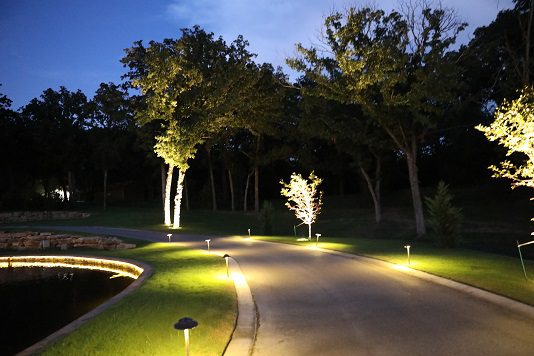
When downlights are installed high in mature trees and directed through the branches, they can create the beautiful effect known as moonlighting.
Leaves and branches interrupt the light and produce constantly changing patterns across the ground.
Rather than looking like a fixture shining on the yard, the light can feel like it naturally belongs there.
Goal #3: Turn Shadows Into Part of the Design
Here’s something that surprises some homeowners:
Landscape lighting isn’t only about the light.
Sometimes the shadow is the feature.
Shadowing Creates Movement and Texture
With shadowing, a fixture illuminates a tree, plant, or decorative feature from the front.
The object’s shadow is then projected onto a wall, fence, or another surface behind it.
Plants with unusual branching patterns or interesting leaves can create particularly beautiful shadows.
A breeze can even cause the shadows to move across the surface.
Suddenly, a blank wall becomes part of the landscape design.
Goal #4: Create a Dramatic Silhouette
Sometimes we don’t want to illuminate the front of a feature at all.
We want to illuminate what’s behind it.
Backlighting Creates Silhouettes
Backlighting—also called silhouette lighting—places the light source behind a tree, shrub, sculpture, or other interesting feature.
The background is illuminated while the feature remains relatively dark.
The result is a dramatic outline.
This technique works especially well with plants and objects that have distinctive shapes.
Instead of revealing every detail, the lighting lets your imagination fill in the rest.
Sometimes showing less creates more impact.
Goal #5: Make Walkways Safer Without Making Them Boring
Path lighting has an obvious job.
Help people see where they’re going.
But functional lighting can still be beautiful.
Path Lights Can Guide the Eye
Path lights generally direct illumination downward toward sidewalks, walkways, driveways, and surrounding landscaping.
The trick is using enough light to comfortably navigate the area without allowing the fixtures to dominate the view.
They don’t need to be positioned in rigid rows on both sides of the sidewalk.
Instead, path lights can be incorporated naturally into landscape beds so the pools of light guide you toward your destination.
You should notice the path before you notice the path lights.
Goal #6: Improve Visibility Around Large Areas
Sometimes subtle accent lighting isn’t enough.
Larger areas may require broader illumination for visibility or security.
Floodlights Have a Job—Use Them Intentionally
Floodlights produce a broad area of illumination and can be useful around larger open spaces or areas where increased visibility is the primary goal.
But brightness needs to be controlled.
An overly bright or poorly positioned floodlight can create glare, shine into windows, spill onto neighboring properties, and overpower the rest of a landscape lighting design.
When broader illumination is needed, the fixture should still be positioned and aimed intentionally.
Functional light doesn’t have to be careless light.
Goal #7: Bring Water to Life After Dark
Water creates possibilities you don’t get anywhere else in the landscape.
It moves.
It reflects.
It refracts light.
And it can create beautiful patterns.
Water Lighting Adds Another Dimension
Pools, fountains, ponds, waterfalls, and streams can become dramatic nighttime features with properly designed lighting.
Depending on the feature, lighting may be positioned around or within the water.
Moving water can reflect and scatter light onto surrounding surfaces, creating effects that constantly change.
Of course, fixtures used in or around water must be specifically designed and appropriately rated for that environment.
When done correctly, water doesn’t simply become illuminated.
It becomes part of the light show.
Goal #8: Make Outdoor Living Spaces More Enjoyable
Your landscape lighting doesn’t only need to look good from the street.
It should make your property more enjoyable while you’re actually using it.
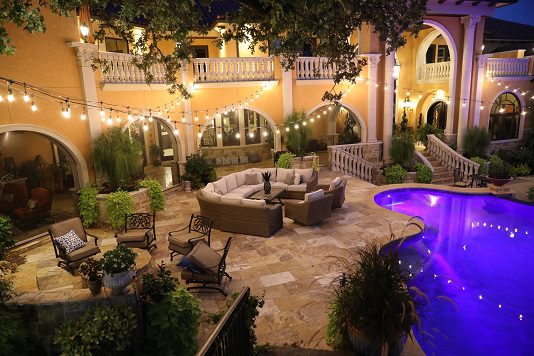
Patios, decks, outdoor kitchens, pools, fire pits, and seating areas can become entirely different spaces after sunset.
Integrate Light Into the Space
Some of the most elegant outdoor lighting is built directly into the features around it.
Lighting can be incorporated into:
Steps
Seating walls
Retaining walls
Decks
Railings
Outdoor kitchen areas
Other hardscape features
Instead of seeing a traditional fixture, you see a soft pool or line of light.
That provides useful illumination while keeping the attention on the outdoor space itself.
Before Installing a Light, Ask Where It Will Be Seen From
A fixture can create a beautiful effect from one angle and terrible glare from another.
That’s why viewing angles matter.
Before choosing a fixture position, think about where people will experience the light.
Will it be visible from:
The street?
The driveway?
The front walkway?
The patio?
A bedroom window?
Your living room?
Your neighbor’s property?
A landscape lighting design should consider all of those perspectives.
You want the light illuminating the feature—not shining into someone’s eyes.
Don’t Forget About Your Neighbors
Good landscape lighting should enhance your property without becoming a nuisance on someone else’s.
Poorly aimed fixtures can send light beyond property lines or directly toward neighboring windows.
This is another reason brighter isn’t necessarily better.
Shielding, fixture position, beam spread, and proper aiming can help keep light where it belongs.
Great lighting should be noticed for the right reasons.
Different Goals Need Different Lights
One of the biggest mistakes in landscape lighting is expecting the same fixture to solve every problem.
The light illuminating a 30-foot tree doesn’t have the same job as the fixture beside a walkway.
The light beneath a seating wall isn’t doing the same thing as a downlight mounted high in a tree.
And the fixture highlighting your home’s stone facade isn’t necessarily right for your water feature.
Professional landscape lighting combines different fixture types and techniques because every light has a different purpose.
That’s how layers are created.
The Best Landscape Lighting Usually Does More Than One Thing
A well-designed fixture can sometimes accomplish several goals at once.
A downlight from a tree might illuminate a walkway while also creating beautiful shadows across the lawn.
Lighting beneath a seating wall might improve visibility while adding atmosphere around the patio.
An uplight on a tree may showcase the landscaping while providing enough reflected light to make the surrounding area feel more comfortable.
That’s where thoughtful design becomes especially valuable.
Instead of asking:
“How many lights do we need?”
We can ask:
“How much can we accomplish with the right lights in the right places?”
Landscape Lighting Can Change How You Use Your Home
There’s another benefit to landscape lighting that’s harder to measure.
It changes how your property feels.
A dark backyard can become an outdoor retreat.
A patio you rarely use after sunset can become one of your favorite places to spend an evening.
A beautiful tree you barely noticed at night can become something you enjoy looking at through the living room window.
A dark walkway can become warm and inviting.
That’s why landscape lighting isn’t simply about adding lights to a yard.
It can change the way you experience your home.
Professional Landscape Lighting in Tulsa and Northeast Oklahoma
At Trinity 918 Designs, we’ve been designing and installing professional outdoor lighting for more than 25 years.
Every property is different.
So before deciding where fixtures should go, we look at what you want the lighting to accomplish.
We consider your home’s architecture, landscaping, walkways, outdoor living areas, viewing angles, and the overall atmosphere you want to create.
Then we put the right light in the right place.
We provide custom landscape lighting design, professional installation, LED conversions, repairs, and service for homes and businesses throughout Tulsa and Northeast Oklahoma.
What Do You Want Your Home to Look Like After Dark?
Maybe you want to make the front of your home more dramatic.
Maybe you want your backyard to feel warmer and more inviting.
Maybe you want to showcase mature trees, improve visibility along walkways, or finally enjoy the landscaping you’ve invested so much time in after sunset.
Whatever your goal, it starts with the right design.
Let Trinity 918 Designs show you what’s possible after dark.
Visit our Landscape Lighting Services page to learn more and schedule your free consultation:
You’ve probably driven past a beautifully illuminated home at night and noticed something interesting.
You see the architecture.
You notice the trees.
Your eye follows the walkway toward the entrance.
The stone has texture, the landscaping has depth, and the entire property feels warm and inviting.
But you barely notice the actual lights.
That’s exactly the point.
Great landscape lighting isn’t about showing off fixtures. It’s about using light to reveal what’s already beautiful about your home.
And that’s one of the biggest differences between simply installing outdoor lights and creating a professionally designed landscape lighting system.
The Best Landscape Lighting Doesn’t Scream for Attention
Good landscape lighting can be surprisingly subtle.
A tree seems to glow.
Stonework suddenly has depth.
A walkway feels naturally illuminated.
The front entrance quietly becomes the focal point.
You don’t necessarily stop and think:
“There’s a landscape light.”
Instead, you notice the effect.
That’s what we’re trying to accomplish.
The fixture is the tool. Your home is the feature.
Start With the Experience, Not the Fixtures
When designing landscape lighting, it’s tempting to begin by deciding how many fixtures you need.
We prefer to start somewhere else:
How should this property feel after sunset?
Warm and welcoming?
Dramatic?
Elegant?
Relaxed?
Maybe you want your home’s architecture to become the focus from the street.
Perhaps your backyard needs to feel more inviting so you’ll actually use the patio after dark.
Or maybe you have beautiful mature trees that disappear completely at night.
Once we understand what the property should look and feel like, we can determine where light belongs.
Create a Nighttime Arrival
Think about what happens when someone arrives at your home after dark.
They pull into the driveway.
Walk toward the entrance.
Follow the sidewalk.
Approach the front door.
Landscape lighting can make that entire experience feel intentional.
Architectural lighting can give the home presence from the street.
Illuminated trees and landscaping can frame the property.
Path lighting can gently guide guests.
And slightly more emphasis around the entrance naturally tells them where they’re going.
Great lighting doesn’t just illuminate a destination. It can shape the journey toward it.
Build the Design in Layers
One of the reasons professionally designed landscape lighting looks different is that it usually isn’t relying on one type of fixture or technique.
The design is built in layers.
Layer 1: Architectural Lighting
Your home itself often provides the foundation.
Columns, stonework, brick, peaks, interesting rooflines, and entry features can become part of the nighttime composition.
But the goal isn’t to blast the entire facade with equal amounts of light.
Different levels of brightness create depth.
Layer 2: Trees and Landscaping
Landscape lighting should include the landscape.
Mature trees can become dramatic focal points.
Smaller ornamental trees can create silhouettes and shadows.
Shrubs and garden areas can provide softer supporting layers.
Without landscape lighting, you may see the house at night while everything around it disappears into darkness.
Illuminating selected landscape features visually connects the home to the property around it.
Layer 3: Pathways and Transitions
Paths, steps, driveways, and transitions between outdoor areas need enough illumination to be comfortable to navigate.
But functional lighting doesn’t need to dominate the design.
Thoughtfully placed fixtures can provide useful illumination while blending naturally into surrounding landscape beds.
Layer 4: Outdoor Living Spaces
Your patio, pool, outdoor kitchen, deck, fire pit, and seating areas should feel like an extension of your home.
That usually means several softer sources of light instead of one bright source.
Hardscape lighting can create a glow beneath a seating wall.
Downlighting can provide useful illumination from above.
Nearby landscaping can be accented to give you something beautiful to look at beyond the patio.
Layer 5: The Finishing Touches
Sometimes it’s the smallest details that complete the scene.
A sculpture.
A fountain.
A flag.
An interesting garden feature.
A beautiful ornamental tree.
These features don’t necessarily need to be the brightest objects on the property.
They just need enough emphasis to become part of the overall composition.
Let Light and Darkness Work Together
This may be one of the most important principles in landscape lighting:
You need darkness.
If everything is illuminated equally, the property loses dimension.
Think about a photograph.
Highlights attract your eye because shadows surround them.
Landscape lighting works the same way.
A beautifully illuminated tree looks more dramatic against a darker background.
Stone reveals texture because light creates tiny shadows across the surface.
An entrance feels more important when surrounding areas are slightly softer.
We’re not trying to eliminate darkness.
We’re deciding where the light belongs.
Avoid the Wall-of-Light Effect
One extremely bright light can certainly illuminate a large area.
But illumination and design aren’t the same thing.
Flooding the front of a home with bright, uniform light can flatten architecture and eliminate the shadows that give the property character.
Instead, different fixtures, beam spreads, positions, and brightness levels can create layers.
Some architectural elements receive more emphasis.
Others remain softer.
Trees add vertical interest.
Path lighting adds another level closer to the ground.
Suddenly the property has depth.
Warm Light Makes a Home Feel Like Home
Brightness isn’t the only characteristic of light that matters.
Color temperature has a tremendous influence on the way a property feels after dark.
Warmer light tends to complement many residential materials beautifully:
Stone
Brick
Wood
Mature landscaping
Outdoor living areas
It can create a comfortable, welcoming atmosphere.
Cooler light creates a different visual effect and can feel harsher in some residential environments.
The goal is to choose a color temperature that complements both the materials and the atmosphere we’re trying to create.
More Fixtures Don’t Automatically Mean Better Lighting
It’s easy to assume that a larger landscape lighting system must be a better one.
Not necessarily.
Sometimes another fixture improves the design.
Sometimes it makes it worse.
Every fixture should have a purpose.
Ask:
What is this light doing?
Is it highlighting architecture?
Improving visibility?
Creating depth?
Showing off landscaping?
Guiding someone toward an entrance?
Adding atmosphere to an outdoor living area?
If there’s no good answer, the fixture may not need to be there.
Good design isn’t measured by how many lights we can install.
The Quality Behind the Light Matters, Too
Landscape lighting has an artistic side, but there’s also a technical system working behind everything you see.
Long-term performance depends on details such as:
Fixture quality
LED quality
Transformer capacity
Proper wire gauge
Voltage management
Quality connections
Timers and controls
Proper installation
Maintenance
Future serviceability
A beautiful lighting design isn’t nearly as enjoyable if you’re constantly dealing with fixtures and connections that fail.
That’s why we consider both sides of the project:
How will it look—and how will it perform?
Design for Tomorrow, Not Just Tonight
Your landscape won’t look exactly the same five years from now.
Trees grow.
Shrubs spread.
Landscape beds change.
Plants mature.
A good landscape lighting system should be able to evolve with the property.
Fixtures may eventually need to be repositioned or re-aimed as plants grow.
Tree lighting may need adjustment as canopies become larger.
New landscaping or outdoor living areas may create opportunities to expand the system.
Planning for the future can make those changes much easier.
Maintenance Protects the Original Design
Even the best landscape lighting system needs occasional attention.
Outdoor fixtures live in a changing environment.
Weather happens.
Plants grow.
Mulch gets added.
Lawn equipment bumps things.
Leaves and dirt accumulate on lenses.
Over time, a fixture can shift just enough to change the lighting effect.
Periodic maintenance can include:
Cleaning fixture lenses
Repositioning fixtures
Re-aiming lights
Trimming vegetation around fixtures
Checking connections
Inspecting wiring
Evaluating system performance
Adjusting lighting as landscaping matures
Sometimes a landscape lighting system doesn’t need more lights.
It just needs the existing lights put back in the right place.
What Makes Professional Landscape Lighting Different?
You can purchase outdoor lights in plenty of places.
But beautiful landscape lighting isn’t really about buying lights.
It’s about making hundreds of small decisions work together.
Which features deserve attention?
Which should remain darker?
How bright should each area be?
What beam spread fits the feature?
Where should the fixture sit?
What will someone see from the street?
What will you see from the patio?
Will there be glare from inside the house?
How will the trees look when they mature?
How should all of those individual lights work together?
That’s where professional design comes in.
Put the Right Light in the Right Place
At Trinity 918 Designs, this is one of the simplest ways we describe our approach to landscape lighting:
Put the right light in the right place.
Not the most light.
Not the most fixtures.
The right light.
Every property is different, and the lighting should be designed around the architecture, landscaping, outdoor living areas, viewing angles, and personality of that specific home.
Because your home shouldn’t look like every other house on the street.
And neither should your landscape lighting.
Professional Landscape Lighting in Tulsa and Northeast Oklahoma
Trinity 918 Designs has been designing and installing professional outdoor lighting for more than 25 years.
We provide custom landscape lighting design, professional installation, LED conversions, repairs, and service for homes and businesses throughout Tulsa and Northeast Oklahoma.
Whether you’re starting with a completely dark property, upgrading an existing system, or trying to improve outdoor lighting that never looked quite right, we can help.
Ready to See Your Home in a Whole New Light?
Great landscape lighting shouldn’t make you stare at the lights.
It should make you fall in love with your home all over again.
Let Trinity 918 Designs create a custom landscape lighting system designed around your home, your landscaping, and the way you want your property to feel after sunset.
Visit our Landscape Lighting Services page to learn more and schedule your free consultation:
During the day, sunlight does something we rarely think about.
It creates highlights and shadows. It reveals the texture of stone. It filters through tree branches. It draws your eye toward certain features while allowing others to fade quietly into the background.
Then the sun sets.
Without thoughtfully designed lighting, much of the character of your home and landscape simply disappears.
That’s where professional landscape lighting becomes more than illumination.
It becomes design.
The goal isn’t to make your property as bright as possible. It’s to use light and shadow intentionally—to reveal architecture, showcase landscaping, create atmosphere, and give your home an entirely new personality after dark.
Don’t Just Light Your Home—Create a Nighttime Scene
Beautiful landscape lighting starts with a vision.
Before deciding where fixtures should go, consider what makes your property special during the day.
Is it the stone across the front of your home?
A magnificent mature tree?
Architectural columns?
The walkway leading to your front door?
A backyard patio surrounded by landscaping?
Those features don’t have to disappear after sunset.
With the right lighting, they can become the stars of an entirely different nighttime scene.
Great landscape lighting doesn’t simply help you see your home at night. It changes the way you see it.
Start With the Features Worth Showing Off
Not everything needs light.
In fact, trying to illuminate everything is one of the quickest ways to lose the elegance of a professional lighting design.
Instead, identify your focal points.
These might include:
Mature or ornamental trees
Stone and brick
Architectural peaks
Columns
Entryways
Garden features
Water features
Outdoor living spaces
Sculptures or artwork
Then decide which deserve the most attention.
One feature might receive dramatic illumination while another gets only a soft glow.
Some areas may remain intentionally dark.
That’s what creates depth.
Think of Your Property in Lighting Zones
Your front entrance and backyard patio don’t serve the same purpose.
Why should they have the same lighting?
Dividing a property into lighting zones helps determine what each area needs.
The Front of the Home
This is where architectural lighting can create nighttime curb appeal and establish the overall character of the property.
Walkways and Entrances
Here, lighting needs to balance appearance with visibility, gently guiding family members and guests through the property.
Trees and Landscaping
These areas provide opportunities for dramatic uplighting, moonlighting, silhouettes, shadows, and other creative effects.
Outdoor Living Areas
Patios, pools, outdoor kitchens, decks, and fire pits generally benefit from softer layers of comfortable illumination.
Thinking in zones prevents the entire property from being treated as one big lighting project.
Each area can have its own mood while still contributing to one cohesive design.
Use Light Like an Artist Uses Paint
A painter doesn’t cover the entire canvas with one color.
Landscape lighting shouldn’t cover the entire property with one type of light either.
Different techniques produce completely different effects.
Uplighting: Create Drama
Uplighting begins near ground level and directs light upward.
It can make a mature tree feel taller, reveal the shape of a canopy, emphasize an architectural peak, or turn a stone column into a nighttime focal point.
The fixture’s distance, angle, brightness, and beam spread all influence the finished appearance.
Move the fixture just a little and the effect can change dramatically.
Moonlighting: Let Nature Create the Pattern
Moonlighting takes the opposite approach.
Instead of illuminating upward from the ground, fixtures are mounted high in mature trees and directed downward.
Light passes through branches and leaves, producing soft patterns across the ground below.
The effect can resemble natural moonlight filtering through the tree canopy.
It’s especially beautiful across:
Lawns
Driveways
Patios
Walkways
Gardens
Outdoor seating areas
When it’s done correctly, moonlighting doesn’t immediately look like a landscape light.
It simply feels like the light belongs there.
Grazing: Let Texture Become the Feature
Some architectural materials deserve more than simple illumination.
Stone, brick, masonry, and other textured surfaces can become dramatically different at night with grazing.
Fixtures are positioned close to the surface so light travels across it.
That creates tiny highlights and shadows across every bump, edge, and irregularity.
Instead of flattening the wall with light, grazing allows the texture itself to become the feature.
Path Lighting: Guide Rather Than Overpower
Path lighting has an important functional job—but that doesn’t mean it can’t be beautiful.
Rather than lining both sides of a walkway with identical fixtures, path lights can be incorporated naturally into surrounding landscape beds.
Soft pools of illumination guide people toward the destination without making the fixtures themselves the focus.
The best path lighting almost feels intuitive.
You simply know where to go.
Warm Light Creates a Different Feeling
Light has color, even when we call it “white.”
Some white light appears cooler and slightly blue, while warmer light has a softer, more golden appearance.
That difference can dramatically affect how a home feels at night.
Warm light often complements residential materials beautifully:
Stone
Brick
Wood
Landscaping
Outdoor living areas
It can make an outdoor space feel comfortable and inviting rather than harsh or overly commercial.
Color temperature is just another part of the overall design.
The question isn’t simply, “How much light do we need?”
It’s also:
“How should this light make the space feel?”
Layer the Light Instead of Relying on One Effect
Natural light is never completely uniform.
Landscape lighting shouldn’t be either.
A professional design may combine:
Uplighting on architecture
Grazing across stone
Accent lighting on trees
Path lighting near walkways
Moonlighting from above
Soft lighting around outdoor living spaces
Darker areas between focal points
Each layer adds something different.
One provides function.
Another creates drama.
Another adds softness.
Together, those layers create a property that feels dimensional rather than flat.
Shadows Aren’t the Enemy
When homeowners first think about outdoor lighting, the instinct is often to eliminate darkness.
But some of the most beautiful landscape lighting depends on it.
Think about moonlight passing through tree branches.
The light is beautiful partly because of the shadows.
Think about a stone wall illuminated from below.
Its texture becomes visible because tiny shadows form across the surface.
Think about a brightly illuminated tree against a dark night sky.
The contrast is what makes it dramatic.
Without darkness, light loses much of its impact.
Professional landscape lighting doesn’t try to eliminate every shadow.
It decides which shadows belong there.
Don’t Over-Light the Property
More fixtures don’t automatically create a better lighting design.
And brighter fixtures don’t necessarily make a home look better.
Too much light can wash out architectural details, flatten landscaping, create glare, and eliminate the contrast that gives a nighttime scene depth.
Sometimes the best decision a lighting designer makes is not adding another fixture.
The goal isn’t maximum brightness.
It’s balance.
Create Visual Interest From Every Angle
Your home isn’t only viewed from the street.
A complete landscape lighting design should consider what you’ll see from:
The driveway
Front walkway
Inside the home
Backyard
Patio
Pool
Outdoor kitchen
Seating areas
A beautifully illuminated tree outside the living room window can become part of your home’s interior view at night.
Landscape lighting around a patio can create depth beyond the seating area instead of leaving everything outside it completely black.
Considering those different viewing angles helps create a lighting design you enjoy while you’re inside the property, not just one that looks good to someone driving past it.
Let Your Landscape Lighting Change With the Property
A landscape is alive.
Trees grow.
Shrubs spread.
Plants change with the seasons.
That means your lighting may need to evolve too.
A fixture aimed perfectly at a young tree today may need repositioning as the canopy grows.
Vegetation may eventually block a beam that was once unobstructed.
Seasonal adjustments and periodic maintenance help the lighting continue to complement the landscape instead of fighting against it.
A great landscape lighting system isn’t simply installed and forgotten.
It grows with the property.
Beauty Still Needs Good Engineering
Landscape lighting may be an art, but there’s plenty of science behind it.
Behind every beautiful nighttime scene are technical considerations such as:
Fixture quality
Beam spread
Brightness
Color temperature
Transformer capacity
Wire gauge
Voltage drop
Connections
Timers and controls
Fixture placement
Glare control
Future expansion
Maintenance
The homeowner may never notice those details.
And that’s the point.
When the technical side is done correctly, you’re free to simply enjoy the finished effect.
Your Home Has Two Personalities
We tend to think of a home’s appearance as something fixed.
But landscape lighting changes that.
During the day, your home’s beauty comes from architecture, materials, landscaping, color, and natural sunlight.
At night, you get to decide what appears.
A tree that blends quietly into the background during the day can become the centerpiece after sunset.
Stonework can become more dramatic.
A walkway can become warmer and more inviting.
A backyard can transform into an intimate outdoor retreat.
Landscape lighting gives your home a second personality—one that only appears after dark.
Professional Landscape Lighting in Tulsa and Northeast Oklahoma
At Trinity 918 Designs, we’ve been designing and installing professional outdoor lighting for more than 25 years.
We don’t believe great landscape lighting is about placing as many fixtures as possible around a property.
It’s about understanding the architecture, landscaping, outdoor living spaces, and viewing angles—and then deciding where light will make the greatest difference.
Our philosophy is simple:
Put the right light in the right place.
We provide custom landscape lighting design, professional installation, LED conversions, repairs, and service for homes and businesses throughout Tulsa and Northeast Oklahoma.
Ready to See the Nighttime Version of Your Home?
You already know what your home looks like during the day.
Let Trinity 918 Designs show you what it can become after dark.
We’ll create a custom landscape lighting design that highlights your home’s architecture, showcases your landscaping, and creates a nighttime atmosphere designed specifically for your property.
Visit our Landscape Lighting Services page to learn more and schedule your free consultation:
When you look at a beautifully illuminated home at night, you probably notice the glowing trees, warm architectural details, inviting walkway, or softly lit patio.
What you probably don’t notice is everything working behind the scenes to make it happen.
A professional landscape lighting system is much more than a collection of lights placed around a yard. It’s a carefully designed system of fixtures, LEDs, wiring, transformers, controls, placement, beam angles, and lighting techniques working together.
The beautiful part is what you see.
The quality of the system is often found in what you don’t.
Here’s what actually goes into creating professional landscape lighting that looks beautiful night after night.
It Starts With a Plan—Not a Box of Lights
One of the biggest differences between basic outdoor lighting and professional landscape lighting happens before the first fixture is ever installed.
It starts with a plan.
Walk around your property during the day and there may be dozens of features competing for attention:
Architectural details
Stone or brick
Mature trees
Flower beds
Walkways
Steps
Entryways
Patios
Pools
Outdoor kitchens
Retaining walls
The question isn’t:
“Where can we put lights?”
It’s:
“What should this property look like after dark?”
Once that’s established, individual fixtures can be selected to create that vision.
Low-Voltage Landscape Lighting: The Foundation of the System
Most professional residential landscape lighting systems use low-voltage power.
A transformer takes the standard household electrical supply and reduces it to the lower voltage used by the landscape lighting system.
Low-voltage systems provide considerable flexibility because different types of fixtures can be positioned throughout the property to create a variety of effects.
But there’s an important point homeowners sometimes overlook:
Low voltage doesn’t mean low planning.
Transformer capacity, wire gauge, cable runs, voltage drop, connections, fixture wattage, and future expansion all need to be considered when designing the system.
Those are things you may never see when you’re sitting on the patio enjoying your lighting—but they’re important to how well the system performs.
Meet the Fixtures That Create the Look
Different landscape lighting fixtures have different jobs.
A beautifully designed system usually combines several fixture types rather than repeating the same light around the entire property.
Accent and Directional Lights: Create the Focal Points
Directional fixtures allow light to be precisely aimed at the features you want to showcase.
They can highlight:
Mature trees
Columns
Architectural peaks
Stonework
Flags
Sculptures
Interesting landscaping
Beam spread makes a tremendous difference.
A narrow beam may emphasize the height of a tall column or tree, while a wider beam may be needed to showcase a broad tree canopy or larger architectural feature.
The light should fit the feature.
Wash Lights: Add Softness
Not everything needs a dramatic spotlight.
Wash lights produce broader, softer illumination that can work beautifully across walls, facades, fences, landscaping, and other larger areas.
They’re particularly useful for creating a background layer of illumination.
Think of accent lighting as saying:
“Look here.”
And wash lighting as saying:
“Notice the whole scene.”
Great landscape lighting often needs both.
Well and In-Ground Lights: Hide the Fixture
Sometimes you want the light without seeing much of the fixture.
Well and in-ground lights can sit at or near ground level and direct illumination upward toward trees, landscaping, walls, and architectural features.
Because the fixture itself is less noticeable, your eye naturally goes toward what’s being illuminated.
It’s one of the principles we love in landscape lighting:
See the effect—not the equipment creating it.
Path and Garden Lights: Guide the Way
Path and garden lights can provide softer pools of illumination around:
Walkways
Flower beds
Steps
Entrances
Garden areas
They provide practical visibility while also becoming part of the landscape design.
But there’s a fine line between guiding someone toward your front door and making your sidewalk look like an airport runway.
Thoughtful spacing matters.
You don’t necessarily need continuous illumination. Areas of light and shadow can guide the eye naturally through the landscape.
Downlights: Bring the Light From Above
Landscape lighting doesn’t always have to come from the ground.
Fixtures can be mounted above an area and directed downward to illuminate lawns, driveways, patios, pathways, and landscaping.
When installed high in mature trees, downlighting can create one of the most beautiful landscape lighting effects: moonlighting.
Light filters through branches and leaves, creating soft patterns of light and shadow across the ground.
When it’s done well, it can feel less like a landscape light and more like nature provided the illumination.
LED Changed Landscape Lighting
Modern LED technology has dramatically changed what’s possible with landscape lighting.
LEDs offer excellent light output while consuming much less power than older halogen technology. They also offer long operating life and produce less heat.
But choosing an LED involves more than looking at wattage.
Professional lighting design considers:
Brightness
Beam spread
Color temperature
Fixture location
What material is being illuminated
How the light interacts with nearby fixtures
The goal isn’t simply to install an LED.
It’s to select the right LED for the effect we’re trying to create.
Color Temperature Changes Everything
Have you ever seen one home with warm, inviting outdoor lighting and another with light that looks almost blue?
That’s color temperature.
It’s measured in Kelvins, and it has a tremendous influence on how a property feels at night.
Warmer light tends to complement many residential materials beautifully, including:
Brick
Stone
Wood
Landscaping
Outdoor living spaces
Cooler light creates a different appearance and can feel much harsher in some residential settings.
The important thing is consistency and intention.
The color of the light should complement the feature it’s illuminating and contribute to the overall atmosphere of the property.
Brightness: More Isn’t Better
One of the most common misconceptions about landscape lighting is:
Brighter = better.
It doesn’t.
In fact, too much light can destroy many of the qualities we’re trying to create.
Extremely bright fixtures can cause glare, wash out texture, eliminate shadows, and make the entire property feel flat.
Professional landscape lighting relies on contrast.
Some features receive more emphasis.
Others get softer illumination.
And some areas remain dark.
The darkness makes the light more beautiful.
Layering Creates Depth
Imagine illuminating the front of a home with one enormous floodlight.
You’d certainly be able to see it.
But that isn’t the same thing as designing it.
Now imagine:
A focused beam highlighting a stone column.
A softer wash across part of the facade.
An uplight revealing the canopy of a mature tree.
Subtle path lighting leading toward the entrance.
A little darkness between those areas.
Suddenly the property has depth.
That’s the power of layering light.
Different types and intensities of illumination work together to create a complete nighttime scene rather than one flat wall of brightness.
Your Outdoor Living Space Deserves Lighting, Too
Landscape lighting isn’t only about what your home looks like from the street.
It’s also about what it feels like when you’re outside.
Patios, pools, decks, outdoor kitchens, fire pits, and seating areas can become entirely different spaces after sunset.
Instead of relying on one bright overhead fixture, outdoor living areas can use multiple layers of softer light.
Hardscape lighting can create a glow beneath seating walls.
Downlighting can provide useful illumination from above.
Nearby trees and landscaping can be accented so you have something beautiful to look at beyond the patio.
Your outdoor space shouldn’t simply be visible after dark.
It should feel inviting.
The Transformer Is the Heart of the System
The fixtures may get all the attention, but the transformer is one of the most important components in a low-voltage landscape lighting system.
Its job is to reduce the household electrical supply to the voltage needed by the lighting system.
Choosing the appropriate transformer involves considering the electrical load of the fixtures as well as the design of the system and potential future expansion.
Quality matters here, too.
At Trinity 918 Designs, we prefer professional-grade equipment designed for long-term outdoor use rather than treating the transformer as an afterthought.
Because the prettiest fixture in the world isn’t very useful if the system behind it isn’t reliable.
Wiring Matters More Than Most Homeowners Realize
Wire isn’t exciting.
Until it’s wrong.
Cable size and the length of the run affect how efficiently power reaches the fixtures.
Long cable runs, undersized wire, poor connections, and improperly designed layouts can contribute to voltage problems and inconsistent system performance.
That’s why the parts you never see matter just as much as the fixtures you do.
A professional landscape lighting system is designed from the transformer all the way to the last fixture.
Make the System Work Automatically
You shouldn’t have to walk outside every evening and flip a switch.
Landscape lighting controls can automate the system using timers, photocells, and other control options.
A photocell can respond to changing sunset times throughout the year, while timers or controls determine how long the system operates.
The result?
Your home simply comes to life when evening arrives.
Landscape Lighting Needs a Little Attention Over Time
Landscape lighting lives in a constantly changing environment.
Trees grow.
Shrubs spread.
Mulch gets added.
Landscaping changes.
Weather happens.
Fixtures can eventually shift, become dirty, or get partially covered by vegetation.
Periodic maintenance may include:
Cleaning lenses
Repositioning fixtures
Adjusting beam direction
Trimming plants around fixtures
Checking wiring and connections
Inspecting equipment
Evaluating the overall lighting design
Sometimes a system doesn’t need another fixture.
It just needs the existing fixtures cleaned, repositioned, and aimed correctly.
Professional Design Brings Everything Together
You can buy landscape lights in plenty of places.
What you can’t buy in a box is design experience.
Which tree deserves attention?
Which beam spread fits it?
How bright should it be?
Where should the fixture sit?
What will that light look like from inside the living room?
Will someone sitting on the patio see glare?
How does that fixture interact with the one illuminating the house?
Is the transformer properly sized?
Is the wiring appropriate?
Can the system be expanded later?
Those are the decisions that turn a collection of fixtures into a landscape lighting system.
Professional Landscape Lighting in Tulsa and Northeast Oklahoma
At Trinity 918 Designs, we’ve been designing and installing professional outdoor lighting for more than 25 years.
We provide custom landscape lighting design, professional installation, LED conversions, repairs, and service throughout Tulsa and Northeast Oklahoma.
We don’t believe professional landscape lighting is about installing as many fixtures as possible.
It’s about putting the right light in the right place—and building the right system behind it.
Ready to See Your Home in a Whole New Light?
A beautiful landscape lighting system starts long before the lights turn on.
It starts with thoughtful design, quality components, and a plan created specifically for your property.
Let Trinity 918 Designs create a professional landscape lighting system designed around your home, landscaping, and outdoor living spaces.
Visit our Landscape Lighting Services page to learn more and schedule your free consultation:
Landscape lighting can completely transform a home after dark.
The right lighting can make a mature tree look spectacular, bring stone and brick to life, create a welcoming path to your front door, and turn a backyard patio into a space you want to use all evening.
But landscape lighting can also go wrong surprisingly quickly.
A fixture that’s too bright can create glare. Poorly spaced path lights can turn a sidewalk into an airport runway. The wrong beam spread can overwhelm a small feature—or barely illuminate a large one.
The secret isn’t simply adding more lights.
It’s knowing what to light, how to light it, and when to leave something in the dark.
Here are some of the biggest do’s and don’ts of professional landscape lighting.
DO: Decide What Deserves Attention
Before placing a single fixture, decide what you actually want to see after sunset.
Look around your property during the day.
Maybe you have:
Beautiful stone or brickwork
Mature trees
Architectural columns
An inviting front entrance
Interesting rooflines
A winding walkway
A fountain or water feature
A backyard patio or outdoor kitchen
Those are potential focal points.
Professional landscape lighting isn’t about illuminating every square foot of your property.
It’s about deciding which features deserve attention and using light to draw your eye toward them.
DON’T: Light Everything
It sounds strange coming from a landscape lighting company, but some darkness is a good thing.
If your house, trees, lawn, driveway, flower beds, and walkways are all illuminated at the same intensity, nothing stands out.
Contrast creates drama.
A beautifully illuminated tree looks more impressive against a darker background. Architectural stone becomes more interesting when light and shadow reveal its texture.
Darkness isn’t something professional lighting needs to eliminate.
It’s part of the design.
DO: Use Uplighting to Make a Statement
Uplighting is one of the most effective ways to showcase architectural and landscape features.
Fixtures are positioned near ground level and directed upward toward features such as:
Mature trees
Columns
Stonework
Architectural peaks
Entryways
Tall landscaping
But placement matters.
Moving a fixture closer, farther away, or changing its angle can dramatically alter the finished appearance.
A fixture positioned too close to the feature may shorten the beam and create a harsh effect. Moving it farther away can allow the light to travel and reveal more of the feature.
A few inches can sometimes make a surprisingly big difference.
DON’T: Use the Same Beam for Everything
Imagine trying to illuminate a 30-foot oak tree and a narrow stone column with exactly the same light.
One of them probably isn’t going to look right.
Beam spread should complement the size and shape of the feature.
A narrow beam can emphasize height on a column, slender tree, or architectural detail.
A wider beam may be needed to illuminate a large tree canopy or broader section of architecture.
The goal is simple:
Fit the light to the feature—not the feature to the light.
DO: Use Grazing to Bring Texture to Life
Stone and brick can look beautiful during the day but almost disappear after sunset.
Grazing can change that.
With this technique, fixtures are positioned relatively close to a textured surface so light travels across it at an angle.
That creates highlights and shadows that reveal texture.
Suddenly, the rough surface of stone, the pattern of brick, or another architectural detail becomes part of the nighttime design.
It’s one of those effects that demonstrates why landscape lighting isn’t just about brightness.
Sometimes we’re actually designing with shadows.
DON’T: Wash Away Beautiful Texture
There’s a difference between grazing a wall and washing a wall.
Grazing emphasizes texture and shadows.
Wall washing creates a softer, more uniform layer of illumination.
Both can be beautiful—but they aren’t interchangeable.
Using too much light on textured stone or brick can flatten the surface visually and erase the shadows that made it interesting in the first place.
The technique should match what you’re trying to accomplish.
DO: Use Wall Washing When You Want a Softer Look
Not every surface needs drama.
Sometimes a wall simply needs a soft, even glow.
Wall washing works well when you want broader illumination across a facade, wall, or row of landscaping without emphasizing every texture.
The light source is generally positioned farther from the surface so the beam can spread more evenly.
When it’s done correctly, you notice the overall glow rather than individual bright spots.
DON’T: Create Hot Spots
A bright circle of light surrounded by darkness usually isn’t the look we’re after.
Hot spots often happen when a fixture is too close to a surface, too bright, or has the wrong beam spread.
Professional lighting should transition naturally.
You want your eye to notice the feature—not immediately identify exactly where every beam begins and ends.
DO: Use Accent Lighting to Create Focal Points
Some features deserve a little extra attention.
A specimen tree.
A sculpture.
A flag.
A fountain.
A distinctive architectural feature.
Accent lighting lets those features become nighttime focal points.
The brightness, beam spread, and fixture position can all be adjusted depending on how dramatic or subtle you want the effect to be.
DON’T: Overpower a Small Feature
More light doesn’t automatically make something look better.
A small ornamental tree illuminated with an extremely wide, bright beam can get lost in the light surrounding it.
Sometimes a tighter beam and lower intensity make the feature stand out much more effectively.
This is where restraint becomes an important part of landscape lighting design.
DO: Experiment With Silhouettes and Shadows
Not every feature needs to be illuminated from the front.
Sometimes the more interesting effect happens behind it.
With silhouette lighting, a fixture illuminates the surface behind a tree, plant, or decorative feature. The object itself remains darker, creating a distinctive outline against the illuminated background.
Shadowing does something different: the fixture illuminates the object from the front so its shadow is projected onto the surface behind it.
Both techniques use something homeowners don’t always associate with landscape lighting:
darkness as a design element.
DON’T: Use Special Effects Everywhere
Silhouetting and shadowing can be dramatic.
That’s exactly why they should be used selectively.
If every part of the landscape is competing for attention, the design becomes busy.
A special effect is most effective when it actually feels special.
DO: Use Downlighting Where Light Is Needed From Above
Not every landscape light needs to originate at ground level.
Downlighting can provide useful illumination around:
Patios
Walkways
Outdoor living areas
Gardens
Driveways
Entrances
Fixtures are mounted above the area and aimed downward, allowing the light to cover the space from a more natural direction.
Downlighting can be especially useful when you want illumination without adding more visible fixtures at ground level.
DO: Let Moonlighting Feel Like Moonlight
Moonlighting is a special type of downlighting—and one of the most beautiful effects in landscape lighting.
Fixtures are mounted high in mature trees and directed downward through the branches.
Leaves and branches break up the light and create soft patterns across the lawn, driveway, walkway, or patio below.
The result can resemble natural moonlight filtering through the trees.
The key word is subtle.
DON’T: Make Moonlighting Too Bright
If your “moonlight” looks like a stadium light mounted in a tree, something has gone wrong.
Moonlighting works because it’s soft.
Too much output destroys the natural effect and can create unnecessary glare.
This is another place where less light can produce a better result.
DO: Make Path Lighting Part of the Landscape
Path lights serve an important practical purpose by improving visibility along walkways.
But they can also contribute to the beauty of the landscape.
Fixtures can be incorporated among plants and landscape beds so they feel like part of the overall design.
Alternating placement along the sides of a walkway can provide overlapping areas of illumination without making the fixtures look overly regimented.
DON’T: Build an Airport Runway
You’ve probably seen it.
Path light. Path light. Path light. Path light.
Perfectly spaced on both sides of a sidewalk all the way to the front door.
It certainly lights the walkway.
But it may not be the look you want for your home.
Path lights don’t need to be lined up like soldiers. Proper spacing and thoughtful placement can provide plenty of visibility while creating a much more natural appearance.
Light the walkway—not the fixture layout.
DO: Control Glare
One of the most important questions in landscape lighting is:
Where will people be looking from?
A fixture might beautifully illuminate a tree from one angle while shining directly into someone’s eyes from another.
Consider the view from:
The street
The driveway
The front entrance
Inside the home
The patio
Outdoor seating areas
Neighboring properties
Fixture position, aiming, shielding, and brightness can all help keep the light where it belongs.
You should notice the effect before you notice the source.
DON’T: Assume Brighter Means Better
This may be the biggest landscape lighting mistake of all.
More lumens don’t automatically create better lighting.
Too much brightness can produce glare, flatten architectural details, wash out landscaping, and destroy the contrast that gives a lighting design depth.
Beautiful landscape lighting isn’t about producing the maximum amount of light.
It’s about using exactly as much as the property needs.
DO: Treat Water Differently
Pools, fountains, ponds, and other water features create unique lighting opportunities.
Underwater lighting can reveal movement, reflections, and textures that completely disappear after sunset.
But fixtures used underwater must be specifically designed and rated for that environment.
Placement is also important because poorly aimed fixtures can create uncomfortable glare and reflections across the water.
When designed correctly, water can become one of the most dramatic elements of a nighttime landscape.
DON’T: Forget the Technical Side of the System
Everything we’ve discussed so far affects what you see.
But a professional landscape lighting system also depends on things you generally don’t see.
That includes:
Proper transformer sizing
Correct wire gauge
Voltage management
Quality connections
Appropriate fixture ratings
Timers and controls
Quality LED components
Planning for future expansion
Maintenance and serviceability
Beautiful fixture placement won’t compensate for a poorly designed system behind the scenes.
Both sides matter.
The Biggest DO: Design the Property as a Whole
One of the easiest mistakes to make is treating every fixture as an individual decision.
A light on this tree.
Another by the sidewalk.
One on the corner of the house.
Another beside the driveway.
Professional landscape lighting takes a different approach.
We step back and ask:
How should the entire property look when all of these lights are on together?
Where should your eye go first?
Where should it go next?
Which areas should be brighter?
Which should be softer?
Where do we need functional light?
And where should we leave some darkness?
That’s when individual fixtures stop looking like individual fixtures—and start becoming a complete lighting design.
Professional Landscape Lighting in Tulsa and Northeast Oklahoma
At Trinity 918 Designs, we’ve been designing and installing professional outdoor lighting for more than 25 years.
We provide custom landscape lighting design, professional installation, LED conversions, repairs, and service for homes and businesses throughout Tulsa and Northeast Oklahoma.
We don’t believe great landscape lighting comes from simply adding more fixtures.
It comes from putting the right light in the right place.
Ready to See Your Home in a Whole New Light?
Your home already has features worth showing off.
Let Trinity 918 Designs reveal them after dark.
We’ll create a custom landscape lighting design around your home’s architecture, landscaping, outdoor living spaces, and the way you use your property.
Visit our Landscape Lighting Services page to learn more and schedule your free consultation:
A beautifully lit home doesn’t happen by accident.
The best landscape lighting designs aren’t simply a collection of fixtures placed around a yard. They’re carefully planned to create layers, focal points, contrast, and atmosphere while also providing useful light where you need it.
Think about the difference between walking into a room with one bright overhead light and walking into a beautifully designed room with lamps, accent lighting, and softer illumination in different areas.
Landscape lighting works much the same way.
The goal isn’t to make your property as bright as possible.
It’s to decide what deserves to be seen—and then use light to tell the story of your home after dark.
Start With the Big Picture
Before choosing fixtures, walk around your property and look at it from different perspectives.
What catches your attention during the day?
Maybe it’s:
The architecture of your home
Stone or brickwork
Mature trees
An inviting front entrance
A winding walkway
Beautiful landscaping
A patio or outdoor kitchen
A pool or water feature
A fire pit or seating area
Now imagine the same property after sunset.
Which of those features disappear?
Those are your opportunities.
Professional landscape lighting allows you to bring selected features back into view while intentionally leaving other areas darker.
And that contrast is important.
If everything is illuminated, nothing feels special.
Think in Zones, Not Individual Lights
Instead of asking, “Where should I put some lights?” think about your property as a collection of different zones.
Each area has its own purpose—and may need a completely different type of lighting.
The Front of the Home: Create the First Impression
Your home’s architecture is often the natural starting point.
Uplighting can showcase columns, rooflines, stonework, brick, and architectural details that otherwise disappear after sunset.
But the goal isn’t to flood the entire house with light.
Some areas may be brighter while others remain softly illuminated or dark. Those variations create depth.
The result should feel welcoming and intentional, not like your house is under a spotlight.
The Front Entry: Make It Feel Inviting
Your front entrance should naturally draw the eye.
Landscape lighting can gently guide guests toward the door using a combination of architectural lighting, path lighting, and existing porch or entry fixtures.
The effect should be subtle.
Your guests shouldn’t have to think about where they’re going.
The lighting should naturally lead them there.
Walkways and Steps: Light the Journey
Safety becomes especially important around paths, stairs, elevation changes, and driveway edges.
But functional lighting doesn’t have to be boring.
Path and step lights can provide enough illumination to comfortably navigate the property while still contributing to the overall design.
And remember—the goal isn’t to line both sides of a walkway with identical fixtures.
Your sidewalk isn’t an airport runway.
A more natural arrangement can create soft pools of light while allowing the fixtures to blend into surrounding landscaping.
Trees and Landscaping: Create Drama and Dimension
Trees can become some of the most dramatic elements of a nighttime landscape.
A large mature tree that almost disappears after sunset can become a spectacular focal point with carefully positioned uplighting.
Smaller ornamental trees can create interesting silhouettes or shadows.
Tall, narrow trees may need a tighter beam, while large spreading canopies may require wider illumination.
The light should complement the size, shape, texture, and character of the feature.
Patios and Outdoor Living Areas: Set the Mood
Your outdoor living spaces should feel comfortable—not over-lit.
A patio, outdoor kitchen, pool area, or fire pit often benefits from several softer sources of light instead of one bright fixture.
Hardscape lighting beneath seating walls can create a warm glow.
Downlighting from above can provide useful illumination.
Accent lighting on nearby trees and landscaping gives you something beautiful to look at beyond the patio.
Together, those layers make the outdoor space feel like an extension of your home.
Layer Your Landscape Lighting
One fixture can’t do everything.
Beautiful landscape lighting usually combines different types of illumination.
You might have:
Uplighting highlighting your home’s architecture
Accent lighting on mature trees
Path lighting along a walkway
Hardscape lighting beneath a seating wall
Downlighting over an outdoor living area
Soft illumination on surrounding landscaping
Each layer serves a different purpose.
Together, they create a complete scene.
It’s similar to decorating a room. You wouldn’t expect one lamp to provide every type of light the room needs.
Your landscape shouldn’t rely on one type of light either.
Create Focal Points
Every great landscape lighting design needs places for your eyes to land.
Maybe that’s a magnificent oak tree.
A stone entrance.
An architectural peak.
A fountain.
A sculpture.
Or even the front door.
Those focal points can receive slightly more emphasis while surrounding areas remain softer.
This creates a visual hierarchy.
Your eye naturally moves from one feature to another instead of seeing a wall of equal brightness.
Let Darkness Be Part of the Design
This may sound strange coming from a landscape lighting company, but:
You don’t need to light everything.
Darkness gives illuminated areas their impact.
Imagine a mature tree beautifully lit against a darker night sky. The contrast is what makes the tree dramatic.
Now imagine the tree, lawn, house, shrubs, sidewalk, driveway, and everything behind it illuminated at exactly the same intensity.
The drama disappears.
Great landscape lighting uses light and shadow together.
Designed to spread light downward and outward, path lights work well around walkways, garden paths, and landscape beds.
Spotlights and Accent Lights
Directional fixtures allow precise control over where the light goes, making them ideal for trees, architectural features, flags, and other focal points.
Well and In-Ground Lights
These fixtures sit at or near ground level, keeping the fixture itself less noticeable while directing attention toward the illuminated feature.
Hardscape Lights
Hardscape fixtures can be tucked beneath wall caps, steps, counters, benches, and other architectural elements.
You primarily see the glow—not the fixture.
Downlights
Mounted above the area being illuminated, downlights can provide functional light for patios, walkways, driveways, and outdoor living areas.
When installed high in mature trees and filtered through branches, downlighting can create the beautiful natural effect known as moonlighting.
Pay Attention to What the Light Looks Like
Choosing a fixture is only the beginning.
The actual light it produces matters just as much.
A professional lighting designer considers:
Beam spread. Should the light be narrow and focused or wide and soft?
Brightness. How much light does the feature actually need?
Color temperature. Will warmer or cooler light best complement the materials and landscaping?
Fixture position. Where should the light originate?
Viewing angle. Will someone see glare from the street, patio, driveway, or inside the house?
These details can completely change the finished effect.
Avoid the Temptation to Over-Light
When homeowners first start planning landscape lighting, it’s easy to assume that more fixtures will create a better result.
Often, the opposite is true.
Too much light can make a property feel flat and overly bright.
Good landscape lighting uses restraint.
You can always expand a professionally designed system later, but starting with an intentional design makes it much easier to preserve the balance between light and darkness.
More light isn’t the goal. Better light is.
Don’t Forget What’s Behind the Scenes
The part of landscape lighting everyone notices is the finished effect.
But what you don’t see matters too.
A professional low-voltage system also requires careful planning for:
Transformer capacity
Wire gauge
Voltage drop
Connections
Fixture quality
Controls
Timers or photocells
Future expansion
Maintenance and serviceability
A beautiful design won’t perform well over time if the system behind it isn’t properly designed and installed.
Make Landscape Lighting Work Automatically
Your landscape lighting shouldn’t require you to remember to turn it on every evening.
Timers, photocells, and other controls can automate when your system operates.
Photocells can respond to changing sunset times throughout the year, while timers and controls can determine how long the system remains on.
The result is simple:
Your home is beautifully illuminated when you want it to be—without thinking about it every day.
Plan for the Landscape You’ll Have Tomorrow
Landscaping changes.
Trees grow taller. Shrubs get wider. Flower beds mature.
That means landscape lighting sometimes needs to evolve too.
Fixtures may eventually need to be repositioned, re-aimed, or adjusted as vegetation grows.
Planning for those changes from the beginning—and maintaining the system periodically—helps preserve the original design as your property matures.
Landscape Lighting Is Part Art, Part Engineering
The most beautiful landscape lighting looks effortless.
But behind that effortless appearance are dozens of small decisions.
Which tree should become a focal point?
How wide should the beam be?
How bright should the stonework appear?
Where should the fixture sit so you don’t see glare from the patio?
Should a walkway receive direct illumination or borrow softer light from surrounding landscaping?
How do all of those individual lights work together when you stand back and view the entire property?
That’s where professional design makes a difference.
At Trinity 918 Designs, we don’t simply decide where fixtures can go.
We consider how the entire property should look and feel after dark.
Then we put the right light in the right place.
Professional Landscape Lighting in Tulsa and Northeast Oklahoma
Trinity 918 Designs has been designing and installing professional outdoor lighting for more than 25 years.
We provide custom landscape lighting design, professional installation, LED conversions, repairs, and service for homes and businesses throughout Tulsa and Northeast Oklahoma.
Whether you’re starting with a completely dark property or upgrading an existing lighting system, we’ll design around your home’s architecture, landscaping, outdoor living areas, and the way you use your property.
Ready to See Your Home in a Whole New Light?
Your home already has the architecture, landscaping, and features that make it unique.
The right landscape lighting simply reveals them after dark.
Let Trinity 918 Designs create a custom outdoor lighting system designed specifically for your property.
Visit our Landscape Lighting Services page to learn more and schedule your free consultation: