
When homeowners start thinking about landscape lighting, one of the first questions is often:
“Where should we put the lights?”
But that’s actually not the best place to start.
Before deciding where a fixture should go, there’s a more important question:
What do you want the light to do?
Do you want to showcase the architecture of your home?
Make a walkway easier to navigate?
Turn a beautiful tree into a nighttime focal point?
Create atmosphere around the patio?
Illuminate a water feature?
Add visibility around darker areas of the property?
Or maybe you want a little of everything.
Professional landscape lighting starts with the purpose of the light. Once we know what we want to accomplish, we can choose the right fixture, position, beam spread, brightness, and technique to create the effect.
Because putting a light somewhere is easy.
Knowing why it belongs there is what makes it design.
Start With the Property, Not the Fixtures
Take a walk around your home during the day.
What catches your eye?
Maybe it’s a beautiful oak tree in the front yard.
The stone surrounding your entrance.
An interesting architectural peak.
A Japanese maple near the patio.
A fountain in the backyard.
Now think about what happens to those features after sunset.
Some disappear completely.
Landscape lighting gives you the opportunity to decide which ones come back.
But that doesn’t mean everything needs to be illuminated.
The goal is to identify the features that deserve attention and then determine how you want them to look after dark.
Goal #1: Make Your Home Stand Out After Sunset
If nighttime curb appeal is the priority, the architecture of your home is a natural place to begin.
Uplighting Can Create Drama
Uplighting places fixtures near ground level and directs light upward.
It’s particularly effective for highlighting:
- Architectural columns
- Stone and brick
- Roof peaks
- Entry features
- Mature trees
- Tall landscaping
The technique can emphasize height, texture, shape, and architectural details that otherwise disappear at night.
But the exact placement matters.
Move the fixture closer to a wall and the effect changes.
Move it farther away and it changes again.
Change the beam spread or brightness and you get yet another look.
That’s why professional landscape lighting isn’t simply about pointing lights at a house.
We’re shaping what you see.
Goal #2: Create a Warm, Natural Look
Not every part of the property needs dramatic illumination.
Sometimes the goal is simply to create comfortable, natural-looking light.
Downlighting Brings Light From Above
Downlighting places fixtures above the area being illuminated and directs the light downward.
Depending on the location, it can provide illumination across:
- Lawns
- Driveways
- Walkways
- Gardens
- Patios
- Outdoor living spaces
When downlights are installed high in mature trees and directed through the branches, they can create the beautiful effect known as moonlighting.
Leaves and branches interrupt the light and produce constantly changing patterns across the ground.
Rather than looking like a fixture shining on the yard, the light can feel like it naturally belongs there.
Goal #3: Turn Shadows Into Part of the Design
Here’s something that surprises some homeowners:
Landscape lighting isn’t only about the light.
Sometimes the shadow is the feature.
Shadowing Creates Movement and Texture
With shadowing, a fixture illuminates a tree, plant, or decorative feature from the front.
The object’s shadow is then projected onto a wall, fence, or another surface behind it.
Plants with unusual branching patterns or interesting leaves can create particularly beautiful shadows.
A breeze can even cause the shadows to move across the surface.
Suddenly, a blank wall becomes part of the landscape design.
Goal #4: Create a Dramatic Silhouette
Sometimes we don’t want to illuminate the front of a feature at all.
We want to illuminate what’s behind it.
Backlighting Creates Silhouettes
Backlighting—also called silhouette lighting—places the light source behind a tree, shrub, sculpture, or other interesting feature.
The background is illuminated while the feature remains relatively dark.
The result is a dramatic outline.
This technique works especially well with plants and objects that have distinctive shapes.
Instead of revealing every detail, the lighting lets your imagination fill in the rest.
Sometimes showing less creates more impact.
Goal #5: Make Walkways Safer Without Making Them Boring
Path lighting has an obvious job.
Help people see where they’re going.
But functional lighting can still be beautiful.
Path Lights Can Guide the Eye
Path lights generally direct illumination downward toward sidewalks, walkways, driveways, and surrounding landscaping.
The trick is using enough light to comfortably navigate the area without allowing the fixtures to dominate the view.
They don’t need to be positioned in rigid rows on both sides of the sidewalk.
Instead, path lights can be incorporated naturally into landscape beds so the pools of light guide you toward your destination.
You should notice the path before you notice the path lights.
Goal #6: Improve Visibility Around Large Areas
Sometimes subtle accent lighting isn’t enough.
Larger areas may require broader illumination for visibility or security.
Floodlights Have a Job—Use Them Intentionally
Floodlights produce a broad area of illumination and can be useful around larger open spaces or areas where increased visibility is the primary goal.
But brightness needs to be controlled.
An overly bright or poorly positioned floodlight can create glare, shine into windows, spill onto neighboring properties, and overpower the rest of a landscape lighting design.
When broader illumination is needed, the fixture should still be positioned and aimed intentionally.
Functional light doesn’t have to be careless light.
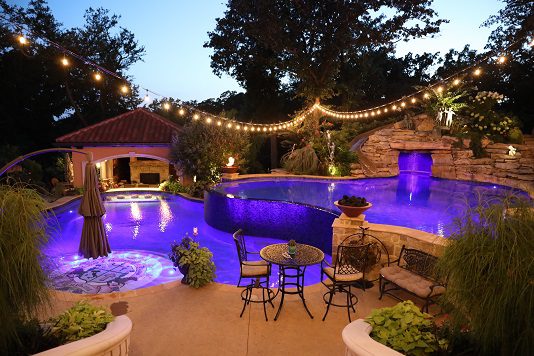
Goal #7: Bring Water to Life After Dark
Water creates possibilities you don’t get anywhere else in the landscape.
It moves.
It reflects.
It refracts light.
And it can create beautiful patterns.
Water Lighting Adds Another Dimension
Pools, fountains, ponds, waterfalls, and streams can become dramatic nighttime features with properly designed lighting.
Depending on the feature, lighting may be positioned around or within the water.
Moving water can reflect and scatter light onto surrounding surfaces, creating effects that constantly change.
Of course, fixtures used in or around water must be specifically designed and appropriately rated for that environment.
When done correctly, water doesn’t simply become illuminated.
It becomes part of the light show.
Goal #8: Make Outdoor Living Spaces More Enjoyable
Your landscape lighting doesn’t only need to look good from the street.
It should make your property more enjoyable while you’re actually using it.
Patios, decks, outdoor kitchens, pools, fire pits, and seating areas can become entirely different spaces after sunset.
Integrate Light Into the Space
Some of the most elegant outdoor lighting is built directly into the features around it.
Lighting can be incorporated into:
- Steps
- Seating walls
- Retaining walls
- Decks
- Railings
- Outdoor kitchen areas
- Other hardscape features
Instead of seeing a traditional fixture, you see a soft pool or line of light.
That provides useful illumination while keeping the attention on the outdoor space itself.
Before Installing a Light, Ask Where It Will Be Seen From
A fixture can create a beautiful effect from one angle and terrible glare from another.
That’s why viewing angles matter.
Before choosing a fixture position, think about where people will experience the light.
Will it be visible from:
- The street?
- The driveway?
- The front walkway?
- The patio?
- A bedroom window?
- Your living room?
- Your neighbor’s property?
A landscape lighting design should consider all of those perspectives.
You want the light illuminating the feature—not shining into someone’s eyes.
Don’t Forget About Your Neighbors
Good landscape lighting should enhance your property without becoming a nuisance on someone else’s.
Poorly aimed fixtures can send light beyond property lines or directly toward neighboring windows.
This is another reason brighter isn’t necessarily better.
Shielding, fixture position, beam spread, and proper aiming can help keep light where it belongs.
Great lighting should be noticed for the right reasons.
Different Goals Need Different Lights
One of the biggest mistakes in landscape lighting is expecting the same fixture to solve every problem.
The light illuminating a 30-foot tree doesn’t have the same job as the fixture beside a walkway.
The light beneath a seating wall isn’t doing the same thing as a downlight mounted high in a tree.
And the fixture highlighting your home’s stone facade isn’t necessarily right for your water feature.
Professional landscape lighting combines different fixture types and techniques because every light has a different purpose.
That’s how layers are created.
The Best Landscape Lighting Usually Does More Than One Thing
A well-designed fixture can sometimes accomplish several goals at once.
A downlight from a tree might illuminate a walkway while also creating beautiful shadows across the lawn.
Lighting beneath a seating wall might improve visibility while adding atmosphere around the patio.
An uplight on a tree may showcase the landscaping while providing enough reflected light to make the surrounding area feel more comfortable.
That’s where thoughtful design becomes especially valuable.
Instead of asking:
“How many lights do we need?”
We can ask:
“How much can we accomplish with the right lights in the right places?”
Landscape Lighting Can Change How You Use Your Home
There’s another benefit to landscape lighting that’s harder to measure.
It changes how your property feels.
A dark backyard can become an outdoor retreat.
A patio you rarely use after sunset can become one of your favorite places to spend an evening.
A beautiful tree you barely noticed at night can become something you enjoy looking at through the living room window.
A dark walkway can become warm and inviting.
That’s why landscape lighting isn’t simply about adding lights to a yard.
It can change the way you experience your home.
Professional Landscape Lighting in Tulsa and Northeast Oklahoma
At Trinity 918 Designs, we’ve been designing and installing professional outdoor lighting for more than 25 years.
Every property is different.
So before deciding where fixtures should go, we look at what you want the lighting to accomplish.
We consider your home’s architecture, landscaping, walkways, outdoor living areas, viewing angles, and the overall atmosphere you want to create.
Then we put the right light in the right place.
We provide custom landscape lighting design, professional installation, LED conversions, repairs, and service for homes and businesses throughout Tulsa and Northeast Oklahoma.
What Do You Want Your Home to Look Like After Dark?
Maybe you want to make the front of your home more dramatic.
Maybe you want your backyard to feel warmer and more inviting.
Maybe you want to showcase mature trees, improve visibility along walkways, or finally enjoy the landscaping you’ve invested so much time in after sunset.
Whatever your goal, it starts with the right design.
Let Trinity 918 Designs show you what’s possible after dark.
Visit our Landscape Lighting Services page to learn more and schedule your free consultation: