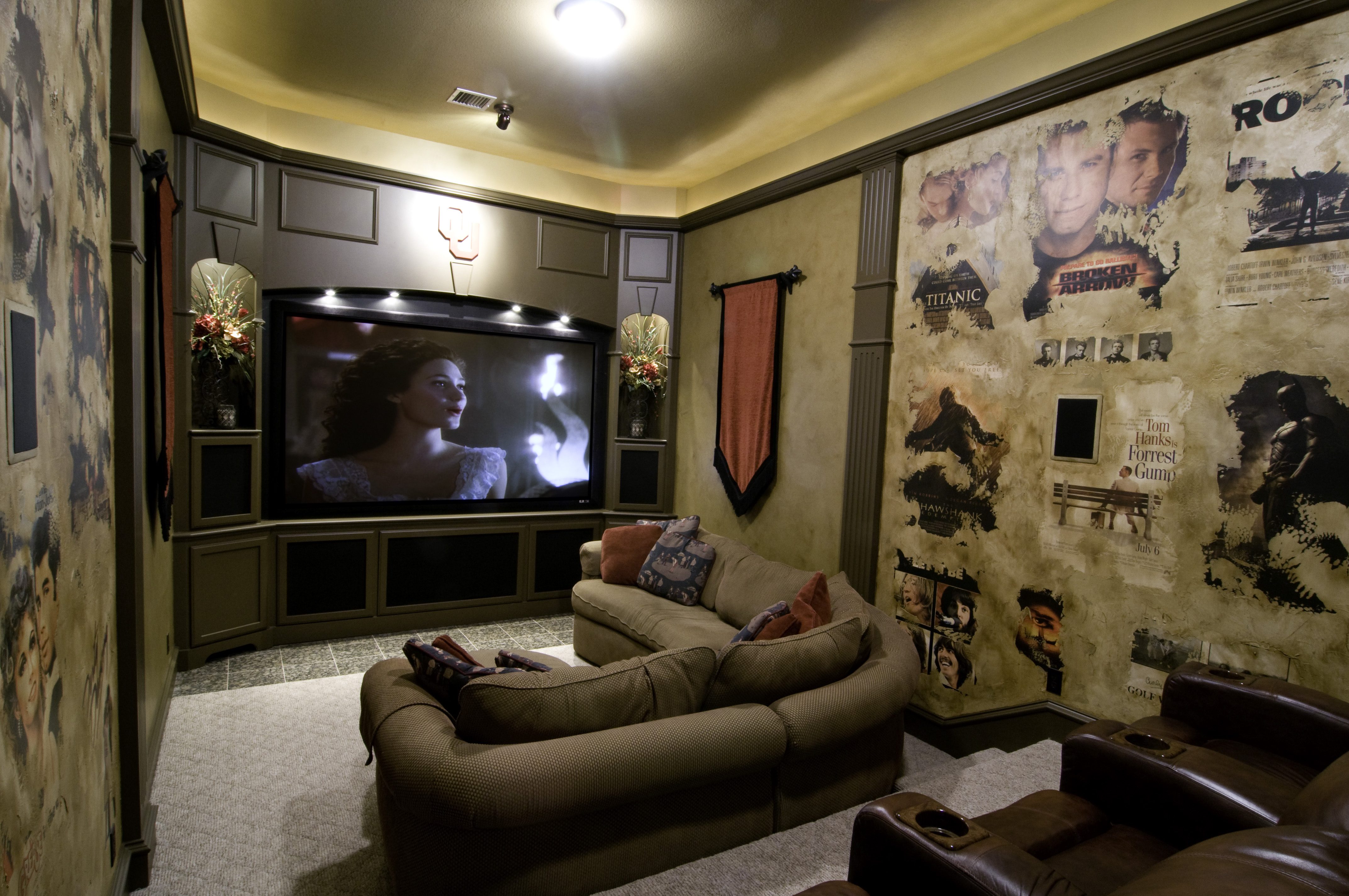
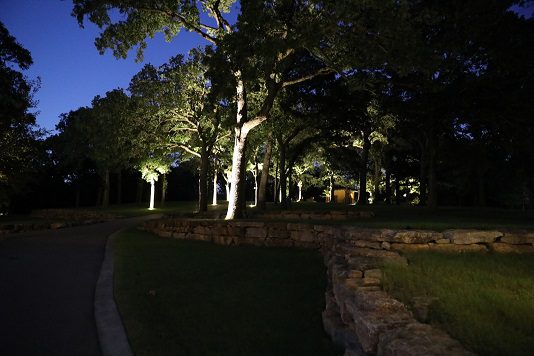
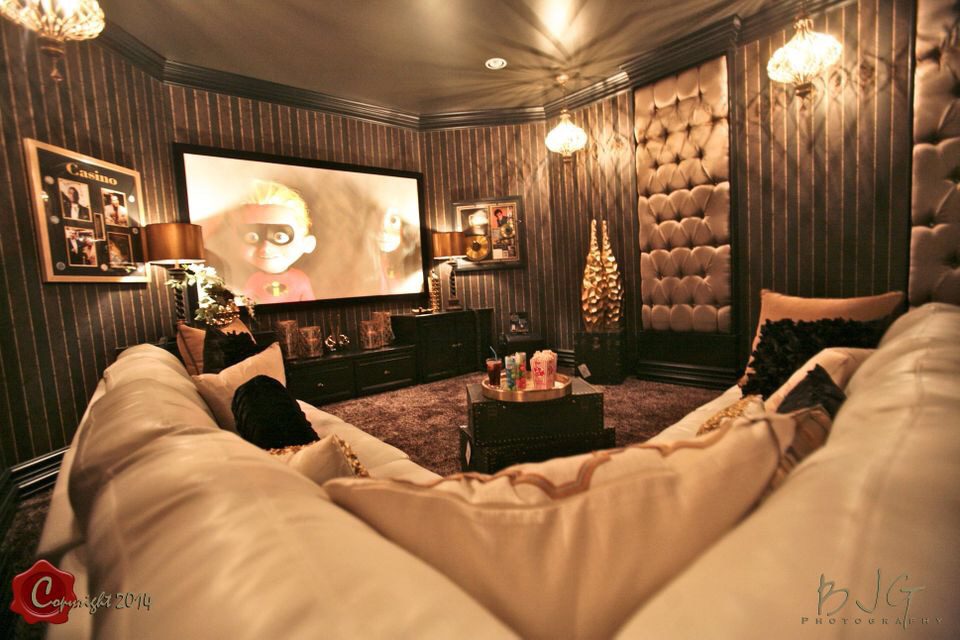
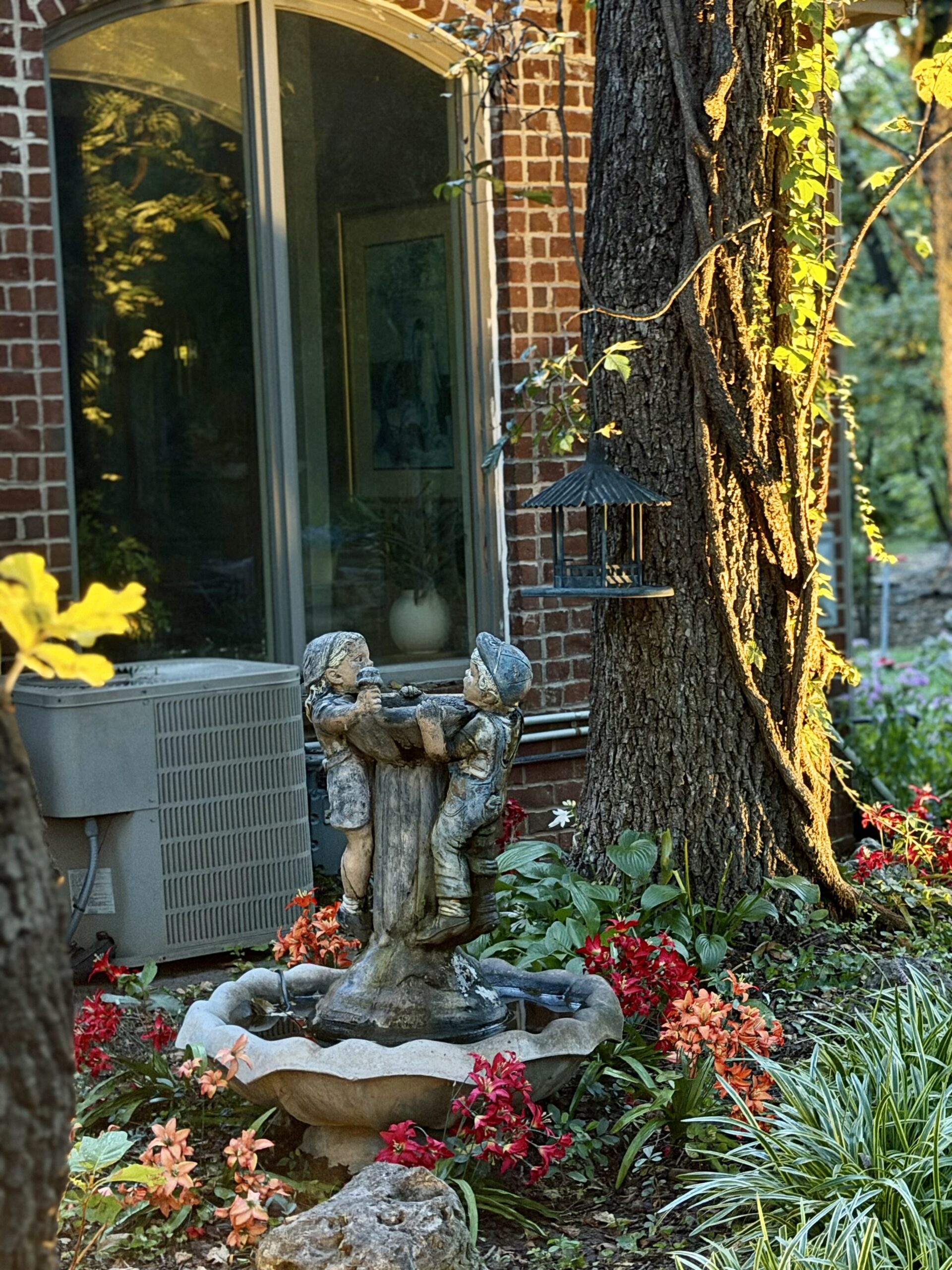
You walk into a store, see an enormous TV on the wall, and think:
“There’s no way I need one that big.”
Then you get a smaller TV home, sit down on the couch, and suddenly it doesn’t look nearly as big as it did in the store.
Sound familiar?
Choosing the right TV size isn’t just about how much wall space you have—or how large of a screen you’re comfortable buying.
The most important factor is actually how far you’ll be sitting from it.
Room size, viewing distance, resolution, furniture placement, and how you use the room all play a role.
And when it comes to modern TVs, homeowners often have more room to go bigger than they think.
Start With Viewing Distance
Before choosing a TV, measure the distance from where the screen will be mounted to your main seating position.
Not from wall to wall.
Not from the front of the couch.
Measure from the screen to where your eyes will actually be when you’re sitting down.
That distance gives you a much better starting point for choosing screen size.
For mixed everyday viewing, a TV that fills roughly 30 degrees of your field of vision is a commonly used guideline. If you’re creating a more immersive movie or gaming experience, you may prefer something closer to 40 degrees.
In practical terms, that means the farther away you sit, the larger the TV generally needs to be.
A Quick TV Size Starting Guide
These aren’t rigid rules, but they’re a useful place to start for a modern 4K TV.
Viewing Distance
Good Starting TV Size
About 6 feet
43–50 inches
About 7 feet
50–55 inches
About 8 feet
55–65 inches
About 9 feet
65–75 inches
About 10 feet
75 inches
About 11 feet
77–85 inches
About 12 feet
85 inches or larger
If movies and immersive viewing are your priority, you may prefer a screen on the larger end—or even above—these ranges.
If the TV is mostly used for casual daytime viewing, you may be perfectly happy with something smaller.
The right size depends on how you use the room.
Bigger TVs Don’t Look as Big Once They’re Installed
This happens all the time.
A homeowner sees an 85-inch TV in a showroom and thinks it looks enormous.
But showrooms aren’t living rooms.
Once that TV is mounted on a large wall and you’re sitting 10 or 12 feet away, the screen can suddenly look much more proportional to the room.
That’s why we recommend thinking about the TV from the seating position, not while standing three feet away from the wall.
If you’re debating between two sizes, it can even help to use painter’s tape to outline both dimensions on the wall.
Then sit where you’ll actually watch TV.
The difference can be surprising.
Remember: TV Size Is Measured Diagonally
This causes some confusion when homeowners are trying to figure out whether a television will fit on a particular wall.
A 75-inch TV is not 75 inches wide.
TV size is measured diagonally from one corner of the screen to the opposite corner.
For example, approximate screen widths are:
55-inch TV: about 48 inches wide
65-inch TV: about 57 inches wide
75-inch TV: about 65 inches wide
85-inch TV: about 74 inches wide
98-inch TV: about 85 inches wide
Actual dimensions vary slightly by manufacturer and bezel design, so always check the specifications of the exact TV before installation.
4K TVs Let You Sit Closer
Years ago, sitting too close to a large television could make pixels and other image imperfections easier to see.
Modern 4K TVs changed that.
Because 4K displays contain far more pixels than older HD televisions, you can sit closer to a large screen while still seeing a detailed image.
That allows a larger TV to create a much more immersive experience without necessarily looking blurry or pixelated.
So if your idea of an appropriate TV size was formed 10 or 15 years ago, you may be thinking too small for today’s TVs.
Think About What You Watch
The right screen size also depends on what you’ll use it for.
Movies
Movies generally benefit from a larger screen.
The more of your field of vision the image fills, the more immersive the experience can feel.
If you’re creating a dedicated home theater or movie-focused media room, you may want to lean toward the larger end of the recommended range.
And if you want an image much larger than conventional TV sizes, that’s when it may be worth comparing a television with a projection system.
Our TV vs. Projector: Which Is Better for Your Room? guide can help with that decision.
Sports
A large TV can be fantastic for sports, especially when several people are watching.
You want the picture large enough to clearly follow the action from every seating position without forcing everyone to crowd around the screen.
Everyday TV
If your television is mainly used for news, shows, kids’ programming, and casual viewing, you may not need the same immersive screen size you’d choose for a dedicated theater.
Gaming
Gaming can also benefit from a larger display, especially with high-resolution consoles and story-driven games.
But response time, refresh rate, viewing distance, and how much of the screen you can comfortably see are important too.
Big is good. Uncomfortably big isn’t.
Your Seating Layout Matters
Most TV-size recommendations assume one main seating position directly in front of the screen.
Real rooms aren’t always that simple.
You may have:
A sectional
Chairs on both sides
Multiple rows of seating
A large open-concept room
Seating positioned at an angle
If several people will regularly watch from different positions, both screen size and viewing angle become important.
A TV that’s perfect from the center seat may feel small from a chair farther away.
The goal isn’t just to choose a TV for the best seat.
It’s to choose one that works for the room.
Don’t Mount the TV Too High
Screen size is only half the equation.
Height matters too.
A beautifully sized TV can still be uncomfortable if it’s mounted so high that everyone spends the evening looking upward.
Ideally, the screen should feel comfortable from your normal seated position.
Fireplaces, cabinetry, windows, furniture, speakers, and room layout can complicate that.
That’s another reason TV placement should be considered as part of the complete room design rather than simply choosing an empty section of wall.
The Fireplace Isn’t Always the Best Place
In many homes, the fireplace naturally becomes the first place people think about installing a television.
Sometimes it works beautifully.
Sometimes it doesn’t.
Depending on the fireplace and mantel height, mounting above it can put the television higher than ideal.
Heat, viewing angle, speaker placement, wiring, and the overall room layout should all be considered before deciding.
The obvious location isn’t always the best location.
Don’t Forget About Your Speakers
As TVs get larger, they take up more wall space.
That can affect speaker placement.
If you’re planning a true surround-sound or home-theater system, you’ll want to consider where the:
Center channel
Front left and right speakers
Surround speakers
Subwoofers
Height or overhead speakers
will be located.
Choosing the largest TV that physically fits on the wall isn’t helpful if it leaves nowhere for the audio system.
The picture and sound should be designed together.
An 85-Inch TV Isn’t Necessarily a Home Theater
A giant screen is great.
But screen size alone doesn’t create a theater experience.
A true home entertainment system considers:
TV or projector
Screen size
Viewing distance
Speaker placement
Surround sound
Subwoofer performance
Lighting
Seating
Equipment location
Room acoustics
Controls
That’s why we look at the entire room, not just the television.
The goal isn’t to install the biggest TV possible.
It’s to create the best viewing experience possible.
Don’t Buy the TV First and Figure Out the Room Later
This is especially important if you’re building or remodeling.
Before purchasing the TV, determine:
Where will people sit?
How far away is the main seating position?
Where should the center of the screen be?
Will speakers surround the television?
Where will the equipment be located?
How will wiring reach the TV?
Is there enough wall space for the size you’re considering?
Then choose the display.
Planning in that order can produce a much cleaner installation.
When Does a TV Become Too Big?
Technically, yes—a TV can be too large for a particular room.
If the screen fills so much of your vision that you’re constantly moving your eyes or head to follow what’s happening, you’re probably sitting too close for that screen size.
But that’s much less common than homeowners simply choosing a screen that’s too small for their viewing distance.
For most modern family rooms and media rooms, viewing distance is a better guide than fear of buying “too much TV.”
What If You’re Choosing Between Two Sizes?
Let’s say you’re deciding between a 65-inch and 75-inch TV.
Or 75 versus 85.
First, check that both physically fit the space.
Then sit in your normal viewing position and imagine each one on the wall.
If your seating distance supports the larger screen and it fits comfortably with the room design, the larger option may provide the more immersive experience.
We rarely hear homeowners say:
“I really wish we’d bought the smaller TV.”
But we’ve heard the opposite plenty of times.
TV Size Is Really About the Room
There’s no single television size that’s right for every home.
A 65-inch TV might seem enormous in one room and surprisingly small in another.
An 85-inch TV may overwhelm a small bedroom but feel perfectly at home in a large living room with seating 11 feet away.
That’s why TV selection should start with:
The room. The seating. The viewing distance. And the way you watch.
Then you can choose the TV that fits them.
Professional TV & Home Theater Installation in Tulsa and Northeast Oklahoma
At Trinity 918 Designs, we’ve been designing and installing home audio/video systems since 1999.
We can help determine the right TV size and placement for your room while also considering everything around it—speakers, wiring, equipment, furniture, viewing angles, and the overall experience you’re trying to create.
Whether you’re adding a television to a living room or designing a complete custom home theater, the goal is the same:
Make the technology fit the room—not force the room to fit the technology.
Ready to Upgrade Your Home Entertainment?
Choosing the right TV size is only one part of creating a great home entertainment system.
Trinity 918 Designs can help with TV installation, home theater, surround sound, hidden wiring, whole-home audio, and complete residential audio/video systems throughout Tulsa and Northeast Oklahoma.
Learn more about Trinity 918 Designs and our home technology services:
When the sun goes down, your home shouldn’t disappear with it.
The architecture, landscaping, mature trees, walkways, patios, and outdoor spaces you’ve invested in are still there—but without the right lighting, much of what makes your property special fades into the darkness.
That’s why landscape lighting matters.
A professionally designed landscape lighting system does much more than make a home look beautiful. It can improve visibility, make outdoor spaces more enjoyable, create a welcoming atmosphere, highlight your favorite features, and completely change the way you experience your property after dark.
The best landscape lighting doesn’t simply make things brighter.
It reveals what was already worth seeing.
1. Landscape Lighting Gives Your Home a Second Look
During the day, natural sunlight determines what you notice.
After dark, landscape lighting gives you control.
A beautiful stone wall can become more dramatic.
A mature tree can become a focal point.
Architectural peaks and columns that disappear at night can suddenly stand out.
And the walkway to your front door can become warm and inviting.
With the right design, your home can have an entirely different personality after sunset.
Think about pulling into a completely dark driveway compared with arriving at a softly illuminated home.
The experience feels different.
Landscape lighting can create a natural sense of arrival by highlighting:
The front entrance
Walkways
Landscaping
Architectural details
Driveway edges
Trees surrounding the home
Rather than relying on one bright porch light, different layers of softer illumination can gently guide visitors toward the entrance.
The result feels intentional.
The lighting quietly says, “Welcome home.”
3. It Improves Visibility Around Walkways and Steps
Beautiful lighting also has a practical job.
After dark, it can be difficult to see:
Steps
Walkways
Changes in elevation
Driveway edges
Patio transitions
Entrances
Strategically placed path, step, hardscape, or downlighting can make these areas easier to navigate.
But good safety lighting doesn’t need to look like safety lighting.
You don’t need glaring fixtures or a perfectly straight row of lights lining both sides of the sidewalk.
The goal is to provide enough illumination to comfortably see where you’re going while allowing the lighting to remain part of the overall design.
4. Landscape Lighting Lets You Enjoy More of Your Property
If you’ve invested in a patio, pool, outdoor kitchen, fire pit, deck, or beautiful backyard, why stop using it just because the sun went down?
Landscape lighting can extend the time you spend outdoors.
Imagine:
Soft light around the patio.
A mature tree glowing in the distance.
Subtle lighting beneath a seating wall.
A pathway gently illuminated through the yard.
Instead of looking beyond your patio into complete darkness, the surrounding landscape becomes part of the evening.
Your outdoor space becomes an extension of your home.
5. It Shows Off the Features You Love
Every property has something worth highlighting.
Maybe it’s:
A magnificent oak tree
Stone columns
A fountain
A Japanese maple
A flag
An architectural peak
A garden
A retaining wall
A pool or water feature
Landscape lighting lets those features become focal points after sunset.
And because you control what receives light, you also control what doesn’t.
Utility areas, trash cans, equipment, and less attractive parts of the property can simply remain in the dark.
Lighting directs the eye toward what you want people to notice.
6. It Adds Depth Instead of Just Brightness
One of the biggest differences between basic outdoor lighting and professional landscape lighting is contrast.
If every part of your property is equally bright, everything begins to look flat.
Professional lighting uses different levels of brightness.
One tree may receive more emphasis.
A stone wall may have softer illumination.
A walkway may only need a small amount of light.
Other areas may intentionally remain dark.
Those variations create depth.
It’s similar to photography: highlights look more dramatic because shadows exist around them.
Darkness is actually part of a good landscape lighting design.
7. It Can Make Your Property Feel More Secure
Dark areas around entrances, side yards, landscaping, and walkways can feel uncomfortable.
Landscape lighting can increase visibility around the property without making your home look like it’s surrounded by security floodlights.
Carefully positioned fixtures can illuminate:
Entrances
Walkways
Driveways
Side yards
Outdoor living areas
Selected landscaping
The goal is useful visibility while still preserving a warm residential atmosphere.
You don’t have to choose between a property that feels comfortable and one that looks beautiful.
8. It Improves Nighttime Curb Appeal
Some homes almost disappear after sunset.
Others come alive.
Thoughtfully designed landscape lighting can highlight architecture and landscaping in a way that makes a property stand out without simply making it brighter than everything around it.
The difference comes from:
Fixture placement
Beam spread
Brightness
Color temperature
Lighting techniques
Contrast
Choosing the right focal points
When those elements work together, landscape lighting can give your home a polished nighttime appearance that a single porch light or floodlight simply can’t create.
9. It Helps You Enjoy the Landscaping You’ve Already Paid For
Landscaping is an investment.
Trees, flower beds, stonework, retaining walls, patios, and outdoor living spaces can represent years of planning and expense.
Without outdoor lighting, you may only enjoy those features during daylight hours.
Landscape lighting allows them to keep contributing to the beauty of your property after sunset.
A tree that looked nice during the day might look spectacular at night.
Stone that seemed ordinary can suddenly reveal dramatic texture.
A garden that disappears after sunset can become part of your evening view.
If you’re curious about the different fixtures used to create these effects, our Landscape Lighting Services can help you see what’s possible for your property.
10. It Changes What You See From Inside the House
Landscape lighting isn’t only for people standing outside.
It can change what you see from inside your home, too.
Without lighting, windows can become dark black rectangles after sunset.
But imagine looking through your living room window and seeing a beautifully illuminated tree.
Or looking out from the kitchen toward softly lit landscaping.
Or seeing the pool and patio glowing beyond the glass.
Outdoor lighting can visually extend your living space beyond the walls of your home.
That’s an advantage homeowners don’t always think about until they experience it.
11. Modern LED Landscape Lighting Is Efficient
Today’s professional landscape lighting commonly uses low-voltage LED technology.
LEDs provide strong light output while using much less energy than older incandescent or halogen lighting.
They also offer long operating life and give lighting designers more options for controlling:
Brightness
Beam spread
Color temperature
Light distribution
That means each fixture can be chosen specifically for the feature it’s illuminating instead of using the same type of light everywhere.
12. Great Landscape Lighting Is Designed—not Just Installed
You can buy outdoor lighting fixtures in plenty of places.
But buying lights and designing landscape lighting are two different things.
Professional design considers questions like:
What should be the focal point?
Where should the eye go next?
How bright should each feature be?
What beam spread fits the tree or architecture?
Will there be glare from the patio or inside the house?
Which areas should remain dark?
How will all the lights look together?
Then there’s everything happening behind the scenes:
Transformer capacity
Proper wire gauge
Voltage management
Connections
Timers and controls
Fixture quality
Future expansion
Maintenance and serviceability
The homeowner may never notice those details.
They’ll simply notice that the lighting looks right and works the way it should.
It’s Not About More Light. It’s About Better Light.
More fixtures don’t automatically create a better lighting system.
Sometimes twenty carefully positioned fixtures can create a more beautiful result than forty poorly positioned ones.
Every light should have a reason for being there.
Maybe it’s highlighting architecture.
Maybe it’s illuminating a walkway.
Maybe it’s showcasing a tree.
Maybe it’s adding atmosphere around the patio.
If a fixture doesn’t have a purpose, it may not need to be there.
At Trinity 918 Designs, our approach is simple:
Put the right light in the right place.
Professional Landscape Lighting in Tulsa and Northeast Oklahoma
Trinity 918 Designs creates custom landscape lighting systems designed around each individual property.
We consider your home’s architecture, landscaping, mature trees, walkways, outdoor living areas, and the way you want your property to feel after dark.
Whether you’re starting with a completely dark property, upgrading an existing lighting system, converting older fixtures to LED, or repairing a system that no longer performs the way it should, we can help.
Ready to See What Your Home Can Look Like After Dark?
You already know what your home looks like during the day.
Landscape lighting lets you discover what it can become at night.
Learn more about custom landscape lighting design, installation, service, repairs, and LED conversions from Trinity 918 Designs:
Imagine starting a playlist in the kitchen while you’re making dinner.
You walk into the living room and the same music continues.
Step onto the patio and it’s playing there too.
Or maybe someone upstairs wants completely different music while you’re listening to something downstairs.
That’s whole-home audio.
Instead of relying on separate Bluetooth speakers, soundbars, or stereo systems scattered throughout the house, whole-home audio creates one connected system that lets you enjoy music and other audio throughout your home.
And the best part?
You control what plays, where it plays, and how loud it is.
Whole-Home Audio Explained
Whole-home audio—sometimes called whole-house audio or multi-room audio—connects speakers in different rooms or areas of your home to a centralized or networked audio system.
Depending on the design, you can play:
The same music throughout the house
Different music in different rooms
Audio in only one room
Music indoors and outdoors at the same time
Podcasts or audiobooks in selected spaces
Streaming services throughout the home
Each room or group of rooms can become its own audio zone.
So the kitchen might be one zone.
The living room could be another.
The primary bedroom could be another.
And the patio or pool area might have its own outdoor audio zone.
You decide which ones are playing.
What Is an Audio Zone?
A zone is simply an area that can be controlled independently.
For example, imagine a home with six audio zones:
Kitchen
Living room
Primary bedroom
Game room
Patio
Pool area
You could play the same playlist in all six zones during a party.
Or maybe you only want music in the kitchen and patio while making dinner outside.
Someone else could listen to something completely different in the game room.
And the bedrooms could stay quiet.
That’s the flexibility of a properly designed whole-home audio system.
It’s About More Than Having Speakers Everywhere
Whole-home audio isn’t simply installing speakers in every room.
The real goal is creating a system that’s easy to use.
You shouldn’t need to walk into a closet full of equipment every time you want to listen to music.
Modern systems can often be controlled from:
Smartphones
Tablets
Touchscreens
Wall-mounted controls
Smart-home systems
Voice-control platforms
You select the room.
Choose the music.
Adjust the volume.
And you’re done.
The technology should work in the background so you can enjoy the music instead of thinking about the equipment producing it.
Where Do the Speakers Go?
One of the advantages of custom whole-home audio is that speakers don’t necessarily need to take up floor or counter space.
Speakers can often be incorporated directly into the home.
In-Ceiling Speakers
In-ceiling speakers are one of the most popular choices for whole-home audio.
Once installed, they blend into the ceiling and provide sound without taking up furniture or wall space.
They’re a great option for areas such as:
Kitchens
Living rooms
Bedrooms
Bathrooms
Hallways
Game rooms
Offices
You hear the music without a bookshelf speaker or portable Bluetooth speaker sitting somewhere in the room.
In-Wall Speakers
In-wall speakers are another option when the room layout or listening goals make them a better fit.
They’re often used when more directional sound is desired or when the speaker placement needs to complement a television or entertainment area.
Outdoor Speakers
Whole-home audio doesn’t have to stop at the back door.
Weather-resistant outdoor speakers can extend the system to:
Patios
Pools
Outdoor kitchens
Fire pits
Decks
Gardens
Large backyards
Your outdoor spaces can become another zone in the same system you use inside.
Whole-Home Audio vs. Bluetooth Speakers
Portable Bluetooth speakers are convenient.
But they’re not really the same thing as a whole-home audio system.
With individual Bluetooth speakers, you may find yourself:
Carrying speakers from room to room
Charging batteries
Pairing and reconnecting devices
Adjusting several speakers separately
Dealing with inconsistent sound
Losing connection when your phone moves too far away
A professionally designed whole-home audio system is intended to feel like it’s simply part of the house.
The speakers are already where you want them.
The system is connected.
And music is available whenever you want it.
Wired vs. Wireless Whole-Home Audio
When people hear “whole-home audio,” they sometimes assume everything is wireless.
That’s not necessarily the case.
Both wired and wireless technology can play a role.
Wired Audio Systems
In a traditional centralized system, speaker wire runs from the equipment location to speakers throughout the home.
Wired systems can provide excellent reliability and allow equipment to remain hidden in a central location.
They’re especially attractive during:
New construction
Major remodeling
Home theater construction
Projects where walls or ceilings are already open
Planning ahead makes it easier to put wiring where it belongs before the home is finished.
Wireless and Networked Audio
Modern network-based systems can also distribute audio throughout a home using your network.
These systems can be particularly useful in existing homes where running new wiring everywhere may not be practical.
In some projects, the best solution may combine wired and networked technology.
The important thing isn’t choosing “wired” or “wireless” because one sounds newer.
It’s choosing the solution that makes the most sense for the house.
Can Different Rooms Play Different Music?
Yes—and this is one of the biggest advantages of multi-room audio.
Imagine this:
You’re listening to classic rock in the garage.
Someone is listening to a podcast in the kitchen.
The kids have their own playlist in the game room.
And soft music is playing outside on the patio.
All from the same whole-home audio system.
Or, when you’re entertaining, you can group multiple rooms together and play the same music throughout the entire entertaining area.
The system adapts to how you’re using the house.
Whole-Home Audio Is Great for Entertaining
This is where the system really becomes fun.
Imagine having friends over.
Music is playing quietly in the kitchen.
The living room is part of the same group.
Open the doors to the patio and the music continues outside.
People can move naturally from room to room without the music suddenly disappearing.
And you don’t need to turn one speaker up so loud that it can be heard from three rooms away.
Instead, multiple speakers can play at a comfortable volume.
The music surrounds the gathering instead of shouting across it.
It Can Sound Better at Lower Volume
This is one of the underrated advantages of distributed audio.
If you’re trying to fill several rooms with one speaker, that speaker has to be fairly loud.
But when properly positioned speakers are distributed throughout the house, each speaker can operate at a more comfortable volume while still providing consistent coverage.
Instead of music blasting from one location, the sound feels more evenly distributed.
That can make the entire listening experience much more pleasant.
What Can You Listen To?
Depending on the equipment and services you use, whole-home audio can provide access to many of the same sources you already use every day.
That may include:
Streaming music services
Internet radio
Podcasts
Audiobooks
Local music libraries
Television audio
Other connected audio sources
The idea isn’t to make listening more complicated.
It’s to make your favorite audio available wherever you want to hear it.
Can TV Audio Be Part of the System?
In many systems, yes.
Whole-home audio and home theater don’t have to exist separately.
Televisions, media rooms, surround-sound systems, and whole-house music can sometimes be integrated as part of a larger audio/video system.
For example, you might have a dedicated surround-sound system in the living room or home theater while still using speakers throughout the rest of the house for music.
The exact setup depends on how you use each room and what you want the system to accomplish.
Don’t Forget About Outdoor Audio
Some of the best whole-home audio zones aren’t technically in the home.
They’re outside.
A well-designed outdoor audio system can provide music around your patio, pool, outdoor kitchen, fire pit, or backyard without relying on one extremely loud speaker mounted to the house.
Instead, multiple appropriately positioned speakers can distribute sound across the space.
That gives you more consistent coverage at a comfortable volume.
And when outdoor audio is integrated with the indoor system, moving the party outside is as simple as adding another zone.
What Does the Equipment Look Like?
In many professionally designed systems, you barely see it.
Speakers may be installed in ceilings or walls.
Amplifiers and other components may be located in an equipment rack, cabinet, closet, or another central location.
Wiring is concealed.
Controls are available on devices you’re already comfortable using.
That’s one of our favorite things about good home technology:
You enjoy what it does without having to look at all the equipment making it happen.
Planning Ahead Makes a Big Difference
If you’re building a home or remodeling, whole-home audio is something worth thinking about before the drywall goes up.
Even if you’re not ready to install every piece of equipment immediately, planning for wiring while the walls and ceilings are open can make future installation much easier.
Consider areas where you may eventually want audio:
Kitchen
Living room
Primary bedroom
Bathroom
Office
Game room
Garage
Patio
Pool
Outdoor kitchen
It’s much easier to plan ahead than to wish the wiring were there later.
Existing Homes Can Have Whole-Home Audio, Too
Don’t assume you’ve missed your chance because your home is already finished.
There are often several ways to add multi-room audio to an existing home.
The right approach depends on:
Home construction
Attic or crawl-space access
Existing wiring
Number of desired zones
Speaker locations
Audio sources
Network infrastructure
Budget
Some homes can accommodate traditional wiring relatively easily.
Others may benefit from a combination of wired and networked solutions.
That’s where designing the system around the actual home becomes important.
How Many Rooms Should You Include?
You don’t necessarily need speakers in every room.
Think about where you actually spend time.
For many homeowners, the most useful zones are places such as:
Kitchen
Main living area
Primary bedroom
Bathroom
Game room
Patio
Pool area
Other homeowners want music throughout nearly the entire property.
There’s no single correct number of zones.
Whole-home audio should fit your lifestyle—not someone else’s floor plan.
What Makes a Good Whole-Home Audio System?
A good system isn’t simply the one with the most speakers.
It should be:
Easy to control. You shouldn’t need instructions every time you want to play music.
Reliable. The system should work when you want to use it.
Well balanced. Speaker placement should provide consistent coverage without unnecessary volume.
Expandable. When possible, the system should allow room for future additions.
Visually clean. Technology should complement your home rather than take it over.
Designed for how you live. The kitchen used every day may deserve more attention than a room nobody enters.
Whole-Home Audio Should Feel Effortless
The best home technology eventually stops feeling like technology.
You walk into the kitchen and put on music.
Move outside and add the patio.
Guests arrive, so you group the main living areas together.
Someone wants something different upstairs, so they choose their own music.
You don’t think about amplifiers, wiring, zones, networking, or equipment.
You just enjoy the music.
And that’s really the point of whole-home audio.
Whole-Home Audio in Tulsa and Northeast Oklahoma
At Trinity 918 Designs, we’ve been designing and installing residential and commercial audio/video systems since 1999.
From a couple of rooms of music to a complete whole-home audio system, we design the system around the way you actually use your home.
That can include:
Whole-home music
In-ceiling and in-wall speakers
Outdoor audio
Home theater
Surround sound
TVs and video distribution
Equipment racks
Hidden wiring
Home automation and control
Whether you’re building a new home, remodeling, or adding audio to a house you already love, we’ll help you determine which rooms need sound and the best way to connect everything.
Ready to Bring Music Into More of Your Home?
Whole-home audio lets your favorite music follow you from room to room—without carrying a speaker with you.
Whether you want music in a few key rooms, throughout the entire house, or all the way out to your patio and pool, Trinity 918 Designs can design an audio system around your home and the way you live.
Learn more about Trinity 918 Designs and our home audio/video services:
You’re planning a home theater or media room, and eventually you reach one of the biggest decisions:
Should you install a TV or a projector?
At first, the answer might seem obvious.
Want a really big picture? Get a projector.
Want something bright and simple? Get a TV.
But there’s actually a lot more to consider.
Room size, windows, lighting, seating distance, screen size, viewing habits, budget, and even what you watch can all affect which option makes the most sense.
The truth is, neither a TV nor a projector is automatically better.
The better choice is the one that fits your room.
Here’s how to decide.
Start With the Experience You Want
Before comparing equipment, ask yourself what you’re trying to create.
Do you want a true movie-theater experience?
A comfortable family media room?
A space primarily for watching sports?
A gaming room?
A multi-purpose living room where the display will be used throughout the day?
Those are very different situations.
A projector might be perfect for one and completely wrong for another.
That’s why we don’t start a home theater design by asking:
“Which projector do you want?”
or
“How big of a TV should we install?”
We start with:
“How are you going to use the room?”
The Biggest Advantage of a Projector: Screen Size
If your dream is a truly cinematic image, projectors have one major advantage:
Size.
A projection system can create an image significantly larger than a typical television.
Instead of watching a movie on a screen across the room, the picture can begin to fill your field of vision.
And that changes the experience.
A large projection screen combined with the right seating distance and surround-sound system can create the feeling of being immersed in the movie rather than simply watching it.
When Bigger Really Is Better
Projectors can be especially appealing in:
Dedicated home theaters
Larger media rooms
Basement theaters
Rooms designed around movie watching
Spaces with multiple rows of seating
If you’re building a true theater room, projection is definitely worth considering.
TVs Have Gotten Really Big
Projectors used to have a much clearer advantage when homeowners wanted a large screen.
That’s changing.
Large TVs have become increasingly practical for home theater and media-room installations.
That means there is now considerable overlap between the two options.
A room that once automatically called for a projector might work beautifully with a large television instead.
So screen size alone doesn’t answer the question anymore.
You have to look at the entire room.
Room Lighting Can Be the Deciding Factor
One of the most important differences between TVs and projectors is how they deal with light.
A television produces its own image directly from the screen.
A projector sends light across the room toward a projection screen.
That difference matters.
Bright Rooms Usually Favor a TV
If your room has:
Large windows
Lots of natural light
Open connections to other rooms
Lighting that will often remain on
Daytime viewing
a TV may be the better fit.
A bright room can wash out a projected image and reduce contrast.
A television generally handles those conditions more easily.
Controlled-Light Rooms Open the Door to Projection
If you’re designing a dedicated theater where you can control the lighting, projection becomes much more attractive.
Blackout shades, controlled lighting, darker walls, and proper fixture placement can all help create an environment where the projected image really shines.
This is why the room itself should be part of the equipment decision.
Think About What You Watch
Your viewing habits matter too.
Movie Lovers
If movies are the priority, a large projection screen can create an immersive experience that’s difficult to duplicate.
There’s something about dimming the lights and having a huge screen come to life that simply feels like going to the movies.
Sports Fans
For sports, the decision can go either way.
A giant projection screen can be fantastic for a big game—especially when you’re watching with a group.
But if you regularly watch sports during the day in a bright room, a TV may be more practical.
Everyday Television
If the display is going to be on throughout the day for:
News
Regular television
Kids’ shows
Casual viewing
Background entertainment
a TV is often the easier choice.
Gaming
Gamers should consider factors such as input responsiveness, resolution, refresh performance, room lighting, and screen size.
The best display isn’t simply the biggest one.
It’s the one that delivers the experience the gamer wants without sacrificing performance.
TV Advantage: Brightness and Contrast
One reason TVs work so well in multi-purpose rooms is their ability to produce a bright, high-contrast picture.
You don’t necessarily have to turn the room into a dark theater every time you want to watch something.
That’s especially valuable in family rooms and open living areas.
A projector can produce an excellent image, but projection generally benefits much more from controlling the surrounding light.
Projector Advantage: That Movie-Theater Feeling
There’s a reason movie theaters use projection.
A very large image creates a different experience.
With the right screen size and seating position, the picture fills more of your vision and pulls you into what you’re watching.
Combine that with:
Proper surround sound
Comfortable seating
Controlled lighting
Acoustic planning
A well-designed room
and you can create an experience that’s much closer to a commercial theater.
That’s where a projector can really shine.
What About the Screen?
With a television, the display and screen are obviously one piece.
Projection is different.
The projection screen matters.
Its size, material, location, aspect ratio, and relationship to the projector all affect the finished image.
Simply projecting onto a blank wall usually isn’t the same as using a properly selected screen.
A professional theater design takes the entire video system into account:
Bigger isn’t automatically better if you’re sitting too close.
And a beautiful high-resolution television can feel surprisingly small if you’re sitting too far away.
Screen size should be selected based partly on viewing distance.
That means the furniture layout and screen decision shouldn’t be treated separately.
Before installing the display, we want to know:
Where will the main seats be?
How far are they from the screen?
How many people will typically watch?
Will there be more than one row?
What type of content will be viewed?
The room helps determine the screen.
Not the other way around.
What Does the Room Look Like When You’re NOT Watching TV?
This is something homeowners sometimes forget to consider.
A large television is always visible.
That may be completely fine in a family room.
In other rooms, homeowners may prefer a cleaner appearance.
Projection offers some interesting possibilities.
A screen may be permanently mounted, or certain systems can use screens that retract when they aren’t being used.
That can allow the room to have a completely different appearance when the theater isn’t operating.
The right solution depends on whether you’re designing a dedicated theater or a space that needs to serve several purposes.
Installation Is Different, Too
Installing a projector involves more than simply mounting it to the ceiling.
The design may require planning for:
Projector location
Throw distance
Screen size
Screen location
Power
Video cabling
Equipment ventilation
Control systems
Ceiling construction
Seating position
Lighting
Audio placement
A television installation has its own considerations:
Wall structure
Mounting height
Viewing angle
Power
Hidden wiring
Equipment location
Audio system
Cable management
In either case, planning before the room is finished can make the installation much cleaner.
What About Sound?
Whether you choose a TV or projector, don’t let the picture get all the attention.
Half of the theater experience is sound.
A giant picture paired with weak audio doesn’t feel like a theater.
A properly designed system can include:
Front speakers
Center channel
Surround speakers
Height or overhead speakers
Subwoofers
AV receiver or processor
Amplification
Acoustic considerations
The display should be designed as part of the entire audio/video system, not as a separate decision.
Dedicated Theater? A Projector May Make More Sense
If you’re building a room specifically for movies and entertainment, projection deserves serious consideration.
You may already be controlling:
Ambient light
Seating location
Wall colors
Speaker placement
Equipment location
Acoustics
That controlled environment allows a projection system to perform the way it was intended.
And if the goal is a truly cinematic experience, the extra screen size can be a major advantage.
Multi-Purpose Room? A TV May Be the Better Fit
Now imagine a completely different room.
Large windows.
People walking through during the day.
Lights frequently on.
Football on Sunday afternoon.
Kids watching TV.
Someone playing video games.
Maybe a movie at night.
That’s not really a dedicated theater.
It’s a media room.
And a large TV can make a lot of sense.
You still get an excellent home entertainment experience without having to control the room every time someone turns on the screen.
What About Having Both?
In some rooms, the answer doesn’t have to be either/or.
A sophisticated system can sometimes incorporate both a television and projection.
The TV can handle everyday viewing.
Then when it’s movie night, a larger projection screen can become the centerpiece.
It isn’t the right solution for every space, but it’s another reason to design the room around how the homeowner actually wants to use it.
TV vs. Projector: The Simple Comparison
A TV May Be Better If:
The room gets a lot of daylight
You watch television throughout the day
The room serves several purposes
You want a very bright image
You want simple everyday operation
A very large cinematic screen isn’t the priority
A Projector May Be Better If:
You’re creating a dedicated theater
You want a very large image
Movies are a major priority
You can control the room lighting
You want a more immersive theater experience
Your room and seating layout work well for projection
But remember:
These are guidelines—not rules.
Every room is different.
Don’t Choose the Equipment Before Designing the Room
This might be the most important takeaway.
Homeowners sometimes buy a projector, screen, TV, speakers, or other equipment before working through the room design.
Then they try to make everything fit.
It’s much easier to do it the other way around.
Start with the room.
Determine:
How will it be used? Where will people sit? How much light is present? How large should the picture be? Where should the speakers go? Where will the equipment live?
Then select the equipment that fits the design.
That’s how you create a system that feels like it belongs in the room instead of a collection of technology that happened to end up there.
Professional Home Theater Design in Tulsa and Northeast Oklahoma
At Trinity 918 Designs, home theater is where our story began.
We’ve been designing and installing residential and commercial audio/video systems since 1999—from basic surround-sound systems to complete custom theater rooms.
We can help with:
Custom home theater design
TVs and projection systems
Surround sound
Equipment selection
Professional installation
Hidden wiring
Audio/video systems
Whole-home audio and video
Automation and control
Most importantly, we’ll help determine what makes sense for your room instead of trying to make your room fit a particular piece of equipment.
So…TV or Projector?
The answer isn’t really about which technology is better.
It’s about which one is better for you.
A huge projector screen in the wrong room may be disappointing.
A beautiful TV that’s too small for a large dedicated theater may leave you wishing you’d gone bigger.
The best home theater starts by matching the display to the room, the seating, the lighting, and the way you actually watch.
Get those decisions right, and both TVs and projectors can deliver an incredible experience.
From equipment selection and surround sound to professional installation and complete custom theater design, we’ll help you put together a system that fits your room and the way your family uses it.
You put a lot into making your home look beautiful.
The landscaping. The stonework. The trees. The patio. The walkway leading to the front door.
Then the sun goes down—and much of it disappears.
Professional landscape lighting lets you enjoy another side of your home.
It can transform the way your property looks, but the benefits go far beyond curb appeal. The right lighting can make outdoor spaces more enjoyable, walkways easier to navigate, entrances more welcoming, and the entire property feel completely different after sunset.
Here are seven reasons landscape lighting may be one of the most enjoyable improvements you can make to your home.
1. Give Your Home a Second Look After Sunset
Your home doesn’t have to look the same at night as it does during the day.
In fact, we don’t think it should.
During daylight hours, the sun decides what gets highlighted.
At night, you get to decide.
Landscape lighting can draw attention to the features that make your home unique:
Stone and brick
Architectural columns
Roof peaks
Mature trees
Ornamental landscaping
Entryways
Water features
Outdoor living areas
A tree that quietly blends into the landscape during the day can become a dramatic focal point after dark.
Stonework can suddenly reveal texture you barely notice in daylight.
Your front entrance can become warmer and more inviting.
Landscape lighting doesn’t simply illuminate your home.
It gives your home an entirely different nighttime personality.
2. Enjoy Your Outdoor Spaces Longer
Your patio shouldn’t close when the sun goes down.
Neither should your pool, outdoor kitchen, fire pit, deck, or backyard seating area.
One of the biggest benefits of landscape lighting is simply being able to enjoy the outdoor spaces you’ve invested in for more hours of the day.
Imagine sitting on the patio after dinner.
There’s a soft glow beneath the seating wall.
Nearby trees are illuminated in the distance.
A walkway has just enough light to comfortably navigate the yard.
Instead of looking out into a wall of darkness, the surrounding landscape becomes part of the experience.
Outdoor Lighting Should Create Atmosphere
The goal isn’t to make your backyard as bright as your kitchen.
Outdoor spaces feel best when lighting is layered.
A little functional light where you need it.
A little accent lighting on the landscape.
Some softer illumination around gathering areas.
And plenty of darkness in between.
The result feels more like an outdoor room than a brightly illuminated yard.
3. Make Walkways and Steps Easier to Navigate
Not every benefit of landscape lighting is about appearance.
Some are simply practical.
Walkways, stairs, driveway edges, elevation changes, and entrances can become difficult to see after dark.
Thoughtfully placed lighting can help illuminate those areas so family members and guests can comfortably move around the property.
That might include:
Path lighting
Step lighting
Hardscape lighting
Downlighting
Illumination near entrances
But practical lighting can still be beautiful.
You don’t need a row of glaring fixtures on both sides of the sidewalk.
The goal is to illuminate where you’re going without making the lights themselves the main attraction.
4. Make Your Home Feel More Welcoming
There’s something about arriving at a beautifully illuminated home at night.
The driveway doesn’t disappear into darkness.
The walkway gently leads toward the entrance.
Trees and landscaping frame the home.
The front door naturally becomes the destination.
Landscape lighting can create a sense of arrival.
And that’s something both you and your guests get to experience.
Instead of your home disappearing after sunset, the lighting allows it to say:
Welcome home.
5. Add Visibility Around Your Property
Dark areas around a home can feel uncomfortable.
Landscape lighting can increase visibility around:
Entrances
Walkways
Side yards
Driveways
Landscaping
Outdoor living areas
That doesn’t mean covering your property in giant floodlights.
In fact, carefully designed landscape lighting can provide useful visibility without sacrificing the atmosphere of your home.
Strategically illuminating entrances, pathways, and selected areas of the landscape can reduce deep pockets of darkness while maintaining a warm residential appearance.
Security Lighting Doesn’t Have to Look Like Security Lighting
Bright floodlights have their place, but they aren’t the only way to increase nighttime visibility.
A professionally designed landscape lighting system can make a property easier to see while still looking beautiful.
That’s an important distinction.
You don’t have to choose between atmosphere and visibility.
6. Showcase the Features You’ve Already Invested In
You probably didn’t choose your home’s architecture, landscaping, or outdoor features because you only wanted to enjoy them during daylight hours.
Maybe you’ve invested in:
Beautiful landscaping
Mature trees
A pool
Stone retaining walls
An outdoor kitchen
A fountain
A patio
Decorative architecture
Landscape lighting allows those investments to keep contributing to the appearance and enjoyment of your property after sunset.
Light the Best and Let the Rest Fade Away
Here’s another advantage of landscape lighting:
You control what people notice.
Want to showcase the beautiful Japanese maple?
Illuminate it.
Want the eye drawn toward your stone entrance?
Highlight it.
Don’t particularly want your trash cans, utility area, or garden equipment becoming part of the nighttime scenery?
Leave them in the dark.
Landscape lighting lets you emphasize the features you love while allowing less attractive areas to quietly disappear.
7. Increase Nighttime Curb Appeal
Curb appeal doesn’t have to end at sunset.
In fact, nighttime can give your home an opportunity to look completely different.
During the day, every house on the street has sunlight.
After dark, thoughtful lighting can make certain homes immediately stand out.
The difference isn’t necessarily brightness.
It’s design.
A beautifully illuminated tree.
Warm architectural lighting.
A softly glowing walkway.
Layers of light and shadow.
Those details give a property depth and character that you simply don’t get from one bright porch light.
Landscape Lighting Can Complement the Value of Your Home
Landscape lighting is also an improvement you get to enjoy while you own the home.
Rather than making an improvement solely with future resale in mind, professional outdoor lighting can enhance curb appeal and outdoor enjoyment every evening you’re there.
And when it’s eventually time to sell, an attractive, well-maintained exterior can contribute to the overall impression buyers have of the property.
Why Low-Voltage LED Landscape Lighting Makes Sense
Modern professional landscape lighting commonly uses low-voltage LED technology.
LED lighting offers several advantages compared with older lighting technologies.
Lower Energy Consumption
LEDs can produce excellent illumination while using substantially less electricity than older incandescent or halogen lighting.
That’s especially important with landscape lighting because a system may operate for several hours every evening.
Long Operating Life
Quality LEDs also offer long operating life, reducing how frequently lamps or light sources need attention.
More Design Options
Modern LED landscape lighting gives designers considerable control over characteristics such as:
Brightness
Beam spread
Color temperature
Fixture style
Light distribution
That allows the light to be selected based on the feature we’re trying to illuminate rather than using the same light everywhere.
The Biggest Benefit? You Enjoy Your Home Differently
We can talk about curb appeal, visibility, outdoor living, LEDs, and property value.
But there’s another benefit that’s harder to put into a list.
Landscape lighting changes the way you experience your home.
You see the trees outside your windows at night instead of black glass.
You linger on the patio a little longer.
You enjoy looking at your home when you pull into the driveway.
You notice details in your landscaping you rarely paid attention to before.
Your backyard becomes somewhere you want to be after sunset.
And your home begins to feel just as intentional at night as it does during the day.
That’s what great landscape lighting can do.
Professional Landscape Lighting in Tulsa and Northeast Oklahoma
At Trinity 918 Designs, we’ve been designing and installing professional outdoor lighting for more than 25 years.
We design each landscape lighting system around the individual property—its architecture, landscaping, trees, walkways, outdoor living areas, and the way the homeowner wants to experience the space after dark.
We provide custom landscape lighting design, professional installation, LED conversions, repairs, and service for homes and businesses throughout Tulsa and Northeast Oklahoma.
Our approach is simple:
Put the right light in the right place.
Not more light.
Better light.
Ready to Enjoy More of Your Home After Dark?
You’ve already invested in your home.
Let Trinity 918 Designs help you enjoy more of it after the sun goes down.
Whether you want better nighttime curb appeal, more inviting outdoor living spaces, improved visibility, or simply want to showcase the home and landscaping you love, we’ll create a custom lighting design around your property.
Visit our Landscape Lighting Services page to learn more and schedule your free consultation:
One of the most common questions homeowners ask about landscape lighting is:
“What kind of lights do I need?”
The answer depends on what you want those lights to do.
The fixture that beautifully illuminates a 30-foot tree probably isn’t the fixture you want beside your walkway. The light tucked beneath a seating wall has a completely different job from the one mounted high in a tree.
That’s one of the keys to professional landscape lighting.
Every fixture should have a purpose.
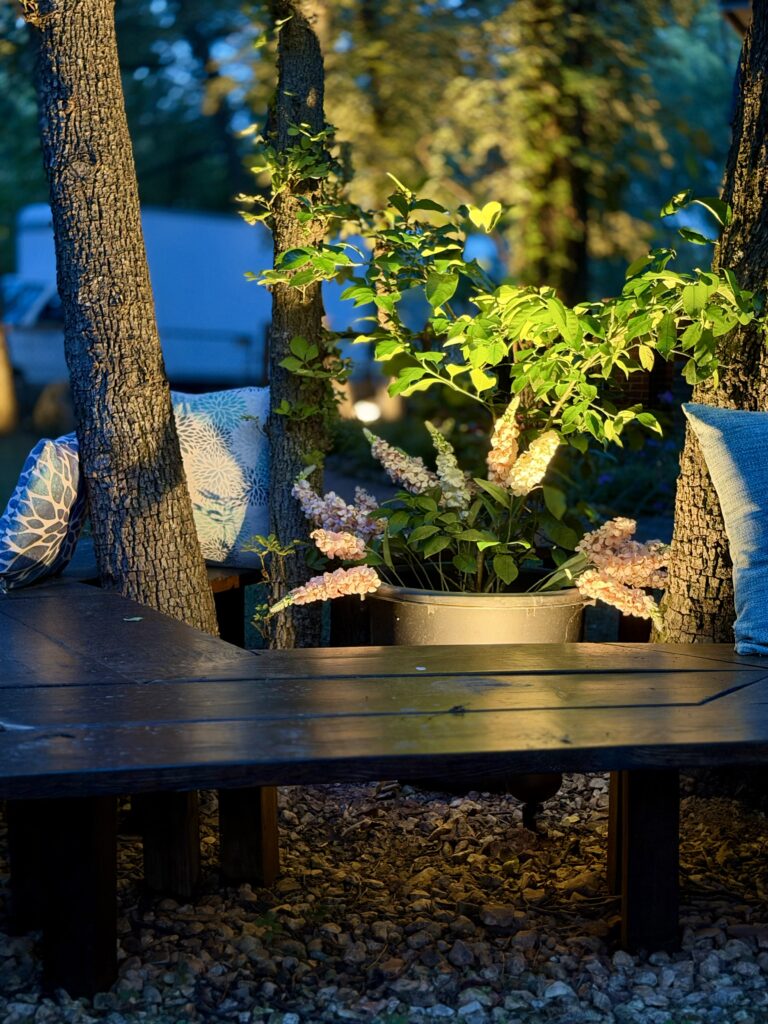
The magic happens when different types of landscape lights work together—some providing visibility, some creating atmosphere, and others drawing your eye toward the features that make your property unique.
Let’s look at some of the most common landscape lighting fixture types and where each one works best.
Why Landscape Lighting Is About More Than Curb Appeal
There’s no question that outdoor lighting can dramatically change the appearance of your home after sunset.
But beautiful lighting can do much more than make a property look good.
A professionally designed system can:
Improve visibility around walkways and steps
Highlight architecture and landscaping
Make outdoor living areas more enjoyable
Showcase trees and garden features
Create atmosphere around patios and pools
Bring attention to water and hardscape features
Help your home feel warm and welcoming after dark
The important part is choosing the right type of light for each of those jobs.
Path Lights: Light the Way
Path lights are among the most recognizable landscape lighting fixtures.
Their primary job is simple:
Help you see where you’re going.
Path and spread lights generally direct illumination downward and outward, creating pools of light around:
Walkways
Garden paths
Steps
Driveway edges
Landscape beds
Entrances
But functional doesn’t have to mean boring.
Path Lighting Should Feel Natural
One of the biggest mistakes with path lighting is assuming you need identical fixtures evenly spaced along both sides of a walkway.
That’s one way to do it.
It’s also a good way to make your sidewalk look like an airport runway.
Instead, path lights can be incorporated naturally into surrounding landscaping.
The light should gently guide you toward your destination without making the fixtures themselves the main attraction.
You should notice where you’re going—not count the lights along the way.
Uplights: Give Your Best Features the Spotlight
Have a beautiful mature tree that disappears after sunset?
Interesting stonework?
Architectural columns?
A distinctive roof peak?
That’s where uplighting can shine—literally.
Uplights are positioned near ground level and direct light upward toward the feature.
They’re ideal for emphasizing:
Trees
Architectural features
Stone and brick
Columns
Sculptures
Tall landscaping
Entry features
The Fixture Is Only Part of the Equation
Simply placing an uplight beneath a tree doesn’t guarantee a beautiful result.
The fixture’s position, brightness, beam spread, and angle all affect what you’ll see.
A tall, narrow tree may look best with a tighter beam.
A broad mature oak may need a completely different approach to reveal the canopy.
Move the fixture closer or farther away and the effect changes again.
That’s why professional landscape lighting isn’t simply about choosing a fixture.
It’s about knowing what to do with it.
Downlights: Bring the Light From Above
Downlights reverse the direction.
Instead of illuminating upward from the ground, they’re positioned above the area and aimed downward.
This makes them useful for larger areas such as:
Lawns
Driveways
Walkways
Patios
Gardens
Outdoor living spaces
Downlighting can provide useful illumination while keeping fixtures off the ground and out of the immediate landscape.
But there’s another reason we love it.
Moonlighting: Let the Trees Do the Work
When downlights are mounted high in mature trees and directed through the branches, they can create moonlighting.
Leaves and branches interrupt the beam, casting natural patterns of light and shadow across the ground.
The effect can resemble actual moonlight filtering through the tree canopy.
Moonlighting works beautifully across lawns, driveways, patios, and walkways because it combines practical illumination with atmosphere.
And unlike a bright floodlight shining over the entire yard, good moonlighting can feel like the light simply belongs there.
Deck and Patio Lights: Make Outdoor Living Last Longer
A beautiful patio shouldn’t have a bedtime.
Outdoor living areas often need more functional illumination because people are actually spending time there—cooking, eating, talking, entertaining, or relaxing.
Deck and patio lighting can help illuminate:
Seating areas
Steps
Outdoor kitchens
Decks
Railings
Dining spaces
Gathering areas
But there’s a difference between making an outdoor space usable and making it excessively bright.
Think Layers Instead of One Big Light
Imagine sitting on a patio beneath one extremely bright fixture.
Now imagine the same patio with softer illumination around the seating area, subtle light integrated into nearby hardscape, and beautifully illuminated trees and landscaping beyond it.
Both allow you to see.
Only one creates an atmosphere.
Outdoor living lighting should make the space feel inviting—not interrogated.
Hardscape Lights: Hide the Fixture and Keep the Glow
Some of the most elegant landscape lighting comes from fixtures you barely notice.
Hardscape lights are designed to integrate into permanent landscape and architectural features such as:
Retaining walls
Seating walls
Steps
Outdoor kitchen counters
Pavers
Fire features
Railings
Other masonry or hardscape elements
They can provide useful illumination while keeping the fixture itself visually unobtrusive.
Perfect for Outdoor Living Areas
Imagine a stone seating wall around a patio.
During the day, you see the stone.
At night, a soft glow appears beneath the cap and illuminates the surrounding area.
You don’t immediately notice a light fixture.
You simply notice the effect.
That’s landscape lighting doing exactly what it should.
See the light—not the equipment creating it.
Wall Lights: Make the Architecture Part of the Design
Wall-mounted and integrated wall fixtures can add useful illumination around walkways, steps, patios, and outdoor living spaces.
Because they’re incorporated into the architecture or hardscape, the fixture itself may also become part of the visual design.
Wall lights can be especially useful when you want controlled illumination without adding another freestanding fixture to the landscape.
The key is choosing a fixture style, brightness, and placement that complement the surrounding materials rather than competing with them.
Water Lights: Let Water Become the Feature
Water and light are a beautiful combination.
Pools, fountains, ponds, waterfalls, and other water features can take on an entirely different appearance after dark.
Specialty water lights can illuminate:
Fountains
Waterfalls
Ponds
Pool features
Streams
Other decorative water elements
Light interacts with moving water in ways you don’t get anywhere else in the landscape.
Reflections shift.
Patterns move.
Surrounding surfaces can catch the light.
A water feature that’s attractive during the day can become one of the most dramatic features on the property at night.
Water Requires the Right Equipment
Fixtures used in or around water need to be specifically designed and appropriately rated for that environment.
This isn’t a place to improvise.
The correct fixture, location, and aiming are all important for safety as well as the finished appearance.
Don’t Choose Landscape Lights by Appearance Alone
It’s natural to care about what a landscape lighting fixture looks like during the day.
Finish, shape, size, and style all matter.
But there’s another question that’s even more important:
What does the light coming out of it look like?
Professional landscape lighting considers factors such as:
Beam spread
Brightness
Color temperature
Fixture position
Aiming
Glare
Viewing angles
The size of the feature
Surrounding light levels
Two fixtures that look similar during the day can create dramatically different effects after sunset.
Ultimately, we’re designing with the light, not just the fixture.
Match the Fixture to the Feature
This is one of the simplest rules in landscape lighting.
The fixture should fit the job.
A narrow architectural column doesn’t need the same beam as a sprawling oak.
A walkway doesn’t need the same illumination as a patio.
A seating wall doesn’t need the same fixture as a fountain.
And a decorative tree doesn’t necessarily need the same brightness as the front of the house.
When each fixture has a specific purpose, the system starts to feel intentional.
Different Fixtures Create Different Layers
The best landscape lighting designs rarely depend on one fixture type.
Imagine the front of a home using:
Uplights on the architecture
Accent lights on mature trees
Path lights near the walkway
Hardscape lighting around the entrance
Downlighting from trees
Each fixture performs a different job.
One creates drama.
One improves visibility.
One adds softness.
One draws attention toward the entrance.
Together, they create something none of them could create alone:
a complete nighttime scene.
Don’t Forget What Powers the Fixtures
The lights may get all the attention, but there’s an entire system working behind them.
A professional low-voltage landscape lighting system also requires consideration of:
Transformer capacity
Wire gauge
Cable runs
Voltage drop
Connections
Timers and controls
Future expansion
Maintenance and serviceability
Those components aren’t nearly as exciting as seeing a beautiful tree illuminated for the first time.
But they’re important to how reliably the system performs night after night.
Choosing Fixtures Is Where Design and Engineering Meet
Landscape lighting has an artistic side.
It also has a technical side.
You need the artistic eye to decide what should be illuminated and how it should feel.
Then you need the technical knowledge to determine which fixture, beam spread, output, location, transformer, wiring, and controls will create that result reliably.
That’s why professional landscape lighting isn’t simply about buying better fixtures.
It’s about knowing how to put all of those pieces together.
Professional Landscape Lighting in Tulsa and Northeast Oklahoma
At Trinity 918 Designs, we’ve been designing and installing professional outdoor lighting for more than 25 years.
Every home is different, which means every landscape lighting system should be different too.
We consider your home’s architecture, landscaping, mature trees, walkways, outdoor living areas, water features, and the way you use your property.
Then we select the fixtures and techniques that make sense for your home.
Our philosophy is simple:
Put the right light in the right place.
Ready to Find the Right Lights for Your Home?
You don’t need one type of landscape light everywhere.
You need the right combination of lights in the right places.
Let Trinity 918 Designs create a custom landscape lighting system that highlights your home’s architecture, showcases your landscaping, improves visibility, and makes your outdoor spaces even more enjoyable after sunset.
Visit our Landscape Lighting Services page to learn more and schedule your free consultation: