
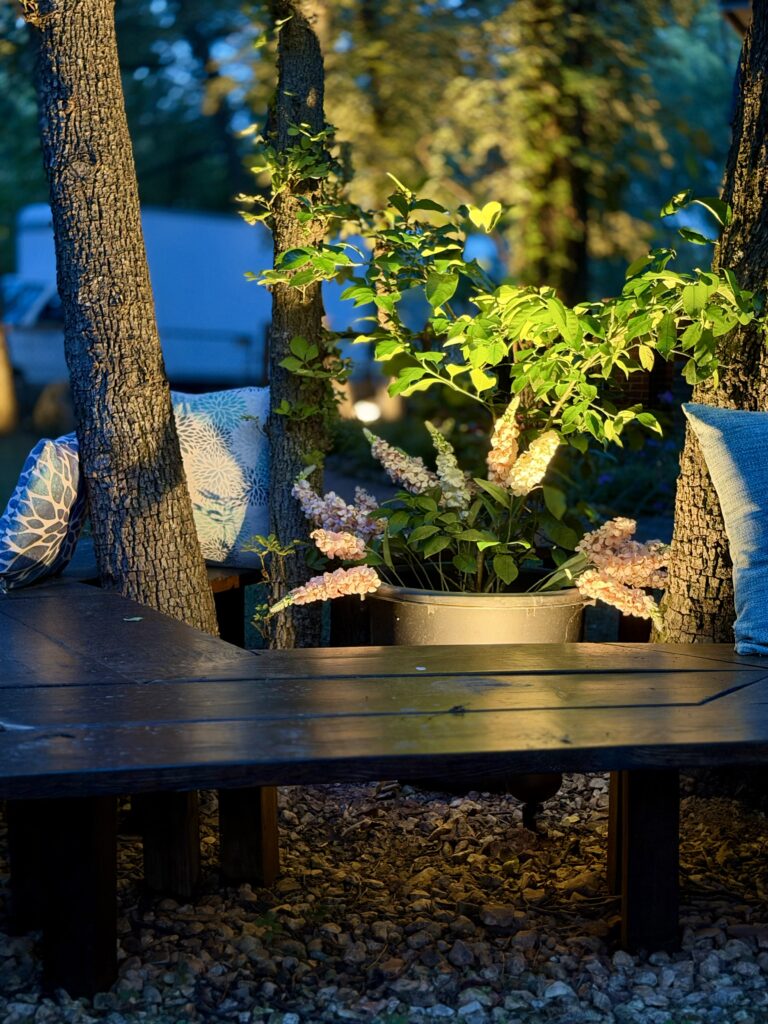
One of the most common questions homeowners ask about landscape lighting is:
“What kind of lights do I need?”
The answer depends on what you want those lights to do.
The fixture that beautifully illuminates a 30-foot tree probably isn’t the fixture you want beside your walkway. The light tucked beneath a seating wall has a completely different job from the one mounted high in a tree.
That’s one of the keys to professional landscape lighting.
Every fixture should have a purpose.
The magic happens when different types of landscape lights work together—some providing visibility, some creating atmosphere, and others drawing your eye toward the features that make your property unique.
Let’s look at some of the most common landscape lighting fixture types and where each one works best.
Why Landscape Lighting Is About More Than Curb Appeal
There’s no question that outdoor lighting can dramatically change the appearance of your home after sunset.
But beautiful lighting can do much more than make a property look good.
A professionally designed system can:
- Improve visibility around walkways and steps
- Highlight architecture and landscaping
- Make outdoor living areas more enjoyable
- Showcase trees and garden features
- Create atmosphere around patios and pools
- Bring attention to water and hardscape features
- Help your home feel warm and welcoming after dark
The important part is choosing the right type of light for each of those jobs.
Path Lights: Light the Way
Path lights are among the most recognizable landscape lighting fixtures.
Their primary job is simple:
Help you see where you’re going.
Path and spread lights generally direct illumination downward and outward, creating pools of light around:
- Walkways
- Garden paths
- Steps
- Driveway edges
- Landscape beds
- Entrances
But functional doesn’t have to mean boring.
Path Lighting Should Feel Natural
One of the biggest mistakes with path lighting is assuming you need identical fixtures evenly spaced along both sides of a walkway.
That’s one way to do it.
It’s also a good way to make your sidewalk look like an airport runway.
Instead, path lights can be incorporated naturally into surrounding landscaping.
The light should gently guide you toward your destination without making the fixtures themselves the main attraction.
You should notice where you’re going—not count the lights along the way.
Uplights: Give Your Best Features the Spotlight
Have a beautiful mature tree that disappears after sunset?
Interesting stonework?
Architectural columns?
A distinctive roof peak?
That’s where uplighting can shine—literally.
Uplights are positioned near ground level and direct light upward toward the feature.
They’re ideal for emphasizing:
- Trees
- Architectural features
- Stone and brick
- Columns
- Sculptures
- Tall landscaping
- Entry features
The Fixture Is Only Part of the Equation
Simply placing an uplight beneath a tree doesn’t guarantee a beautiful result.
The fixture’s position, brightness, beam spread, and angle all affect what you’ll see.
A tall, narrow tree may look best with a tighter beam.
A broad mature oak may need a completely different approach to reveal the canopy.
Move the fixture closer or farther away and the effect changes again.
That’s why professional landscape lighting isn’t simply about choosing a fixture.
It’s about knowing what to do with it.
Downlights: Bring the Light From Above
Downlights reverse the direction.
Instead of illuminating upward from the ground, they’re positioned above the area and aimed downward.
This makes them useful for larger areas such as:
- Lawns
- Driveways
- Walkways
- Patios
- Gardens
- Outdoor living spaces
Downlighting can provide useful illumination while keeping fixtures off the ground and out of the immediate landscape.
But there’s another reason we love it.
Moonlighting: Let the Trees Do the Work
When downlights are mounted high in mature trees and directed through the branches, they can create moonlighting.
Leaves and branches interrupt the beam, casting natural patterns of light and shadow across the ground.
The effect can resemble actual moonlight filtering through the tree canopy.
Moonlighting works beautifully across lawns, driveways, patios, and walkways because it combines practical illumination with atmosphere.
And unlike a bright floodlight shining over the entire yard, good moonlighting can feel like the light simply belongs there.
Deck and Patio Lights: Make Outdoor Living Last Longer
A beautiful patio shouldn’t have a bedtime.
Outdoor living areas often need more functional illumination because people are actually spending time there—cooking, eating, talking, entertaining, or relaxing.
Deck and patio lighting can help illuminate:
- Seating areas
- Steps
- Outdoor kitchens
- Decks
- Railings
- Dining spaces
- Gathering areas
But there’s a difference between making an outdoor space usable and making it excessively bright.
Think Layers Instead of One Big Light
Imagine sitting on a patio beneath one extremely bright fixture.
Now imagine the same patio with softer illumination around the seating area, subtle light integrated into nearby hardscape, and beautifully illuminated trees and landscaping beyond it.
Both allow you to see.
Only one creates an atmosphere.
Outdoor living lighting should make the space feel inviting—not interrogated.
Hardscape Lights: Hide the Fixture and Keep the Glow
Some of the most elegant landscape lighting comes from fixtures you barely notice.
Hardscape lights are designed to integrate into permanent landscape and architectural features such as:
- Retaining walls
- Seating walls
- Steps
- Outdoor kitchen counters
- Pavers
- Fire features
- Railings
- Other masonry or hardscape elements
They can provide useful illumination while keeping the fixture itself visually unobtrusive.
Perfect for Outdoor Living Areas
Imagine a stone seating wall around a patio.
During the day, you see the stone.
At night, a soft glow appears beneath the cap and illuminates the surrounding area.
You don’t immediately notice a light fixture.
You simply notice the effect.
That’s landscape lighting doing exactly what it should.
See the light—not the equipment creating it.
Wall Lights: Make the Architecture Part of the Design
Wall-mounted and integrated wall fixtures can add useful illumination around walkways, steps, patios, and outdoor living spaces.
Because they’re incorporated into the architecture or hardscape, the fixture itself may also become part of the visual design.
Wall lights can be especially useful when you want controlled illumination without adding another freestanding fixture to the landscape.
The key is choosing a fixture style, brightness, and placement that complement the surrounding materials rather than competing with them.
Water Lights: Let Water Become the Feature
Water and light are a beautiful combination.
Pools, fountains, ponds, waterfalls, and other water features can take on an entirely different appearance after dark.
Specialty water lights can illuminate:
- Fountains
- Waterfalls
- Ponds
- Pool features
- Streams
- Other decorative water elements
Light interacts with moving water in ways you don’t get anywhere else in the landscape.
Reflections shift.
Patterns move.
Surrounding surfaces can catch the light.
A water feature that’s attractive during the day can become one of the most dramatic features on the property at night.
Water Requires the Right Equipment
Fixtures used in or around water need to be specifically designed and appropriately rated for that environment.
This isn’t a place to improvise.
The correct fixture, location, and aiming are all important for safety as well as the finished appearance.
Don’t Choose Landscape Lights by Appearance Alone
It’s natural to care about what a landscape lighting fixture looks like during the day.
Finish, shape, size, and style all matter.
But there’s another question that’s even more important:
What does the light coming out of it look like?
Professional landscape lighting considers factors such as:
- Beam spread
- Brightness
- Color temperature
- Fixture position
- Aiming
- Glare
- Viewing angles
- The size of the feature
- Surrounding light levels
Two fixtures that look similar during the day can create dramatically different effects after sunset.
Ultimately, we’re designing with the light, not just the fixture.
Match the Fixture to the Feature
This is one of the simplest rules in landscape lighting.
The fixture should fit the job.
A narrow architectural column doesn’t need the same beam as a sprawling oak.
A walkway doesn’t need the same illumination as a patio.
A seating wall doesn’t need the same fixture as a fountain.
And a decorative tree doesn’t necessarily need the same brightness as the front of the house.
When each fixture has a specific purpose, the system starts to feel intentional.
Different Fixtures Create Different Layers
The best landscape lighting designs rarely depend on one fixture type.
Imagine the front of a home using:
- Uplights on the architecture
- Accent lights on mature trees
- Path lights near the walkway
- Hardscape lighting around the entrance
- Downlighting from trees
Each fixture performs a different job.
One creates drama.
One improves visibility.
One adds softness.
One draws attention toward the entrance.
Together, they create something none of them could create alone:
a complete nighttime scene.
Don’t Forget What Powers the Fixtures
The lights may get all the attention, but there’s an entire system working behind them.
A professional low-voltage landscape lighting system also requires consideration of:
- Transformer capacity
- Wire gauge
- Cable runs
- Voltage drop
- Connections
- Timers and controls
- Future expansion
- Maintenance and serviceability
Those components aren’t nearly as exciting as seeing a beautiful tree illuminated for the first time.
But they’re important to how reliably the system performs night after night.
Choosing Fixtures Is Where Design and Engineering Meet
Landscape lighting has an artistic side.
It also has a technical side.
You need the artistic eye to decide what should be illuminated and how it should feel.
Then you need the technical knowledge to determine which fixture, beam spread, output, location, transformer, wiring, and controls will create that result reliably.
That’s why professional landscape lighting isn’t simply about buying better fixtures.
It’s about knowing how to put all of those pieces together.
Professional Landscape Lighting in Tulsa and Northeast Oklahoma
At Trinity 918 Designs, we’ve been designing and installing professional outdoor lighting for more than 25 years.
Every home is different, which means every landscape lighting system should be different too.
We consider your home’s architecture, landscaping, mature trees, walkways, outdoor living areas, water features, and the way you use your property.
Then we select the fixtures and techniques that make sense for your home.
Our philosophy is simple:
Put the right light in the right place.
Ready to Find the Right Lights for Your Home?
You don’t need one type of landscape light everywhere.
You need the right combination of lights in the right places.
Let Trinity 918 Designs create a custom landscape lighting system that highlights your home’s architecture, showcases your landscaping, improves visibility, and makes your outdoor spaces even more enjoyable after sunset.
Visit our Landscape Lighting Services page to learn more and schedule your free consultation:
https://www.nptpool.com/resources/blog/landscape-lighting-types-and-techniques