
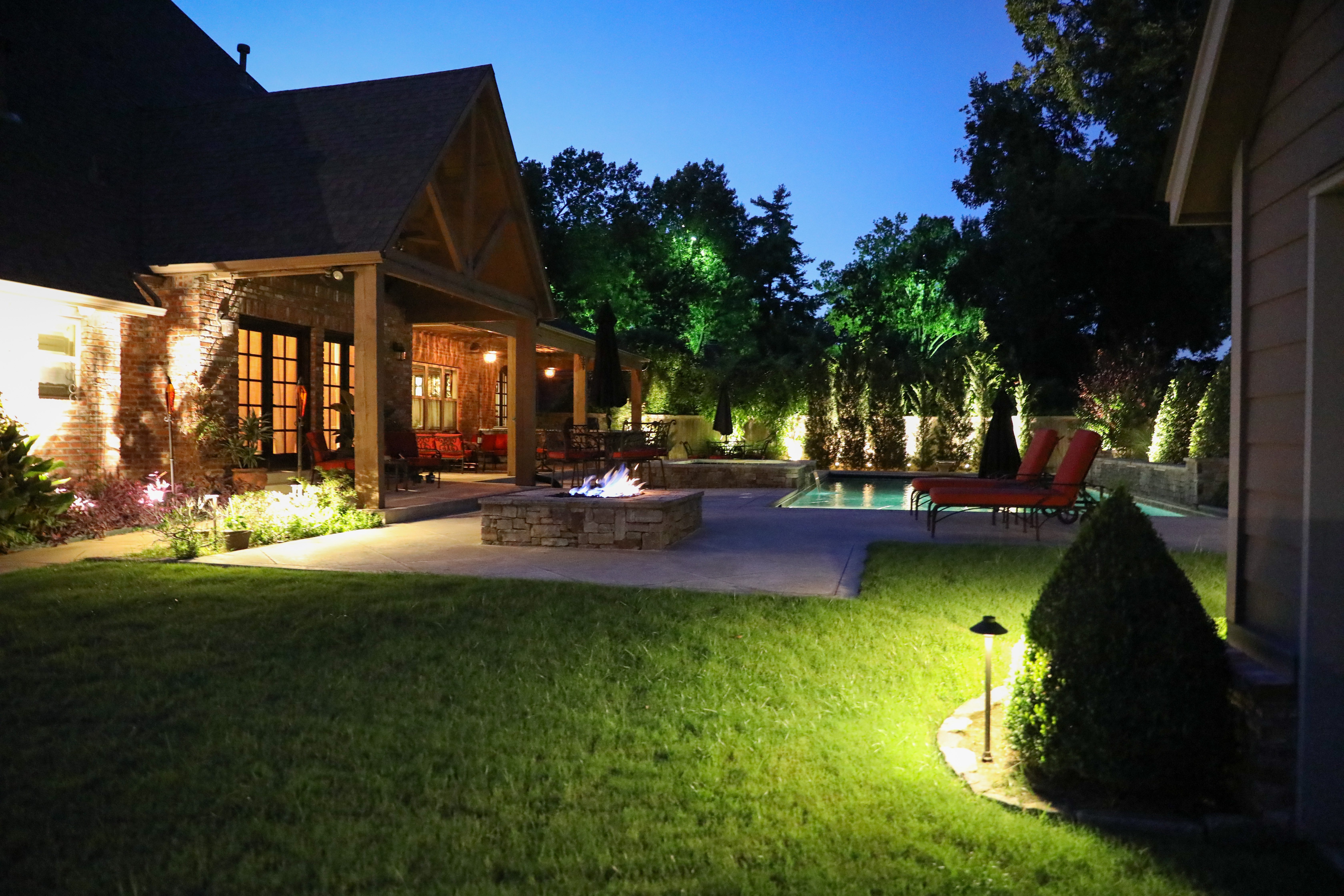
During the day, sunlight does something we rarely think about.
It creates highlights and shadows. It reveals the texture of stone. It filters through tree branches. It draws your eye toward certain features while allowing others to fade quietly into the background.
Then the sun sets.
Without thoughtfully designed lighting, much of the character of your home and landscape simply disappears.
That’s where professional landscape lighting becomes more than illumination.
It becomes design.
The goal isn’t to make your property as bright as possible. It’s to use light and shadow intentionally—to reveal architecture, showcase landscaping, create atmosphere, and give your home an entirely new personality after dark.
Don’t Just Light Your Home—Create a Nighttime Scene
Beautiful landscape lighting starts with a vision.
Before deciding where fixtures should go, consider what makes your property special during the day.
Is it the stone across the front of your home?
A magnificent mature tree?
Architectural columns?
The walkway leading to your front door?
A backyard patio surrounded by landscaping?
Those features don’t have to disappear after sunset.
With the right lighting, they can become the stars of an entirely different nighttime scene.
Great landscape lighting doesn’t simply help you see your home at night. It changes the way you see it.
Start With the Features Worth Showing Off
Not everything needs light.
In fact, trying to illuminate everything is one of the quickest ways to lose the elegance of a professional lighting design.
Instead, identify your focal points.
These might include:
- Mature or ornamental trees
- Stone and brick
- Architectural peaks
- Columns
- Entryways
- Garden features
- Water features
- Outdoor living spaces
- Sculptures or artwork
Then decide which deserve the most attention.
One feature might receive dramatic illumination while another gets only a soft glow.
Some areas may remain intentionally dark.
That’s what creates depth.
Think of Your Property in Lighting Zones
Your front entrance and backyard patio don’t serve the same purpose.
Why should they have the same lighting?
Dividing a property into lighting zones helps determine what each area needs.
The Front of the Home
This is where architectural lighting can create nighttime curb appeal and establish the overall character of the property.
Walkways and Entrances
Here, lighting needs to balance appearance with visibility, gently guiding family members and guests through the property.
Trees and Landscaping
These areas provide opportunities for dramatic uplighting, moonlighting, silhouettes, shadows, and other creative effects.
Outdoor Living Areas
Patios, pools, outdoor kitchens, decks, and fire pits generally benefit from softer layers of comfortable illumination.
Thinking in zones prevents the entire property from being treated as one big lighting project.
Each area can have its own mood while still contributing to one cohesive design.
Use Light Like an Artist Uses Paint
A painter doesn’t cover the entire canvas with one color.
Landscape lighting shouldn’t cover the entire property with one type of light either.
Different techniques produce completely different effects.
Uplighting: Create Drama
Uplighting begins near ground level and directs light upward.
It can make a mature tree feel taller, reveal the shape of a canopy, emphasize an architectural peak, or turn a stone column into a nighttime focal point.
The fixture’s distance, angle, brightness, and beam spread all influence the finished appearance.
Move the fixture just a little and the effect can change dramatically.
Moonlighting: Let Nature Create the Pattern
Moonlighting takes the opposite approach.
Instead of illuminating upward from the ground, fixtures are mounted high in mature trees and directed downward.
Light passes through branches and leaves, producing soft patterns across the ground below.
The effect can resemble natural moonlight filtering through the tree canopy.
It’s especially beautiful across:
- Lawns
- Driveways
- Patios
- Walkways
- Gardens
- Outdoor seating areas
When it’s done correctly, moonlighting doesn’t immediately look like a landscape light.
It simply feels like the light belongs there.
Grazing: Let Texture Become the Feature
Some architectural materials deserve more than simple illumination.
Stone, brick, masonry, and other textured surfaces can become dramatically different at night with grazing.
Fixtures are positioned close to the surface so light travels across it.
That creates tiny highlights and shadows across every bump, edge, and irregularity.
Instead of flattening the wall with light, grazing allows the texture itself to become the feature.
Path Lighting: Guide Rather Than Overpower
Path lighting has an important functional job—but that doesn’t mean it can’t be beautiful.
Rather than lining both sides of a walkway with identical fixtures, path lights can be incorporated naturally into surrounding landscape beds.
Soft pools of illumination guide people toward the destination without making the fixtures themselves the focus.
The best path lighting almost feels intuitive.
You simply know where to go.
Warm Light Creates a Different Feeling
Light has color, even when we call it “white.”
Some white light appears cooler and slightly blue, while warmer light has a softer, more golden appearance.
That difference can dramatically affect how a home feels at night.
Warm light often complements residential materials beautifully:
- Stone
- Brick
- Wood
- Landscaping
- Outdoor living areas
It can make an outdoor space feel comfortable and inviting rather than harsh or overly commercial.
Color temperature is just another part of the overall design.
The question isn’t simply, “How much light do we need?”
It’s also:
“How should this light make the space feel?”
Layer the Light Instead of Relying on One Effect
Natural light is never completely uniform.
Landscape lighting shouldn’t be either.
A professional design may combine:
- Uplighting on architecture
- Grazing across stone
- Accent lighting on trees
- Path lighting near walkways
- Moonlighting from above
- Soft lighting around outdoor living spaces
- Darker areas between focal points
Each layer adds something different.
One provides function.
Another creates drama.
Another adds softness.
Together, those layers create a property that feels dimensional rather than flat.
Shadows Aren’t the Enemy
When homeowners first think about outdoor lighting, the instinct is often to eliminate darkness.
But some of the most beautiful landscape lighting depends on it.
Think about moonlight passing through tree branches.
The light is beautiful partly because of the shadows.
Think about a stone wall illuminated from below.
Its texture becomes visible because tiny shadows form across the surface.
Think about a brightly illuminated tree against a dark night sky.
The contrast is what makes it dramatic.
Without darkness, light loses much of its impact.
Professional landscape lighting doesn’t try to eliminate every shadow.
It decides which shadows belong there.
Don’t Over-Light the Property
More fixtures don’t automatically create a better lighting design.
And brighter fixtures don’t necessarily make a home look better.
Too much light can wash out architectural details, flatten landscaping, create glare, and eliminate the contrast that gives a nighttime scene depth.
Sometimes the best decision a lighting designer makes is not adding another fixture.
The goal isn’t maximum brightness.
It’s balance.
Create Visual Interest From Every Angle
Your home isn’t only viewed from the street.
A complete landscape lighting design should consider what you’ll see from:
- The driveway
- Front walkway
- Inside the home
- Backyard
- Patio
- Pool
- Outdoor kitchen
- Seating areas
A beautifully illuminated tree outside the living room window can become part of your home’s interior view at night.
Landscape lighting around a patio can create depth beyond the seating area instead of leaving everything outside it completely black.
Considering those different viewing angles helps create a lighting design you enjoy while you’re inside the property, not just one that looks good to someone driving past it.
Let Your Landscape Lighting Change With the Property
A landscape is alive.
Trees grow.
Shrubs spread.
Plants change with the seasons.
That means your lighting may need to evolve too.
A fixture aimed perfectly at a young tree today may need repositioning as the canopy grows.
Vegetation may eventually block a beam that was once unobstructed.
Seasonal adjustments and periodic maintenance help the lighting continue to complement the landscape instead of fighting against it.
A great landscape lighting system isn’t simply installed and forgotten.
It grows with the property.
Beauty Still Needs Good Engineering
Landscape lighting may be an art, but there’s plenty of science behind it.
Behind every beautiful nighttime scene are technical considerations such as:
- Fixture quality
- Beam spread
- Brightness
- Color temperature
- Transformer capacity
- Wire gauge
- Voltage drop
- Connections
- Timers and controls
- Fixture placement
- Glare control
- Future expansion
- Maintenance
The homeowner may never notice those details.
And that’s the point.
When the technical side is done correctly, you’re free to simply enjoy the finished effect.
Your Home Has Two Personalities
We tend to think of a home’s appearance as something fixed.
But landscape lighting changes that.
During the day, your home’s beauty comes from architecture, materials, landscaping, color, and natural sunlight.
At night, you get to decide what appears.
A tree that blends quietly into the background during the day can become the centerpiece after sunset.
Stonework can become more dramatic.
A walkway can become warmer and more inviting.
A backyard can transform into an intimate outdoor retreat.
Landscape lighting gives your home a second personality—one that only appears after dark.
Professional Landscape Lighting in Tulsa and Northeast Oklahoma
At Trinity 918 Designs, we’ve been designing and installing professional outdoor lighting for more than 25 years.
We don’t believe great landscape lighting is about placing as many fixtures as possible around a property.
It’s about understanding the architecture, landscaping, outdoor living spaces, and viewing angles—and then deciding where light will make the greatest difference.
Our philosophy is simple:
Put the right light in the right place.
We provide custom landscape lighting design, professional installation, LED conversions, repairs, and service for homes and businesses throughout Tulsa and Northeast Oklahoma.
Ready to See the Nighttime Version of Your Home?
You already know what your home looks like during the day.
Let Trinity 918 Designs show you what it can become after dark.
We’ll create a custom landscape lighting design that highlights your home’s architecture, showcases your landscaping, and creates a nighttime atmosphere designed specifically for your property.
Visit our Landscape Lighting Services page to learn more and schedule your free consultation: