Why We Love Landscape Lighting
Landscape lights allow you to enjoy the beauty of your yard even when it’s dark out. A professionally designed landscape lighting system can make your landscape even more dramatic, with well-placed outdoor spotlights and washes casting intriguing shadows and highlighting the best plants, water features and other aspects. While focusing attention on the area’s most important details, outdoor lighting also helps people safely traverse across an area with path lighting and deck lighting guiding the way.
Where Outdoor Landscape Lighting Works Best
Most outdoor landscape lighting is designed to discretely illuminate and keep the landscape at the center of attention. These fixtures are best hidden within bushes or rock formations and oriented to highlight the leaves in a tree or wash up a textural wall. Backyard ponds or water features benefit from underwater lights, while in-ground well lights provide an atmospheric glow. Lastly, use bollard lights anywhere you need extra illumination for safety or direction.
The Benefits of LED Landscape Lighting
In addition to the cost savings you’ll notice, the use of LED landscape fixtures requires very little maintenance on your part. LEDs are rated to last for a very long time, meaning you won’t have to change out your lights every summer.
How to Choose the Best Landscape Light Fixtures
There are several considerations that go into selecting the right kind of landscape lighting for your front yard, back yard or commercial property. Use these quick tips to help you get it right.
Types of Landscape Lighting
Depending on your application, you’ll have a few different options to use including bollards, path lights, in-ground lights, spotlights and floodlights. Decide where you will plan to use landscape fixtures and the type of light you expect them to provide – uplighting, silhouetting, wall washing, etc.
UL Listing Is Critical
Be sure to check the UL rating of the fixtures you are interested in. While all of the landscape lights in this assortment are safe to use outdoors, some are available as damp-rated (safe to be exposed to water occasionally) and others are wet-rated (can be exposed to any amount of water without harm).
Dark-Sky Compliance
If you live in an area that promotes dark-sky compliance in outdoor lighting, be sure to select fixtures that are specifically rated as dark-sky compliant. These designs are meant to minimize the amount of glow emitted by shielding glare and light trespass.
Other Considerations
Any outdoor lighting scheme isn’t complete without more decorative lighting. Wall, ceiling, portable and post-mounted fixtures add to the functionality of landscape lighting. Grill on the barbecue with the proper amount of light with a BBQ light from Focus Industries. Finally, enjoy your landscape lighting into the evening hours with comfortable and design-forward outdoor furniture including sofas, lounge chairs and hammocks.
Landscape lighting can be the thing that transforms an outdoor space. In this guide we will walk you through a basic overview of the various types of lighting you’ll find in a landscape and exactly what each of them is supposed to do. We’ll look at:
- What to light in your yard
- Types of landscape lighting
- How to use landscape lighting
Like many things in life, less can be more—and this is the case when it comes to landscape lighting. The instinct to light up everything—every detail, every tree, every nook and every cranny—is not only inefficient, but it can also wash the yard out.
What makes a space special during the night is the play of light and dark, highlighting features and creating visual contrast using the forms and plants in your yard. Playing with these elements creates intrigue and drama, and a well-lit space will often be one that feels most inviting.
 What Landscape Elements Need Light
So what do you light and what do you leave in the dark? Here are three things to consider:
- Identify the features in your yard that you like. Maybe it’s a pond or a particularly stately tree—highlighting those with light will show them off.
- Add drama to areas that might not stand out during the day. A simple stone wall can take on a whole new personality at night when graced with light and shadow.
- Think about function. A deck with stairs or a meandering pathway need to be lit to ensure that you can move about your yard without risk of injury.
Always consider an inviting and well-lit entryway. A properly illuminated entrance will safely guide family members or guests while creating that warm and welcoming curb appeal.
The goal of landscape lighting is to only see the effect of the light, not the light source itself. The exception is path lighting, which are designed to be decorative and on display.
Types of Landscape Lighting
There are a few basic types of fixtures that you want to get familiar with when you are making your lighting plan. Below are the various types of lighting you might find in a landscape:
Spotlights / Floodlights
The difference between a spotlight and floodlight comes down to beam spread. Spotlights project a concentrated, narrow beam of light that’s usually around 45 degrees. It’s easier to aim and adjust so that if you’re looking to highlight specific display points, like architectural details or landscape features, a spotlight will be your best choice.
Floodlights generally have a wider beam spread, up to 120 degrees. If you’re looking to cast light over general areas like a driveway or lot, use a floodlight. It’s better for overall safety and visibility.
Knowing the width of the beam spread you want isn’t nearly as important as the beam width in feet. You want to make sure the light reaches its subject and properly illuminates all the key features you’re looking for. To determine how much light will reach its target from a certain distance, use this formula:
Angle of Beam x 0.018 x Distance from Light Bulb = Beam Width
(Example: If you have an 80-degree floodlight and install it from 10-feet away, your formula will be 80 degrees x 0.018 x 10 feet = 14.4 feet wide)
Inground Lighting
An inground light, or well light, is typically a circle-shaped fixture that installs directly into the ground, and is often used to illuminate walkways and driveways. Inground lights really heighten the sophistication and visibility of the features in your yard. It helps create drama and atmosphere with an uplight effect that illuminates the whole of a tree or structure. It also silhouettes the characters that stand around the yard—those you wouldn’t be able to see on a typical night. They’re best mixed with spotlights, if and when you can blend them, but uplighting on its own can be a strong lighting solution.
Since inground lights are hidden in the ground, the actual light effect is what stands out. In the case of an inground, make sure it’s used to light up a strong presence in your yard. Don’t worry about garden gnomes or short flowerbeds—concentrate on trees and garden walls.
Inground lights may also be used to light up driveways for safer navigation through gates and lot areas. These need to have the proper vehicular weight ratings to suit cars that drive over them. Choose one that is strong and has ample weight sustainability. It’s also highly suggested to go with an LED option, as they have crisp color temperatures that look brilliant in the dark and last for thousands of hours.
Outdoor Post Lights
Post lights (and their robust cousins, bollard lights) help accent the pathway to your home and set an ambient tone without the overpowering brightness of floodlights. Tall posts are great for illuminating driveways and long stretches of space that get lost in the dark. Shorter posts work well for paths and small alcoves.
Important considerations:
Number of lights: To figure out how many post lights you need, take note of the diameter that the light encompasses around the post. Then set your next fixture outside of that space. The height of the fixture will help you determine the proper placement while the function of the light will let you know if it’s in the right place. Doing so will help prevent the yard from looking like an airplane runway. If possible, try placing the fixtures on either side of the path, working back and forth to create an effective and inviting entry.
PATH LIGHTING
Path lights are a basic outdoor fixture all yards should have. Similar to post lights in that they create light markers that run down a line, path lights are shorter and smaller in comparison. Path lights easily improve curb appeal and, of course, make walking along paths safer.
Important considerations:
Size: When choosing your path lights, take height into consideration. For a nice, even glow, path lights should be installed about 14-inches high.
Scale: In terms of the borders, your paths should be within 1 foot from the sides of the walkway/pathway. Again, take note of the diameter of the light around the fixture itself and install your lights outside of these areas to avoid overcrowding.
Materials: Your path lights should be sturdy and made from materials that resist corrosion and wear. Powder-coated finishes have long-term resistance to the outdoor elements while soda lime glass stays tough throughout the seasons. LED path lights are highly suggested, as they keep costs low with reduced power consumption and burn cool with options in color temperature. Find one that will enhance the visual appearance of the exterior of your home.
Other Landscape Accent Lights
Deck and Step Lights
Used as an accent to architectural details and add safe passage to dark stairs, deck and step lights are installed directly into a yard’s hardscape or decking. They can also be used for washing light down stone walls and lighting up entertainment spaces.
Pond Light
Similar to the spotlight, but made to be submerged in water to add real drama to outdoor water features.
Hardscape Lights
Hardscape lights are a newer addition to landscape lighting, thanks to LED technology. These are tiny lights with brackets or flanges that install onto or into structures that are used to wash and graze walls with light.
How to Light a Landscape
Don’t feel overwhelmed—there are a lot of types of lights and several spaces to place them. One of the best things that you can do to scope out your own project is to grab a good, high-powered flashlight with a dimming optic and get out into your yard at night. Then, play with the light. See what looks cool, or what might not work as well.
Here’s a look at the various landscape lighting effects you might want to try:
Up Lighting
Used as an accent to architectural details and add safe passage to dark stairs, deck and step lights are installed directly into a yard’s hardscape or decking.
Up lighting is one of the most basic forms of landscape lighting. It is used to create drama with a taller structure or tree. You can choose to highlight the trunk of larger trees, or the underside of the tree’s canopy on larger or smaller trees.
Use with: Spotlights, Well Lights
Silhouetting
This is a fantastic effect for highlighting dramatic shapes you might have hiding in plain daylight. Place the light source behind the item, and light toward where the main vantage point will be, making sure that the light source itself cannot be seen.
Use With: Spotlights, Well Lights
Shadowing
This is the reverse technique of silhouetting. Placing the light between the main vantage point and the item being lit, with the light source aimed at the item. This only works when you have a wall or flat surface behind the item being lit to catch the shadows created. But it can create a bit softer, more moody effect.
Use with: Spotlights, Well Lights, Flood lights
Moon Lighting
This is an especially effective way of using lighting when you have larger trees in your space. The light source is placed high up in the tree aimed down, washing the branches and ground below in light. It creates an impressive effect when used with an open-branched tree.
Use with: Spotlights
Have an extra-large tree that deserves a special treatment? Giants, especially evergreens, can look amazing when you double-team them with lighting. Get both a spotlighting and a moonlighting effect by placing two spotlights half- to three-quarters of the way up the tree. Aiming one light up and one light down will create a dramatic effect, and the year-round foliage will hide the light sources.
Grazing
This can be a great option if you have a hardscape-heavy yard. Grazing involves placing the light close to the flat surface and aiming directly up or down the surface to create dramatic light and shadow play. You can graze up or down, but the idea is to take advantage of a texture across a flat plane, so uneven or irregular patterns work best. This can add an upscale touch, as it is often seen in hotel and restaurant design.
Use with: Well Lights, Hardscape Lights
Washing
Sometimes a space will need more ambient lighting. To create a well-lit space, try flooding a large wall or hedge in an entertainment area with light, which will “wash” the space with light. Use a wide-beamed light placed between the main vantage point and the surface to cast an even, gentle light over the whole area.
Use with: Flood Lights
Technical Tips
Lumen output for landscape lighting can be subjective—it depends on how brightly you wish to illuminate any particular element. Look for fixtures with adjustable lumen output, so you can control the brightness yourself.
LED lighting is the new standard for landscapes, with lower operating costs and longevity that can’t be beat. Plus, new LED lights have features you will want to take advantage of, like adjustable beam spread.
And don’t forget the color temperature. The best lighting for your landscaping should be in the same color family as the objects you’re lighting up: Use warmer light on oak trees and brown siding, while cooler colors like those found on pine trees or dark gray exterior stone play better with a more neutral color temperature. Very cool whites (4000-5000K) are best suited to ultramodern or commercial landscape projects.
How Many Lumens to Uplight a Tree?
Your lumen output will depend on the height of your trees. This is important because too high of output could cause a tree to look blown out and too low of output could prevent the viewer from seeing the tree’s details. We suggest following these guidelines:
- For smaller trees up to 1 story or 6-10 feet, opt for 80-120 lumens. This level is the lowest lumen level and also works great for bushes and shrubs.
- For medium-sized trees up to 2 stories, go with 140-180 lumens.
- Larger trees up to 3 stories require 230-270 lumens.
- And finally, tall trees up to 4 stories or 50-80 feet tall will benefit from a 350-1000 lumen output.
Now you have the basics to go forth and lay out your own landscape design. It is important to note that you should consult with a professional when laying out your landscaping plan so they can ensure you’re working with the right voltage for your transformer and other important details.
The key is to take your time. And you can start small and build from there—an over-lit space can be as uncomfortable or unusable as a completely dark one.
There are many ways to light your landscape, but the fun is in creating a unique look that reflects your own personal taste and lifestyle.


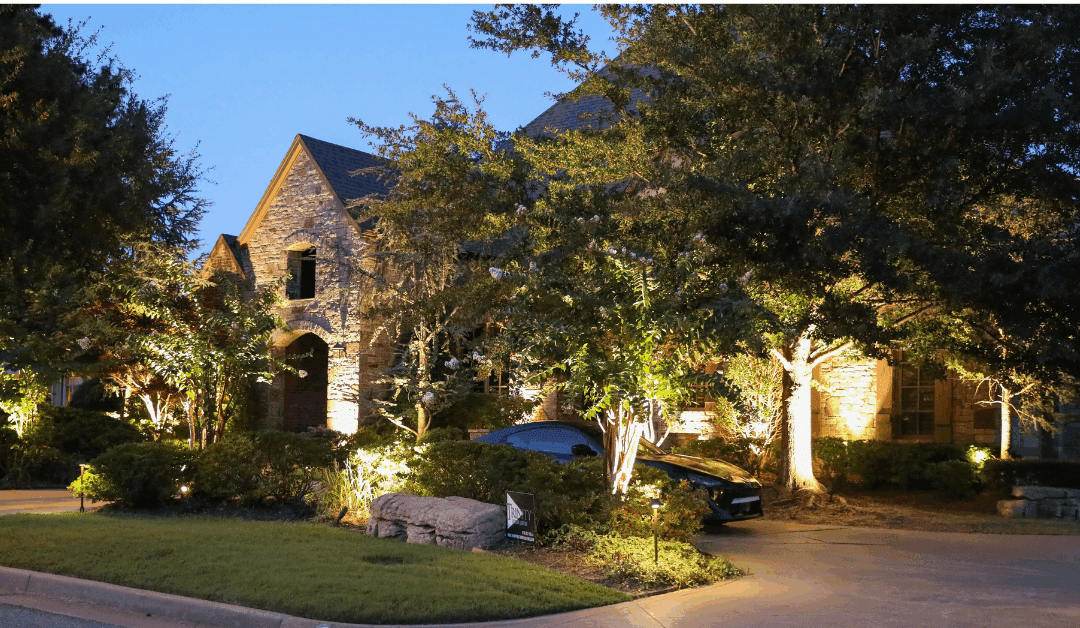
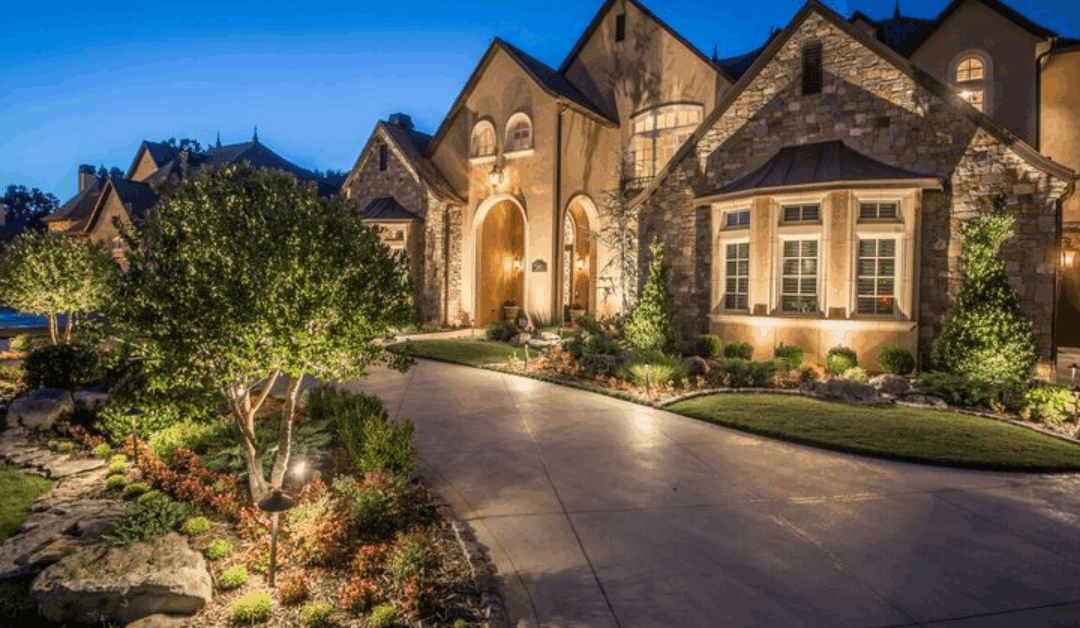


 An inground light, or well light, is typically a circle-shaped fixture that installs directly into the ground, and is often used to illuminate walkways and driveways. Inground lights really heighten the sophistication and visibility of the features in your yard. It helps create drama and atmosphere with an uplight effect that illuminates the whole of a tree or structure. It also silhouettes the characters that stand around the yard—those you wouldn’t be able to see on a typical night. They’re best mixed with spotlights, if and when you can blend them, but uplighting on its own can be a strong lighting solution.
Since inground lights are hidden in the ground, the actual light effect is what stands out. In the case of an inground, make sure it’s used to light up a strong presence in your yard. Don’t worry about garden gnomes or short flowerbeds—concentrate on trees and garden walls.
An inground light, or well light, is typically a circle-shaped fixture that installs directly into the ground, and is often used to illuminate walkways and driveways. Inground lights really heighten the sophistication and visibility of the features in your yard. It helps create drama and atmosphere with an uplight effect that illuminates the whole of a tree or structure. It also silhouettes the characters that stand around the yard—those you wouldn’t be able to see on a typical night. They’re best mixed with spotlights, if and when you can blend them, but uplighting on its own can be a strong lighting solution.
Since inground lights are hidden in the ground, the actual light effect is what stands out. In the case of an inground, make sure it’s used to light up a strong presence in your yard. Don’t worry about garden gnomes or short flowerbeds—concentrate on trees and garden walls.
 Inground lights may also be used to light up driveways for safer navigation through gates and lot areas. These need to have the proper vehicular weight ratings to suit cars that drive over them. Choose one that is strong and has ample weight sustainability. It’s also highly suggested to go with an LED option, as they have crisp color temperatures that look brilliant in the dark and last for thousands of hours.
 Post lights (and their robust cousins, bollard lights) help accent the pathway to your home and set an ambient tone without the overpowering brightness of floodlights. Tall posts are great for illuminating driveways and long stretches of space that get lost in the dark. Shorter posts work well for paths and small alcoves.
 Path lights are a basic outdoor fixture all yards should have. Similar to post lights in that they create light markers that run down a line, path lights are shorter and smaller in comparison. Path lights easily improve curb appeal and, of course, make walking along paths safer.


 Up lighting is one of the most basic forms of landscape lighting. It is used to create drama with a taller structure or tree. You can choose to highlight the trunk of larger trees, or the underside of the tree’s canopy on larger or smaller trees.
Use with: Spotlights, Well Lights
Up lighting is one of the most basic forms of landscape lighting. It is used to create drama with a taller structure or tree. You can choose to highlight the trunk of larger trees, or the underside of the tree’s canopy on larger or smaller trees.
Use with: Spotlights, Well Lights
 This is the reverse technique of silhouetting. Placing the light between the main vantage point and the item being lit, with the light source aimed at the item. This only works when you have a wall or flat surface behind the item being lit to catch the shadows created. But it can create a bit softer, more moody effect.
Use with: Spotlights, Well Lights, Flood lights
This is the reverse technique of silhouetting. Placing the light between the main vantage point and the item being lit, with the light source aimed at the item. This only works when you have a wall or flat surface behind the item being lit to catch the shadows created. But it can create a bit softer, more moody effect.
Use with: Spotlights, Well Lights, Flood lights
 This is an especially effective way of using lighting when you have larger trees in your space. The light source is placed high up in the tree aimed down, washing the branches and ground below in light. It creates an impressive effect when used with an open-branched tree.
Use with: Spotlights
Have an extra-large tree that deserves a special treatment? Giants, especially evergreens, can look amazing when you double-team them with lighting. Get both a spotlighting and a moonlighting effect by placing two spotlights half- to three-quarters of the way up the tree. Aiming one light up and one light down will create a dramatic effect, and the year-round foliage will hide the light sources.
This is an especially effective way of using lighting when you have larger trees in your space. The light source is placed high up in the tree aimed down, washing the branches and ground below in light. It creates an impressive effect when used with an open-branched tree.
Use with: Spotlights
Have an extra-large tree that deserves a special treatment? Giants, especially evergreens, can look amazing when you double-team them with lighting. Get both a spotlighting and a moonlighting effect by placing two spotlights half- to three-quarters of the way up the tree. Aiming one light up and one light down will create a dramatic effect, and the year-round foliage will hide the light sources.
 This can be a great option if you have a hardscape-heavy yard. Grazing involves placing the light close to the flat surface and aiming directly up or down the surface to create dramatic light and shadow play. You can graze up or down, but the idea is to take advantage of a texture across a flat plane, so uneven or irregular patterns work best. This can add an upscale touch, as it is often seen in hotel and restaurant design.
Use with: Well Lights, Hardscape Lights
This can be a great option if you have a hardscape-heavy yard. Grazing involves placing the light close to the flat surface and aiming directly up or down the surface to create dramatic light and shadow play. You can graze up or down, but the idea is to take advantage of a texture across a flat plane, so uneven or irregular patterns work best. This can add an upscale touch, as it is often seen in hotel and restaurant design.
Use with: Well Lights, Hardscape Lights
 Sometimes a space will need more ambient lighting. To create a well-lit space, try flooding a large wall or hedge in an entertainment area with light, which will “wash” the space with light. Use a wide-beamed light placed between the main vantage point and the surface to cast an even, gentle light over the whole area.
Use with: Flood Lights
Sometimes a space will need more ambient lighting. To create a well-lit space, try flooding a large wall or hedge in an entertainment area with light, which will “wash” the space with light. Use a wide-beamed light placed between the main vantage point and the surface to cast an even, gentle light over the whole area.
Use with: Flood Lights