
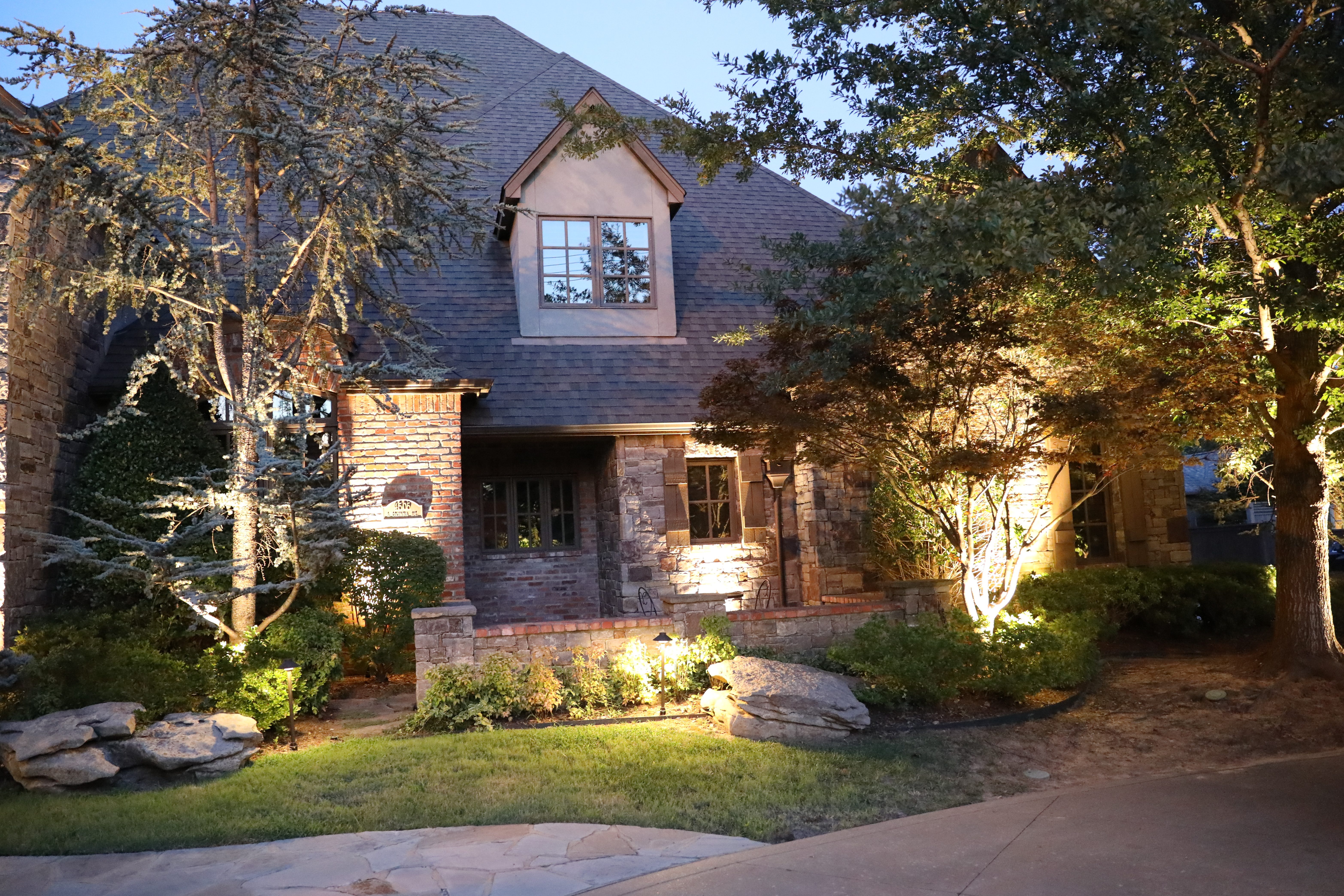
You’ve probably driven past a beautifully illuminated home at night and noticed something interesting.
You see the architecture.
You notice the trees.
Your eye follows the walkway toward the entrance.
The stone has texture, the landscaping has depth, and the entire property feels warm and inviting.
But you barely notice the actual lights.
That’s exactly the point.
Great landscape lighting isn’t about showing off fixtures. It’s about using light to reveal what’s already beautiful about your home.
And that’s one of the biggest differences between simply installing outdoor lights and creating a professionally designed landscape lighting system.
The Best Landscape Lighting Doesn’t Scream for Attention
Good landscape lighting can be surprisingly subtle.
A tree seems to glow.
Stonework suddenly has depth.
A walkway feels naturally illuminated.
The front entrance quietly becomes the focal point.
You don’t necessarily stop and think:
“There’s a landscape light.”
Instead, you notice the effect.
That’s what we’re trying to accomplish.
The fixture is the tool. Your home is the feature.
Start With the Experience, Not the Fixtures
When designing landscape lighting, it’s tempting to begin by deciding how many fixtures you need.
We prefer to start somewhere else:
How should this property feel after sunset?
Warm and welcoming?
Dramatic?
Elegant?
Relaxed?
Maybe you want your home’s architecture to become the focus from the street.
Perhaps your backyard needs to feel more inviting so you’ll actually use the patio after dark.
Or maybe you have beautiful mature trees that disappear completely at night.
Once we understand what the property should look and feel like, we can determine where light belongs.
Create a Nighttime Arrival
Think about what happens when someone arrives at your home after dark.
They pull into the driveway.
Walk toward the entrance.
Follow the sidewalk.
Approach the front door.
Landscape lighting can make that entire experience feel intentional.
Architectural lighting can give the home presence from the street.
Illuminated trees and landscaping can frame the property.
Path lighting can gently guide guests.
And slightly more emphasis around the entrance naturally tells them where they’re going.
Great lighting doesn’t just illuminate a destination. It can shape the journey toward it.
Build the Design in Layers
One of the reasons professionally designed landscape lighting looks different is that it usually isn’t relying on one type of fixture or technique.
The design is built in layers.
Layer 1: Architectural Lighting
Your home itself often provides the foundation.
Columns, stonework, brick, peaks, interesting rooflines, and entry features can become part of the nighttime composition.
But the goal isn’t to blast the entire facade with equal amounts of light.
Different levels of brightness create depth.
Layer 2: Trees and Landscaping
Landscape lighting should include the landscape.
Mature trees can become dramatic focal points.
Smaller ornamental trees can create silhouettes and shadows.
Shrubs and garden areas can provide softer supporting layers.
Without landscape lighting, you may see the house at night while everything around it disappears into darkness.
Illuminating selected landscape features visually connects the home to the property around it.
Layer 3: Pathways and Transitions
Paths, steps, driveways, and transitions between outdoor areas need enough illumination to be comfortable to navigate.
But functional lighting doesn’t need to dominate the design.
Thoughtfully placed fixtures can provide useful illumination while blending naturally into surrounding landscape beds.
Layer 4: Outdoor Living Spaces
Your patio, pool, outdoor kitchen, deck, fire pit, and seating areas should feel like an extension of your home.
That usually means several softer sources of light instead of one bright source.
Hardscape lighting can create a glow beneath a seating wall.
Downlighting can provide useful illumination from above.
Nearby landscaping can be accented to give you something beautiful to look at beyond the patio.
Layer 5: The Finishing Touches
Sometimes it’s the smallest details that complete the scene.
A sculpture.
A fountain.
A flag.
An interesting garden feature.
A beautiful ornamental tree.
These features don’t necessarily need to be the brightest objects on the property.
They just need enough emphasis to become part of the overall composition.
Let Light and Darkness Work Together
This may be one of the most important principles in landscape lighting:
You need darkness.
If everything is illuminated equally, the property loses dimension.
Think about a photograph.
Highlights attract your eye because shadows surround them.
Landscape lighting works the same way.
A beautifully illuminated tree looks more dramatic against a darker background.
Stone reveals texture because light creates tiny shadows across the surface.
An entrance feels more important when surrounding areas are slightly softer.
We’re not trying to eliminate darkness.
We’re deciding where the light belongs.
Avoid the Wall-of-Light Effect
One extremely bright light can certainly illuminate a large area.
But illumination and design aren’t the same thing.
Flooding the front of a home with bright, uniform light can flatten architecture and eliminate the shadows that give the property character.
Instead, different fixtures, beam spreads, positions, and brightness levels can create layers.
Some architectural elements receive more emphasis.
Others remain softer.
Trees add vertical interest.
Path lighting adds another level closer to the ground.
Suddenly the property has depth.
Warm Light Makes a Home Feel Like Home
Brightness isn’t the only characteristic of light that matters.
Color temperature has a tremendous influence on the way a property feels after dark.
Warmer light tends to complement many residential materials beautifully:
- Stone
- Brick
- Wood
- Mature landscaping
- Outdoor living areas
It can create a comfortable, welcoming atmosphere.
Cooler light creates a different visual effect and can feel harsher in some residential environments.
The goal is to choose a color temperature that complements both the materials and the atmosphere we’re trying to create.
More Fixtures Don’t Automatically Mean Better Lighting
It’s easy to assume that a larger landscape lighting system must be a better one.
Not necessarily.
Sometimes another fixture improves the design.
Sometimes it makes it worse.
Every fixture should have a purpose.
Ask:
What is this light doing?
Is it highlighting architecture?
Improving visibility?
Creating depth?
Showing off landscaping?
Guiding someone toward an entrance?
Adding atmosphere to an outdoor living area?
If there’s no good answer, the fixture may not need to be there.
Good design isn’t measured by how many lights we can install.
The Quality Behind the Light Matters, Too
Landscape lighting has an artistic side, but there’s also a technical system working behind everything you see.
Long-term performance depends on details such as:
- Fixture quality
- LED quality
- Transformer capacity
- Proper wire gauge
- Voltage management
- Quality connections
- Timers and controls
- Proper installation
- Maintenance
- Future serviceability
A beautiful lighting design isn’t nearly as enjoyable if you’re constantly dealing with fixtures and connections that fail.
That’s why we consider both sides of the project:
How will it look—and how will it perform?
Design for Tomorrow, Not Just Tonight
Your landscape won’t look exactly the same five years from now.
Trees grow.
Shrubs spread.
Landscape beds change.
Plants mature.
A good landscape lighting system should be able to evolve with the property.
Fixtures may eventually need to be repositioned or re-aimed as plants grow.
Tree lighting may need adjustment as canopies become larger.
New landscaping or outdoor living areas may create opportunities to expand the system.
Planning for the future can make those changes much easier.
Maintenance Protects the Original Design
Even the best landscape lighting system needs occasional attention.
Outdoor fixtures live in a changing environment.
Weather happens.
Plants grow.
Mulch gets added.
Lawn equipment bumps things.
Leaves and dirt accumulate on lenses.
Over time, a fixture can shift just enough to change the lighting effect.
Periodic maintenance can include:
- Cleaning fixture lenses
- Repositioning fixtures
- Re-aiming lights
- Trimming vegetation around fixtures
- Checking connections
- Inspecting wiring
- Evaluating system performance
- Adjusting lighting as landscaping matures
Sometimes a landscape lighting system doesn’t need more lights.
It just needs the existing lights put back in the right place.
What Makes Professional Landscape Lighting Different?
You can purchase outdoor lights in plenty of places.
But beautiful landscape lighting isn’t really about buying lights.
It’s about making hundreds of small decisions work together.
Which features deserve attention?
Which should remain darker?
How bright should each area be?
What beam spread fits the feature?
Where should the fixture sit?
What will someone see from the street?
What will you see from the patio?
Will there be glare from inside the house?
How will the trees look when they mature?
How should all of those individual lights work together?
That’s where professional design comes in.
Put the Right Light in the Right Place
At Trinity 918 Designs, this is one of the simplest ways we describe our approach to landscape lighting:
Put the right light in the right place.
Not the most light.
Not the most fixtures.
The right light.
Every property is different, and the lighting should be designed around the architecture, landscaping, outdoor living areas, viewing angles, and personality of that specific home.
Because your home shouldn’t look like every other house on the street.
And neither should your landscape lighting.
Professional Landscape Lighting in Tulsa and Northeast Oklahoma
Trinity 918 Designs has been designing and installing professional outdoor lighting for more than 25 years.
We provide custom landscape lighting design, professional installation, LED conversions, repairs, and service for homes and businesses throughout Tulsa and Northeast Oklahoma.
Whether you’re starting with a completely dark property, upgrading an existing system, or trying to improve outdoor lighting that never looked quite right, we can help.
Ready to See Your Home in a Whole New Light?
Great landscape lighting shouldn’t make you stare at the lights.
It should make you fall in love with your home all over again.
Let Trinity 918 Designs create a custom landscape lighting system designed around your home, your landscaping, and the way you want your property to feel after sunset.
Visit our Landscape Lighting Services page to learn more and schedule your free consultation: