
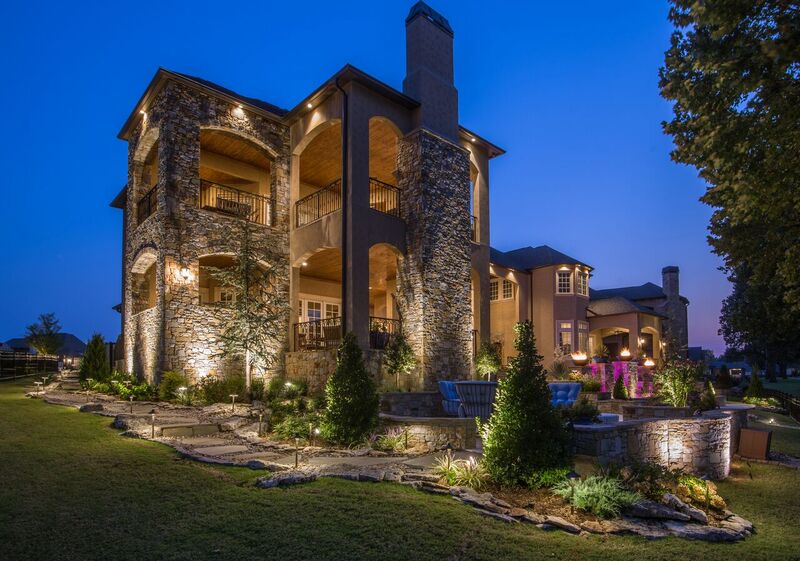
When you look at a beautifully illuminated home at night, you probably notice the glowing trees, warm architectural details, inviting walkway, or softly lit patio.
What you probably don’t notice is everything working behind the scenes to make it happen.
A professional landscape lighting system is much more than a collection of lights placed around a yard. It’s a carefully designed system of fixtures, LEDs, wiring, transformers, controls, placement, beam angles, and lighting techniques working together.
The beautiful part is what you see.
The quality of the system is often found in what you don’t.
Here’s what actually goes into creating professional landscape lighting that looks beautiful night after night.
It Starts With a Plan—Not a Box of Lights
One of the biggest differences between basic outdoor lighting and professional landscape lighting happens before the first fixture is ever installed.
It starts with a plan.
Walk around your property during the day and there may be dozens of features competing for attention:
- Architectural details
- Stone or brick
- Mature trees
- Flower beds
- Walkways
- Steps
- Entryways
- Patios
- Pools
- Outdoor kitchens
- Retaining walls
The question isn’t:
“Where can we put lights?”
It’s:
“What should this property look like after dark?”
Once that’s established, individual fixtures can be selected to create that vision.
Low-Voltage Landscape Lighting: The Foundation of the System
Most professional residential landscape lighting systems use low-voltage power.
A transformer takes the standard household electrical supply and reduces it to the lower voltage used by the landscape lighting system.
Low-voltage systems provide considerable flexibility because different types of fixtures can be positioned throughout the property to create a variety of effects.
But there’s an important point homeowners sometimes overlook:
Low voltage doesn’t mean low planning.
Transformer capacity, wire gauge, cable runs, voltage drop, connections, fixture wattage, and future expansion all need to be considered when designing the system.
Those are things you may never see when you’re sitting on the patio enjoying your lighting—but they’re important to how well the system performs.
Meet the Fixtures That Create the Look
Different landscape lighting fixtures have different jobs.
A beautifully designed system usually combines several fixture types rather than repeating the same light around the entire property.
Accent and Directional Lights: Create the Focal Points
Directional fixtures allow light to be precisely aimed at the features you want to showcase.
They can highlight:
- Mature trees
- Columns
- Architectural peaks
- Stonework
- Flags
- Sculptures
- Interesting landscaping
Beam spread makes a tremendous difference.
A narrow beam may emphasize the height of a tall column or tree, while a wider beam may be needed to showcase a broad tree canopy or larger architectural feature.
The light should fit the feature.
Wash Lights: Add Softness
Not everything needs a dramatic spotlight.
Wash lights produce broader, softer illumination that can work beautifully across walls, facades, fences, landscaping, and other larger areas.
They’re particularly useful for creating a background layer of illumination.
Think of accent lighting as saying:
“Look here.”
And wash lighting as saying:
“Notice the whole scene.”
Great landscape lighting often needs both.
Well and In-Ground Lights: Hide the Fixture
Sometimes you want the light without seeing much of the fixture.
Well and in-ground lights can sit at or near ground level and direct illumination upward toward trees, landscaping, walls, and architectural features.
Because the fixture itself is less noticeable, your eye naturally goes toward what’s being illuminated.
It’s one of the principles we love in landscape lighting:
See the effect—not the equipment creating it.
Path and Garden Lights: Guide the Way
Path and garden lights can provide softer pools of illumination around:
- Walkways
- Flower beds
- Steps
- Entrances
- Garden areas
They provide practical visibility while also becoming part of the landscape design.
But there’s a fine line between guiding someone toward your front door and making your sidewalk look like an airport runway.
Thoughtful spacing matters.
You don’t necessarily need continuous illumination. Areas of light and shadow can guide the eye naturally through the landscape.
Downlights: Bring the Light From Above
Landscape lighting doesn’t always have to come from the ground.
Fixtures can be mounted above an area and directed downward to illuminate lawns, driveways, patios, pathways, and landscaping.
When installed high in mature trees, downlighting can create one of the most beautiful landscape lighting effects: moonlighting.
Light filters through branches and leaves, creating soft patterns of light and shadow across the ground.
When it’s done well, it can feel less like a landscape light and more like nature provided the illumination.
LED Changed Landscape Lighting
Modern LED technology has dramatically changed what’s possible with landscape lighting.
LEDs offer excellent light output while consuming much less power than older halogen technology. They also offer long operating life and produce less heat.
But choosing an LED involves more than looking at wattage.
Professional lighting design considers:
- Brightness
- Beam spread
- Color temperature
- Fixture location
- What material is being illuminated
- How the light interacts with nearby fixtures
The goal isn’t simply to install an LED.
It’s to select the right LED for the effect we’re trying to create.
Color Temperature Changes Everything
Have you ever seen one home with warm, inviting outdoor lighting and another with light that looks almost blue?
That’s color temperature.
It’s measured in Kelvins, and it has a tremendous influence on how a property feels at night.
Warmer light tends to complement many residential materials beautifully, including:
- Brick
- Stone
- Wood
- Landscaping
- Outdoor living spaces
Cooler light creates a different appearance and can feel much harsher in some residential settings.
The important thing is consistency and intention.
The color of the light should complement the feature it’s illuminating and contribute to the overall atmosphere of the property.
Brightness: More Isn’t Better
One of the most common misconceptions about landscape lighting is:
Brighter = better.
It doesn’t.
In fact, too much light can destroy many of the qualities we’re trying to create.
Extremely bright fixtures can cause glare, wash out texture, eliminate shadows, and make the entire property feel flat.
Professional landscape lighting relies on contrast.
Some features receive more emphasis.
Others get softer illumination.
And some areas remain dark.
The darkness makes the light more beautiful.
Layering Creates Depth
Imagine illuminating the front of a home with one enormous floodlight.
You’d certainly be able to see it.
But that isn’t the same thing as designing it.
Now imagine:
A focused beam highlighting a stone column.
A softer wash across part of the facade.
An uplight revealing the canopy of a mature tree.
Subtle path lighting leading toward the entrance.
A little darkness between those areas.
Suddenly the property has depth.
That’s the power of layering light.
Different types and intensities of illumination work together to create a complete nighttime scene rather than one flat wall of brightness.
Your Outdoor Living Space Deserves Lighting, Too
Landscape lighting isn’t only about what your home looks like from the street.
It’s also about what it feels like when you’re outside.
Patios, pools, decks, outdoor kitchens, fire pits, and seating areas can become entirely different spaces after sunset.
Instead of relying on one bright overhead fixture, outdoor living areas can use multiple layers of softer light.
Hardscape lighting can create a glow beneath seating walls.
Downlighting can provide useful illumination from above.
Nearby trees and landscaping can be accented so you have something beautiful to look at beyond the patio.
Your outdoor space shouldn’t simply be visible after dark.
It should feel inviting.
The Transformer Is the Heart of the System
The fixtures may get all the attention, but the transformer is one of the most important components in a low-voltage landscape lighting system.
Its job is to reduce the household electrical supply to the voltage needed by the lighting system.
Choosing the appropriate transformer involves considering the electrical load of the fixtures as well as the design of the system and potential future expansion.
Quality matters here, too.
At Trinity 918 Designs, we prefer professional-grade equipment designed for long-term outdoor use rather than treating the transformer as an afterthought.
Because the prettiest fixture in the world isn’t very useful if the system behind it isn’t reliable.
Wiring Matters More Than Most Homeowners Realize
Wire isn’t exciting.
Until it’s wrong.
Cable size and the length of the run affect how efficiently power reaches the fixtures.
Long cable runs, undersized wire, poor connections, and improperly designed layouts can contribute to voltage problems and inconsistent system performance.
That’s why the parts you never see matter just as much as the fixtures you do.
A professional landscape lighting system is designed from the transformer all the way to the last fixture.
Make the System Work Automatically
You shouldn’t have to walk outside every evening and flip a switch.
Landscape lighting controls can automate the system using timers, photocells, and other control options.
A photocell can respond to changing sunset times throughout the year, while timers or controls determine how long the system operates.
The result?
Your home simply comes to life when evening arrives.
Landscape Lighting Needs a Little Attention Over Time
Landscape lighting lives in a constantly changing environment.
Trees grow.
Shrubs spread.
Mulch gets added.
Landscaping changes.
Weather happens.
Fixtures can eventually shift, become dirty, or get partially covered by vegetation.
Periodic maintenance may include:
- Cleaning lenses
- Repositioning fixtures
- Adjusting beam direction
- Trimming plants around fixtures
- Checking wiring and connections
- Inspecting equipment
- Evaluating the overall lighting design
Sometimes a system doesn’t need another fixture.
It just needs the existing fixtures cleaned, repositioned, and aimed correctly.
Professional Design Brings Everything Together
You can buy landscape lights in plenty of places.
What you can’t buy in a box is design experience.
Which tree deserves attention?
Which beam spread fits it?
How bright should it be?
Where should the fixture sit?
What will that light look like from inside the living room?
Will someone sitting on the patio see glare?
How does that fixture interact with the one illuminating the house?
Is the transformer properly sized?
Is the wiring appropriate?
Can the system be expanded later?
Those are the decisions that turn a collection of fixtures into a landscape lighting system.
Professional Landscape Lighting in Tulsa and Northeast Oklahoma
At Trinity 918 Designs, we’ve been designing and installing professional outdoor lighting for more than 25 years.
We provide custom landscape lighting design, professional installation, LED conversions, repairs, and service throughout Tulsa and Northeast Oklahoma.
We don’t believe professional landscape lighting is about installing as many fixtures as possible.
It’s about putting the right light in the right place—and building the right system behind it.
Ready to See Your Home in a Whole New Light?
A beautiful landscape lighting system starts long before the lights turn on.
It starts with thoughtful design, quality components, and a plan created specifically for your property.
Let Trinity 918 Designs create a professional landscape lighting system designed around your home, landscaping, and outdoor living spaces.
Visit our Landscape Lighting Services page to learn more and schedule your free consultation: