
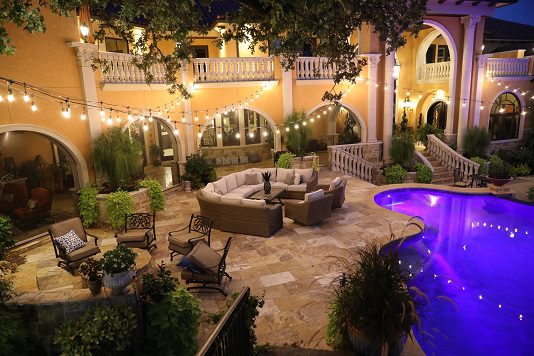
A beautifully lit home doesn’t happen by accident.
The best landscape lighting designs aren’t simply a collection of fixtures placed around a yard. They’re carefully planned to create layers, focal points, contrast, and atmosphere while also providing useful light where you need it.
Think about the difference between walking into a room with one bright overhead light and walking into a beautifully designed room with lamps, accent lighting, and softer illumination in different areas.
Landscape lighting works much the same way.
The goal isn’t to make your property as bright as possible.
It’s to decide what deserves to be seen—and then use light to tell the story of your home after dark.
Start With the Big Picture
Before choosing fixtures, walk around your property and look at it from different perspectives.
What catches your attention during the day?
Maybe it’s:
- The architecture of your home
- Stone or brickwork
- Mature trees
- An inviting front entrance
- A winding walkway
- Beautiful landscaping
- A patio or outdoor kitchen
- A pool or water feature
- A fire pit or seating area
Now imagine the same property after sunset.
Which of those features disappear?
Those are your opportunities.
Professional landscape lighting allows you to bring selected features back into view while intentionally leaving other areas darker.
And that contrast is important.
If everything is illuminated, nothing feels special.
Think in Zones, Not Individual Lights
Instead of asking, “Where should I put some lights?” think about your property as a collection of different zones.
Each area has its own purpose—and may need a completely different type of lighting.
The Front of the Home: Create the First Impression
Your home’s architecture is often the natural starting point.
Uplighting can showcase columns, rooflines, stonework, brick, and architectural details that otherwise disappear after sunset.
But the goal isn’t to flood the entire house with light.
Some areas may be brighter while others remain softly illuminated or dark. Those variations create depth.
The result should feel welcoming and intentional, not like your house is under a spotlight.
The Front Entry: Make It Feel Inviting
Your front entrance should naturally draw the eye.
Landscape lighting can gently guide guests toward the door using a combination of architectural lighting, path lighting, and existing porch or entry fixtures.
The effect should be subtle.
Your guests shouldn’t have to think about where they’re going.
The lighting should naturally lead them there.
Walkways and Steps: Light the Journey
Safety becomes especially important around paths, stairs, elevation changes, and driveway edges.
But functional lighting doesn’t have to be boring.
Path and step lights can provide enough illumination to comfortably navigate the property while still contributing to the overall design.
And remember—the goal isn’t to line both sides of a walkway with identical fixtures.
Your sidewalk isn’t an airport runway.
A more natural arrangement can create soft pools of light while allowing the fixtures to blend into surrounding landscaping.
Trees and Landscaping: Create Drama and Dimension
Trees can become some of the most dramatic elements of a nighttime landscape.
A large mature tree that almost disappears after sunset can become a spectacular focal point with carefully positioned uplighting.
Smaller ornamental trees can create interesting silhouettes or shadows.
Tall, narrow trees may need a tighter beam, while large spreading canopies may require wider illumination.
The light should complement the size, shape, texture, and character of the feature.
Patios and Outdoor Living Areas: Set the Mood
Your outdoor living spaces should feel comfortable—not over-lit.
A patio, outdoor kitchen, pool area, or fire pit often benefits from several softer sources of light instead of one bright fixture.
Hardscape lighting beneath seating walls can create a warm glow.
Downlighting from above can provide useful illumination.
Accent lighting on nearby trees and landscaping gives you something beautiful to look at beyond the patio.
Together, those layers make the outdoor space feel like an extension of your home.
Layer Your Landscape Lighting
One fixture can’t do everything.
Beautiful landscape lighting usually combines different types of illumination.
You might have:
- Uplighting highlighting your home’s architecture
- Accent lighting on mature trees
- Path lighting along a walkway
- Hardscape lighting beneath a seating wall
- Downlighting over an outdoor living area
- Soft illumination on surrounding landscaping
Each layer serves a different purpose.
Together, they create a complete scene.
It’s similar to decorating a room. You wouldn’t expect one lamp to provide every type of light the room needs.
Your landscape shouldn’t rely on one type of light either.
Create Focal Points
Every great landscape lighting design needs places for your eyes to land.
Maybe that’s a magnificent oak tree.
A stone entrance.
An architectural peak.
A fountain.
A sculpture.
Or even the front door.
Those focal points can receive slightly more emphasis while surrounding areas remain softer.
This creates a visual hierarchy.
Your eye naturally moves from one feature to another instead of seeing a wall of equal brightness.
Let Darkness Be Part of the Design
This may sound strange coming from a landscape lighting company, but:
You don’t need to light everything.
Darkness gives illuminated areas their impact.
Imagine a mature tree beautifully lit against a darker night sky. The contrast is what makes the tree dramatic.
Now imagine the tree, lawn, house, shrubs, sidewalk, driveway, and everything behind it illuminated at exactly the same intensity.
The drama disappears.
Great landscape lighting uses light and shadow together.
Choose Fixtures Based on Their Job
Landscape lighting fixtures aren’t interchangeable.
Different fixtures produce different effects.
Path Lights
Designed to spread light downward and outward, path lights work well around walkways, garden paths, and landscape beds.
Spotlights and Accent Lights
Directional fixtures allow precise control over where the light goes, making them ideal for trees, architectural features, flags, and other focal points.
Well and In-Ground Lights
These fixtures sit at or near ground level, keeping the fixture itself less noticeable while directing attention toward the illuminated feature.
Hardscape Lights
Hardscape fixtures can be tucked beneath wall caps, steps, counters, benches, and other architectural elements.
You primarily see the glow—not the fixture.
Downlights
Mounted above the area being illuminated, downlights can provide functional light for patios, walkways, driveways, and outdoor living areas.
When installed high in mature trees and filtered through branches, downlighting can create the beautiful natural effect known as moonlighting.
Pay Attention to What the Light Looks Like
Choosing a fixture is only the beginning.
The actual light it produces matters just as much.
A professional lighting designer considers:
Beam spread. Should the light be narrow and focused or wide and soft?
Brightness. How much light does the feature actually need?
Color temperature. Will warmer or cooler light best complement the materials and landscaping?
Fixture position. Where should the light originate?
Viewing angle. Will someone see glare from the street, patio, driveway, or inside the house?
These details can completely change the finished effect.
Avoid the Temptation to Over-Light
When homeowners first start planning landscape lighting, it’s easy to assume that more fixtures will create a better result.
Often, the opposite is true.
Too much light can make a property feel flat and overly bright.
Good landscape lighting uses restraint.
You can always expand a professionally designed system later, but starting with an intentional design makes it much easier to preserve the balance between light and darkness.
More light isn’t the goal. Better light is.
Don’t Forget What’s Behind the Scenes
The part of landscape lighting everyone notices is the finished effect.
But what you don’t see matters too.
A professional low-voltage system also requires careful planning for:
- Transformer capacity
- Wire gauge
- Voltage drop
- Connections
- Fixture quality
- Controls
- Timers or photocells
- Future expansion
- Maintenance and serviceability
A beautiful design won’t perform well over time if the system behind it isn’t properly designed and installed.
Make Landscape Lighting Work Automatically
Your landscape lighting shouldn’t require you to remember to turn it on every evening.
Timers, photocells, and other controls can automate when your system operates.
Photocells can respond to changing sunset times throughout the year, while timers and controls can determine how long the system remains on.
The result is simple:
Your home is beautifully illuminated when you want it to be—without thinking about it every day.
Plan for the Landscape You’ll Have Tomorrow
Landscaping changes.
Trees grow taller. Shrubs get wider. Flower beds mature.
That means landscape lighting sometimes needs to evolve too.
Fixtures may eventually need to be repositioned, re-aimed, or adjusted as vegetation grows.
Planning for those changes from the beginning—and maintaining the system periodically—helps preserve the original design as your property matures.
Landscape Lighting Is Part Art, Part Engineering
The most beautiful landscape lighting looks effortless.
But behind that effortless appearance are dozens of small decisions.
Which tree should become a focal point?
How wide should the beam be?
How bright should the stonework appear?
Where should the fixture sit so you don’t see glare from the patio?
Should a walkway receive direct illumination or borrow softer light from surrounding landscaping?
How do all of those individual lights work together when you stand back and view the entire property?
That’s where professional design makes a difference.
At Trinity 918 Designs, we don’t simply decide where fixtures can go.
We consider how the entire property should look and feel after dark.
Then we put the right light in the right place.
Professional Landscape Lighting in Tulsa and Northeast Oklahoma
Trinity 918 Designs has been designing and installing professional outdoor lighting for more than 25 years.
We provide custom landscape lighting design, professional installation, LED conversions, repairs, and service for homes and businesses throughout Tulsa and Northeast Oklahoma.
Whether you’re starting with a completely dark property or upgrading an existing lighting system, we’ll design around your home’s architecture, landscaping, outdoor living areas, and the way you use your property.
Ready to See Your Home in a Whole New Light?
Your home already has the architecture, landscaping, and features that make it unique.
The right landscape lighting simply reveals them after dark.
Let Trinity 918 Designs create a custom outdoor lighting system designed specifically for your property.
Visit our Landscape Lighting Services page to learn more and schedule your free consultation:
https://the-edit.lumens.com/the-guides/landscape-lighting-guide