
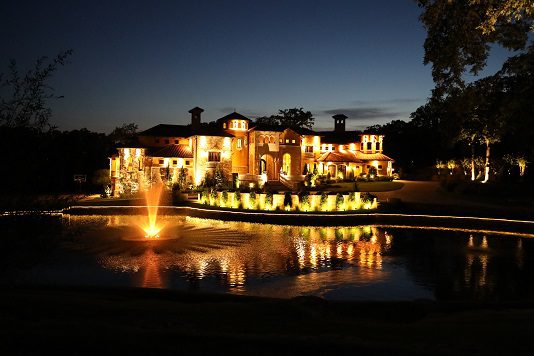
Beautiful landscape lighting is about much more than placing a few lights around your home. The real difference comes from knowing what to illuminate, where to position each fixture, and which lighting technique will create the desired effect.
Professional landscape lighting uses a combination of light, shadow, brightness, texture, and contrast to showcase your home’s architecture and landscaping after dark.
From highlighting beautiful stonework to creating the soft appearance of moonlight through the trees, different landscape lighting techniques can completely change the nighttime appearance of your property.
Why Landscape Lighting Techniques Matter
Two homes can have the same number of landscape lighting fixtures and look completely different at night.
Why?
Fixture placement and lighting technique.
Instead of illuminating everything at the same brightness, a professionally designed landscape lighting system creates layers. Certain architectural or landscape features become focal points, while softer illumination and intentional shadows provide depth in other areas.
Here are some of the techniques that can be used to create that effect.
1. Uplighting: Highlight Trees and Architecture
Uplighting is one of the most recognizable landscape lighting techniques.
Fixtures are positioned near ground level and directed upward toward the feature being illuminated.
Uplighting works beautifully for:
- Mature trees
- Columns
- Architectural details
- Stone and brick
- Entryways
- Tall landscaping
The distance from the feature, fixture angle, brightness, and beam spread can all change the finished appearance.
A narrow beam might emphasize a tall architectural feature, while a wider beam can illuminate the canopy of a large tree.
The goal isn’t simply to shine a light upward—it’s to select the right amount and shape of light for the feature.
2. Wall Washing: Create Soft, Even Illumination
Wall washing uses a broad, softer light to illuminate a larger vertical surface.
Rather than creating a dramatic focal point, wall washing can provide a subtle backdrop that helps visually connect different areas of a landscape lighting design.
This technique works particularly well on larger walls and architectural surfaces where you want gentle illumination without creating harsh bright spots.
3. Grazing: Showcase Brick, Stone and Texture
If your home has beautiful stonework, brick, stucco, or another textured architectural surface, grazing can help make those details stand out after dark.
With grazing, fixtures are positioned relatively close to the surface and aimed so the light travels across it.
The resulting highlights and shadows emphasize the texture of the material.
A stone wall that may look relatively flat under ordinary lighting can become a dramatic architectural feature when professionally illuminated using this technique.
4. Shadowing: Make Landscaping Part of the Design
Sometimes the most interesting part of landscape lighting isn’t the light itself—it’s the shadow it creates.
Shadowing involves positioning a fixture so that trees, plants, or other objects cast shadows onto a nearby surface.
Interesting plant shapes can create beautiful patterns against walls and other architectural features.
This technique can add movement, texture, and depth to a nighttime landscape.
5. Silhouette Lighting: Highlight Interesting Shapes
Silhouetting essentially reverses the way we normally think about accent lighting.
Instead of illuminating the feature from the front, a light is positioned behind it and directed toward a wall or another vertical surface.
The illuminated background causes the object in front of it to appear as a dark silhouette.
This can work beautifully with:
- Ornamental trees
- Sculptural plants
- Decorative landscaping
- Architectural elements
- Garden features
The result can be dramatic without requiring an excessive amount of light.
6. Path and Walkway Lighting: Combine Beauty With Safety
Landscape lighting doesn’t only need to look good—it should also make your property easier to navigate after dark.
Path lighting can provide illumination along:
- Sidewalks
- Garden paths
- Driveways
- Steps
- Lawn walkways
- Entrances
Good path lighting doesn’t mean placing fixtures in two perfectly straight rows along a sidewalk.
Strategic placement provides the visibility you need while allowing the fixtures and surrounding landscaping to become part of the overall lighting design.
This creates a more natural appearance while helping family members and guests safely navigate the property.
7. Hardscape Lighting: Integrate Light Into Outdoor Features
Hardscape lighting can be incorporated directly into architectural and outdoor living features.
It’s particularly useful for illuminating:
- Retaining walls
- Outdoor kitchens
- Steps
- Seating walls
- Handrails
- Benches
- Patios
- Decks
Many hardscape fixtures can be installed so that the fixture itself is barely noticeable.
Instead, you primarily see the effect of the light.
Hardscape lighting can also serve two purposes at once—highlighting attractive architectural details while providing useful illumination for steps, seating areas, and other outdoor spaces.
8. Moonlighting: Create a Natural Effect From Above
Moonlighting can create one of the most beautiful effects in professional landscape lighting.
Fixtures are installed high in mature trees and aimed downward through the branches.
As the light travels through the tree, branches and leaves create natural patterns of light and shadow on the ground below.
The result can resemble the appearance of natural moonlight.
Moonlighting works especially well over:
- Lawns
- Walkways
- Patios
- Driveways
- Gardens
- Outdoor living spaces
It can provide useful illumination while maintaining a soft and natural appearance.
9. In-Ground Lighting: Illuminate Without Drawing Attention to the Fixture
In-ground fixtures are installed partially or completely at ground level.
Because the fixture is less noticeable during the day, in-ground lighting can be a good choice for areas where you want the light—not the fixture—to attract attention.
These fixtures can be used around:
- Mature trees
- Walls
- Architectural features
- Walkways
- Flagpoles
- Other permanent landscape features
As with other landscape lighting techniques, selecting the proper fixture, brightness, and beam spread is important for achieving the desired effect.
10. Lighting Water Features
Pools, fountains, streams, and other water features offer additional opportunities for creative landscape lighting.
Lighting can emphasize moving water, create reflections, and make water features visible after dark.
Mirror Lighting
Mirror lighting uses illuminated landscaping around a body of water to create reflections across the surface.
The water essentially becomes part of the lighting design.
Underwater Lighting
Lighting installed within fountains, waterfalls, streams, and other water features can highlight the movement of the water itself.
Used correctly, water and light can create some of the most dramatic effects in an outdoor lighting design.
The Best Landscape Lighting Uses Layers
One of the most important principles of professional landscape lighting is that everything shouldn’t be illuminated the same way.
A great lighting design may combine:
- Uplighting on architectural features
- Grazing across stone walls
- Path lighting near walkways
- Hardscape lighting around steps
- Moonlighting from mature trees
- Shadowing through landscaping
- Softer illumination in transitional areas
Some areas should attract your attention immediately.
Others should provide subtle background illumination.
And some areas should remain darker so that the brighter areas have contrast.
It’s that balance between light and shadow that gives a professionally designed landscape lighting system depth and dimension.
More Landscape Lights Don’t Necessarily Mean Better Lighting
It’s easy to assume that adding more fixtures will produce a better result.
That’s not necessarily true.
Too much light can flatten a landscape and eliminate the contrast that makes professional lighting visually interesting.
The goal should be to use the right fixture, in the right location, at the right brightness to achieve the desired effect.
In many cases, thoughtful fixture placement is more important than simply increasing the number of lights.
Why Professional Landscape Lighting Design Makes a Difference
Landscape lighting combines design with technical knowledge.
A professional needs to consider not only what looks beautiful but also factors such as:
- Fixture placement
- Beam spread
- Lumen output
- Color temperature
- Transformer capacity
- Wire sizing
- Voltage drop
- Connections
- Fixture durability
- Future expansion
- Maintenance and serviceability
All of those pieces work together to create a landscape lighting system that looks beautiful and performs properly.
At Trinity 918 Designs, we design each landscape lighting system around the individual home and property rather than relying on a one-size-fits-all layout.
Our goal is to put the right light in the right place to enhance your home’s architecture, landscaping, safety, and outdoor living spaces.
Professional Landscape Lighting in Tulsa and Northeast Oklahoma
Trinity 918 Designs provides professional landscape lighting design, installation, service, and LED conversions for homes and businesses throughout the Tulsa area.
Whether you’d like to showcase your home’s architecture, illuminate mature trees, improve visibility around walkways and steps, or create a completely new nighttime look for your property, a professionally designed lighting system can make a dramatic difference.
Ready to See Your Home in a Whole New Light?
Every home and property is different. Your landscape lighting should be too.
Trinity 918 Designs can create a custom landscape lighting system designed specifically for your home, landscaping, and outdoor living spaces.
Visit our Landscape Lighting Services page to learn more about our custom outdoor lighting design, professional installation, lighting service, and LED conversions—and schedule your free consultation.
Landscape Lighting Services:
https://trinity918designs.com/landscape-lighting-services