
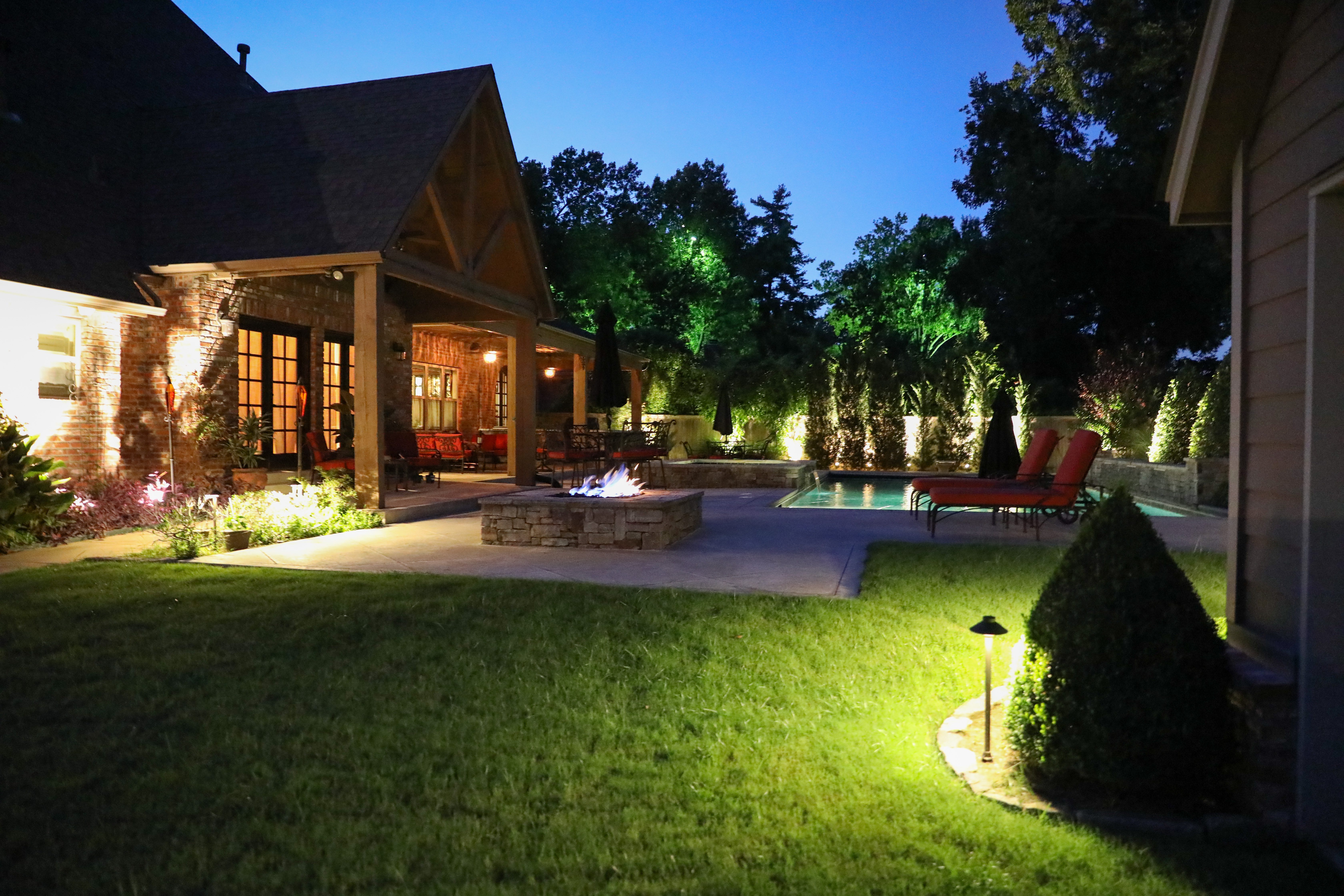
If you’re planning a new landscape lighting system—or updating an older one—you may wonder whether LED or halogen lighting is the better choice.
Years ago, halogen fixtures were extremely common in outdoor lighting.
Today, LED has become the standard choice for most new residential landscape lighting systems.
Why?
Because LED lighting generally offers:
- Lower energy use
- Longer lamp life
- Less heat
- More color-temperature options
- Better control
- Less maintenance
Halogen can still produce beautiful light, but for most homeowners, LED is the more practical long-term solution.
The difference isn’t just the bulb. It’s how the entire lighting system performs over time.
What Is Halogen Landscape Lighting?
Halogen lighting uses a filament inside a bulb, similar to traditional incandescent lighting.
Electricity heats the filament until it glows, producing light.
Halogen bulbs became popular because they offered:
- Warm color
- Good brightness
- Excellent color rendering
- Familiar lamp replacement
For many years, halogen was one of the primary choices for professional landscape lighting.
What Is LED Landscape Lighting?
LED stands for light-emitting diode.
Instead of heating a filament to create light, LEDs produce light electronically.
That makes them much more energy-efficient.
Modern LED landscape lighting is available in a wide range of:
- Brightness levels
- Beam spreads
- Color temperatures
- Fixture styles
- Output levels
That gives a lighting designer much more flexibility.
LED Uses Much Less Energy
One of the biggest differences between LED and halogen is power consumption.
Halogen lamps require considerably more energy to produce the same general amount of usable light.
LEDs can create strong illumination while drawing much less power.
That’s especially helpful in a landscape lighting system containing many fixtures.
A property with:
- Path lights
- Tree lights
- Architectural uplights
- Hardscape lights
- Downlights
can require significantly less electrical load with LED technology.
Lower Energy Use Can Allow More Design Flexibility
Lower wattage isn’t only about the electric bill.
It can also make the system easier to design.
Because each LED fixture uses less power, the transformer may be able to support more fixtures without reaching its capacity as quickly.
That can provide more flexibility for:
- Larger properties
- Multiple lighting zones
- Future additions
- More complex designs
The exact transformer size still depends on the system, but LED generally gives designers more room to work with.
LED Produces Less Heat
Halogen bulbs get very hot.
That’s simply part of how they create light.
LED fixtures typically operate much cooler.
That can be beneficial around:
- Plants
- Mulch
- Hardscape
- Enclosed fixture areas
Less heat also means less energy is being wasted simply producing warmth instead of light.
LED Usually Lasts Much Longer
Halogen bulbs eventually burn out and need replacement.
In a large outdoor system, that can mean regular maintenance.
LED light sources typically have a much longer service life.
That means fewer:
- Bulb changes
- Maintenance visits
- Failed lamps
- Dark fixtures around the property
For many homeowners, that convenience alone is a major reason to choose LED.
Fewer Burned-Out Lamps Means a Better-Looking Property
One failed fixture may not sound like a big deal.
But once one lamp burns out, another often isn’t far behind.
Soon the design can start looking uneven.
One tree is lit.
Another is dark.
Half the walkway is working.
One side of the house looks brighter than the other.
Longer-lasting LED lighting helps keep the system looking more consistent.
LED Offers More Color Temperature Choices
Halogen light naturally has a warm appearance.
Many homeowners like that look.
Fortunately, LED can now reproduce warm white light very well.
Common landscape lighting color temperatures include:
- 2700K
- 3000K
- 3500K
- 4000K
That means you can choose a color temperature that complements the architecture and landscaping rather than being locked into one look.
LED Doesn’t Have to Look Blue
This is one of the biggest misconceptions about LED lighting.
Early LEDs often had a cool or bluish appearance.
Modern LED technology is very different.
Warm-white LEDs can create a soft, inviting look that works beautifully with:
- Brick
- Stone
- Wood
- Landscaping
- Traditional architecture
LED doesn’t automatically mean cold light.
Warm LED Can Look Very Similar to Halogen
A quality warm-white LED can create the same kind of comfortable residential atmosphere many people associate with halogen.
That means you can keep the warm appearance without giving up the efficiency and longevity of LED.
Color temperature selection matters.
A warm 2700K LED will look very different from a cool 5000K LED.
Halogen Still Has Excellent Color Quality
Halogen has always been appreciated for its natural-looking color.
It generally renders colors very accurately.
Modern high-quality LED products can also provide excellent color rendering.
The quality of the LED matters.
Cheap LEDs may make colors look dull or unnatural.
A good fixture should be selected based on more than just wattage.
LED Gives Better Control Over Beam Spread
Modern LED landscape fixtures can be available in many beam configurations.
That makes it easier to match the light to the feature.
For example:
A narrow beam may work well for a tall column.
A medium beam may be ideal for an ornamental tree.
A wider beam may illuminate a broad canopy or architectural section.
That level of control is one reason LED works so well in professional landscape lighting.
LED Can Reduce Maintenance
Outdoor fixtures are exposed to:
- Heat
- Cold
- Moisture
- Irrigation
- Landscaping
- Lawn maintenance
Any time a fixture needs to be opened to replace a lamp, there’s another maintenance task.
With LED systems, lamp replacement is typically required much less often.
That helps reduce ongoing upkeep.
What About Replaceable LED Lamps?
Some landscape lighting fixtures use replaceable LED lamps.
Others use integrated LED modules.
Both approaches have advantages.
Replaceable lamps may make future servicing easier.
Integrated fixtures can allow the manufacturer to design the optics, thermal management, and LED together as one complete system.
The best choice depends on the fixture and installation.
Integrated LED Fixtures Can Offer Precise Performance
When the LED and fixture are engineered together, manufacturers can control:
- Beam shape
- Light output
- Heat management
- Color temperature
- Optics
That can result in a very refined lighting effect.
This is one reason many professional-grade landscape fixtures now use integrated LED technology.
Halogen Can Require Larger Transformers
Because halogen fixtures consume more power, larger systems may require greater transformer capacity.
A system using many high-wattage halogen lamps can add up quickly.
LED fixtures usually reduce the total load considerably.
That can simplify both new installations and upgrades.
LED Can Be Helpful When Expanding an Existing System
If you want to add more fixtures to an existing landscape lighting system, available transformer capacity becomes important.
Switching some or all of the system to LED may reduce the total wattage and create additional capacity.
That doesn’t automatically mean every old system can simply be converted.
Wiring, transformer condition, fixtures, and voltage should all be evaluated.
Can You Put LED Bulbs in Old Halogen Fixtures?
Sometimes.
Certain existing fixtures may accept compatible LED replacement lamps.
But a retrofit isn’t always as simple as swapping bulbs.
You may need to consider:
- Voltage
- Lamp size
- Beam spread
- Fixture design
- Transformer compatibility
- Dimming
- Heat management
A professional evaluation can help determine whether the old fixtures are worth keeping.
Older Fixtures May Need More Than New Bulbs
If an older lighting system has:
- Corroded fixtures
- Damaged wiring
- Poor connections
- Water intrusion
- Outdated transformer
- Broken seals
simply installing LED lamps may not solve the underlying problems.
Sometimes an upgrade is the better long-term solution.
LED Can Be Better for Large Properties
The energy savings and reduced maintenance become even more noticeable as the system grows.
A large property might include dozens of fixtures.
With halogen, that can mean:
- Higher electrical load
- More lamp replacements
- More heat
- More maintenance
LED makes large landscape lighting systems much more practical.
LED Works Well With Smart Controls
Modern landscape lighting systems can often be integrated with:
- Timers
- Photocells
- Smart controls
- Automation
- Dimming systems
LED technology generally works very well in systems where more precise control is desired.
This can make the lighting easier to manage throughout the year.
Dimming Adds Another Layer of Control
Some LED systems allow output to be adjusted.
That can be useful when fine-tuning a design.
Maybe one tree needs more emphasis.
Another area should be softer.
Instead of replacing lamps, the system may be able to adjust output.
That can help create better balance across the property.
LED Is Better for Layered Lighting
Professional landscape lighting often uses multiple layers.
That might include:
- Architectural lighting
- Path lighting
- Tree lighting
- Hardscape lighting
- Downlighting
Because LED provides so many choices in output, color temperature, and beam spread, each fixture can be tailored to its job.
The result can feel more intentional and refined.
Halogen Has a Beautiful Warm Look
It’s worth saying clearly:
Halogen light can look beautiful.
Its naturally warm color is one reason many people still remember older landscape lighting systems fondly.
But today, high-quality LED can create a very similar warm appearance while using less energy and requiring less maintenance.
That’s why halogen is no longer necessary to achieve that classic warm look.
LED Is Usually the Better Long-Term Choice
For most new residential landscape lighting systems, LED makes the most sense.
You generally get:
- Lower energy use
- Longer life
- Less maintenance
- More color choices
- More beam options
- Better control
- Lower heat
That combination is hard to beat.
LED vs. Halogen: The Simple Comparison
LED May Be Better If:
- You want lower energy use
- You want fewer lamp changes
- You want multiple color-temperature options
- You’re installing a new system
- You want future expansion flexibility
- You want modern control options
Halogen May Still Appeal If:
- You already have a working halogen system
- You love its warm appearance
- You prefer traditional replaceable lamps
- You’re maintaining an older installation
For most new systems, however, LED is generally the more practical choice.
Don’t Choose LED Based Only on Wattage
LED fixtures with similar wattage can perform very differently.
You still need to consider:
- Lumens
- Beam spread
- Color temperature
- Fixture optics
- Placement
- Desired effect
A lower-wattage fixture may outperform a higher-wattage one if the beam is better suited to the feature.
Good lighting is about the effect—not the number on the box.
Quality Still Matters
Not all LEDs are created equal.
Cheap fixtures may have issues with:
- Color consistency
- Premature failure
- Poor optics
- Weak seals
- Limited adjustability
Professional-grade landscape lighting is designed to handle outdoor conditions and deliver predictable light.
The goal isn’t simply to install LED.
It’s to install the right LED fixtures in the right places.
The Fixture Still Needs Proper Placement
Upgrading from halogen to LED won’t fix bad fixture placement.
You still need to think about:
- Beam angle
- Distance
- Glare
- Viewing direction
- Tree size
- Architecture
- Walkways
Technology helps.
Design is what makes the lighting look good.
A Good Upgrade Should Improve More Than Efficiency
If you’re replacing an older halogen system, it’s also an opportunity to improve the design.
Maybe fixtures have been added randomly over the years.
Maybe trees have grown.
Maybe landscaping has changed.
Maybe the original system creates too much glare.
An LED upgrade can be a chance to rethink:
- Fixture placement
- Beam spread
- Brightness
- Color temperature
- Overall balance
That can create a much bigger improvement than simply changing lamps.
Professional LED Landscape Lighting in Tulsa and Northeast Oklahoma
At Trinity 918 Designs, we design landscape lighting around the property rather than simply choosing a standard fixture and using it everywhere.
We consider:
- Architecture
- Landscaping
- Trees
- Beam spread
- Color temperature
- Brightness
- Transformer capacity
- Future expansion
- Fixture placement
Whether you’re starting with a new system or upgrading older halogen lighting, we can help create a more efficient, lower-maintenance design.
Our approach is simple:
Put the right light in the right place.
Ready to Upgrade Your Landscape Lighting?
If you’re still using an older halogen system—or you’re planning new landscape lighting—LED can provide beautiful warm light with significantly less maintenance and energy use.
Trinity 918 Designs can help with new systems, LED upgrades, fixture replacement, transformers, wiring, and complete landscape lighting design.
Learn more about professional landscape lighting from Trinity 918 Designs: