
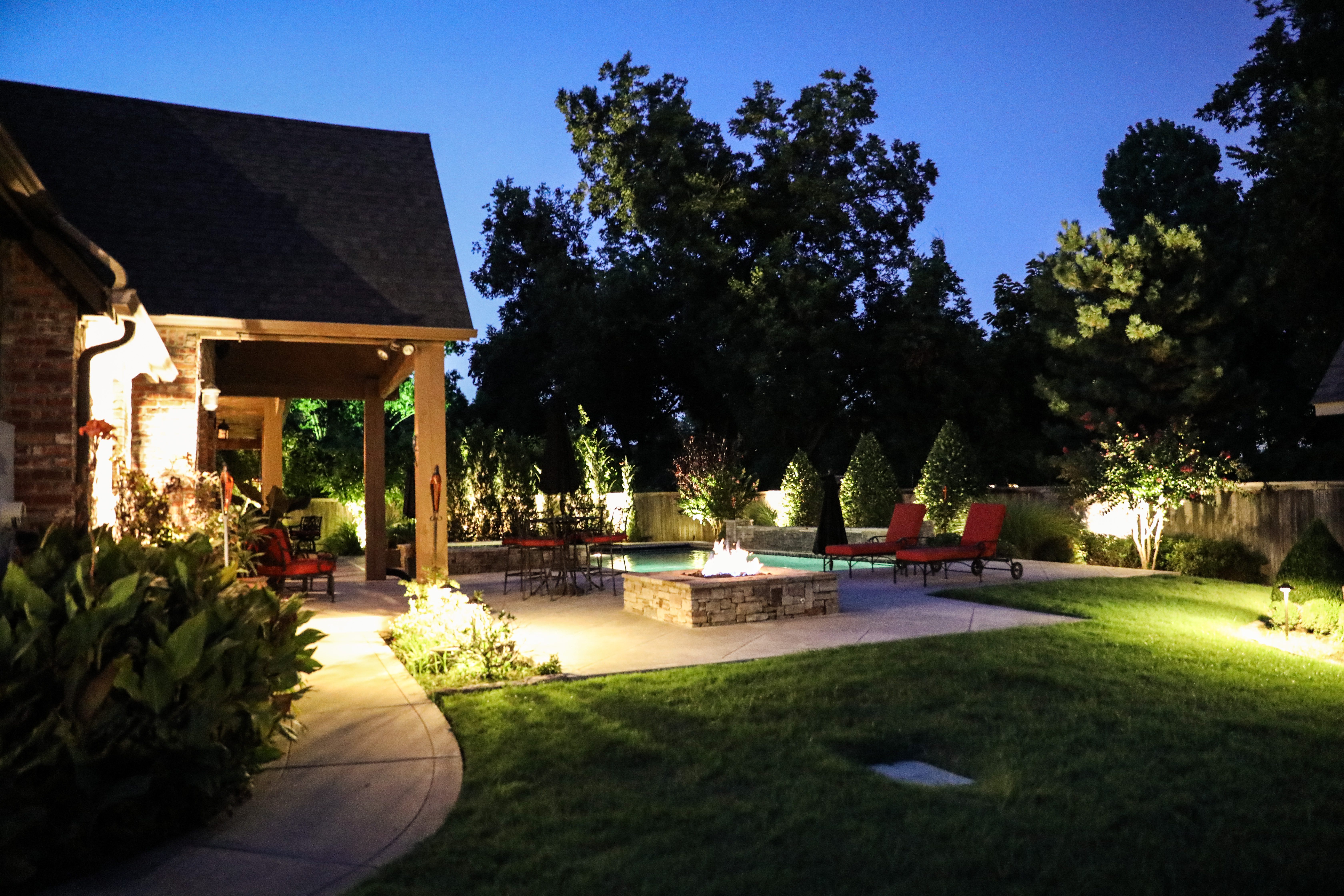
You’ve probably seen both kinds of landscape lighting.
There’s the home you drive past at night where the lighting looks warm, elegant, and effortless. The trees have dimension, the architecture stands out, and the walkway has just enough illumination to feel inviting.
Then there’s the other kind.
Lights everywhere. Bright spots. Dark spots. Glare in your eyes. A perfectly straight row of path lights that looks more like an airport runway than a landscape.
The difference isn’t necessarily the number of fixtures—or even how much was spent on them.
The difference is design.
Professional landscape lighting is part art and part technical skill. The goal isn’t simply to make your property brighter. It’s to put the right light in the right place so your home and landscape look their best after dark.
Here are some of the details that make the biggest difference.
1. Start With What You Want to See
Before deciding where lights should go, start with a different question:
What do you want to see after dark?
Maybe it’s the architecture of your home.
A beautiful mature oak.
Stone columns around the entrance.
A winding walkway.
Your backyard pool.
Or the patio where everyone gathers in the evening.
Those features become the starting points for the lighting design.
Not everything needs to be illuminated. In fact, trying to light everything usually produces a less interesting result.
Good landscape lighting guides your eye toward the features worth noticing.
2. Layer Your Landscape Lighting
One of the secrets to beautiful landscape lighting is layering.
Instead of using the same type and intensity of light everywhere, professional designs combine different types of illumination.
Think of it in three basic layers:
Ambient lighting provides gentle overall illumination and sets the mood.
Task lighting provides useful light where you actually need to see—such as steps, pathways, entrances, and outdoor living areas.
Accent lighting draws attention to something special, such as a mature tree, stone wall, architectural feature, fountain, or sculpture.
When those layers work together, the property gains depth and dimension.
Rather than seeing a collection of individual lights, you see a complete nighttime scene.
3. Don’t Make Everything the Same Brightness
This is one of the easiest ways to tell the difference between basic outdoor lighting and professionally designed landscape lighting.
Everything shouldn’t be equally bright.
If the house, trees, pathways, landscaping, and patio all have the same intensity of light, the property begins to look flat.
Contrast is what creates visual interest.
One feature may be illuminated more dramatically while another receives just a touch of light.
And some areas may intentionally remain darker.
That’s not a mistake.
Darkness is part of good landscape lighting design.
The darker areas allow the illuminated features to stand out.
4. Choose the Right Beam Spread for the Feature
A beautiful landscape lighting design doesn’t use the same beam of light on every object.
Consider the difference between a tall, narrow evergreen and a massive spreading oak tree.
They shouldn’t be illuminated the same way.
A narrow beam can emphasize the height of a slender tree, column, or architectural feature.
A wider beam may be needed to illuminate the canopy and branching structure of a large tree.
The size, height, width, shape, and texture of the object all influence the type of fixture and beam spread that will produce the best result.
The light should fit the feature—not the other way around.
5. Use the Right Color Temperature
Not all white light looks the same.
Some light appears warm and golden, while other light looks cooler and closer to daylight.
Color temperature can dramatically change the way your home feels after dark.
Warmer light tends to complement residential architecture, stone, brick, wood, landscaping, patios, and outdoor living spaces beautifully.
Cooler light may be useful when visibility is the primary goal, but using it throughout a residential landscape can create an entirely different atmosphere.
Color temperature should be chosen intentionally based on the materials being illuminated and the mood you want to create.
6. Avoid the “Airport Runway” Effect
Path lighting is one of the most useful types of landscape lighting—and one of the easiest to overdo.
Placing fixtures in perfectly straight, evenly spaced rows on both sides of a sidewalk can make your walkway resemble a runway.
Instead, path lights can be integrated naturally into the surrounding landscape.
The goal is simple:
Light the path, not the fixtures.
Thoughtful placement provides enough illumination for people to comfortably navigate the walkway while allowing the fixtures to blend into the overall landscape design.
7. Control Glare
A landscape light can be perfectly positioned to illuminate a tree and still be unpleasant if the person sitting on the patio is staring directly into the bulb.
That’s why viewing angles matter.
Where will people see the property from?
The street?
The driveway?
Inside the living room?
The patio?
The pool?
Professional landscape lighting considers those perspectives so fixtures can be positioned, aimed, and shielded appropriately.
You should notice the effect of the light, not be distracted by the source producing it.
8. Keep the Light Where It Belongs
More light isn’t always better—and light going somewhere it wasn’t intended to go can create problems.
Poorly aimed fixtures may shine into windows, across neighboring properties, toward drivers, or up into the night sky.
Shielded fixtures and careful positioning help direct light toward the intended feature while reducing unnecessary spill and glare.
Good lighting is controlled lighting.
Illuminate what matters and let the rest remain dark.
9. Use Moonlighting for a Natural Effect
Sometimes the most beautiful landscape lighting doesn’t look artificial at all.
Moonlighting is created by mounting fixtures high in mature trees and directing the light downward through the branches.
Leaves and branches create patterns of light and shadow across the ground below, producing an effect similar to natural moonlight.
Moonlighting can work beautifully over:
- Lawns
- Driveways
- Patios
- Walkways
- Gardens
- Outdoor living areas
It’s a perfect example of landscape lighting that can be both beautiful and functional.
10. Think About How the Landscape Will Grow
Landscaping isn’t static.
That small tree you’re illuminating today may look very different five years from now.
Trees grow. Shrubs spread. Plants mature.
A landscape lighting system should be designed with that in mind.
Fixture placement and beam spread may need to change as the landscape matures. Adjustable fixtures can provide additional flexibility as trees and shrubs grow.
This is also one reason periodic landscape lighting maintenance is important.
A system that looked perfect when it was installed may need adjustments as the property changes.
11. Keep Fixtures Out of the Way When Possible
Fixture placement isn’t only about nighttime appearance.
It matters during the day, too.
Fixtures installed in the middle of grassy areas can become obstacles when mowing and maintaining the lawn.
Whenever possible, fixtures can be incorporated into landscape beds, mulch areas, hardscape features, or other locations where they won’t interfere with normal yard maintenance.
A professionally designed system considers how your property functions during the day as well as how it looks at night.
12. Don’t Forget Landscape Lighting Maintenance
Landscape lighting lives outdoors year-round.
That means fixtures encounter rain, wind, dirt, mulch, lawn equipment, growing plants, falling leaves, and Oklahoma weather.
Over time, fixtures may shift or become partially covered by landscaping. Lenses can get dirty. Trees and shrubs can grow into the beam. Connections and equipment may eventually need attention.
Periodic maintenance can include:
- Cleaning fixture lenses
- Straightening and repositioning fixtures
- Adjusting beam direction
- Trimming vegetation around fixtures
- Checking connections
- Inspecting wiring
- Evaluating system performance
Maintaining the system helps preserve the original lighting design as your landscape changes.
13. What’s Behind the Lights Matters Just as Much
The beautiful part of landscape lighting is what you see.
Some of the most important parts are what you don’t see.
A professional low-voltage landscape lighting system also depends on:
- Quality fixtures
- Proper wire gauge
- Correct transformer sizing
- Voltage management
- Weather-resistant connections
- Appropriate controls
- Proper installation techniques
Poor connections and undersized wiring can affect system performance and longevity.
That’s why landscape lighting isn’t simply about choosing attractive fixtures. The design and installation behind those fixtures matter, too.
14. Don’t Assume More Fixtures Mean Better Lighting
It’s tempting to think:
More lights = better landscape lighting.
But that’s rarely how good design works.
Too many fixtures in a small area can make a property feel cluttered, overly bright, and visually confusing.
Sometimes adding another light improves the design.
Sometimes removing one does.
The goal isn’t to install the greatest number of fixtures possible.
The goal is to create the best nighttime appearance possible.
Great Landscape Lighting Should Feel Effortless
When landscape lighting is done well, you shouldn’t walk outside thinking about individual fixtures.
You should notice the way the stone on your home comes alive.
The canopy of a mature tree glowing against the night sky.
The subtle light leading you toward the front door.
The shadows from tree branches moving across the lawn.
The warm glow around the patio where your family is sitting.
That’s what professional landscape lighting is really about.
Not simply seeing more after dark—but seeing your property differently.
Professional Landscape Lighting in Tulsa and Northeast Oklahoma
At Trinity 918 Designs, we’ve been designing and installing professional outdoor lighting for more than 25 years.
Every property is different, so every lighting design should be different.
We consider your home’s architecture, landscaping, trees, outdoor living areas, viewing angles, safety needs, and the overall atmosphere you want to create.
Then we put the right light in the right place.
Whether you’re starting with a completely dark property, upgrading an existing landscape lighting system, converting older lighting to LED, or repairing a system that’s no longer performing properly, Trinity 918 Designs can help.
Ready to See Your Home in a Whole New Light?
Your home doesn’t have to disappear when the sun goes down.
Let Trinity 918 Designs create a custom landscape lighting system designed specifically for your home and property.
Visit our Landscape Lighting Services page to learn more about custom lighting design, professional installation, LED conversions, repairs, and service—and schedule your free consultation.
Landscape Lighting Services:
https://trinity918designs.com/landscape-lighting-services